
Best U.S. Metros Where Graduates Can Study, Stay & Start a Career


More than half of college graduates start out in jobs that don’t require their degree. Of course, where you land after graduation has always mattered, and it matters more now: The entry-level market is recovering unevenly across metros with some pulling ahead on hiring while others lag. But, what if the city where you studied was also the best place to launch the career that your degree pointed toward?
For a metro, that question cuts both ways. That’s because universities represent years of public investment and institutional effort — a pipeline of people who could become the next generation of entrepreneurs, researchers and local business owners. However, too often, that talent leaves. Consequently, the city that spent years cultivating it ends up watching it build someone else’s economy.
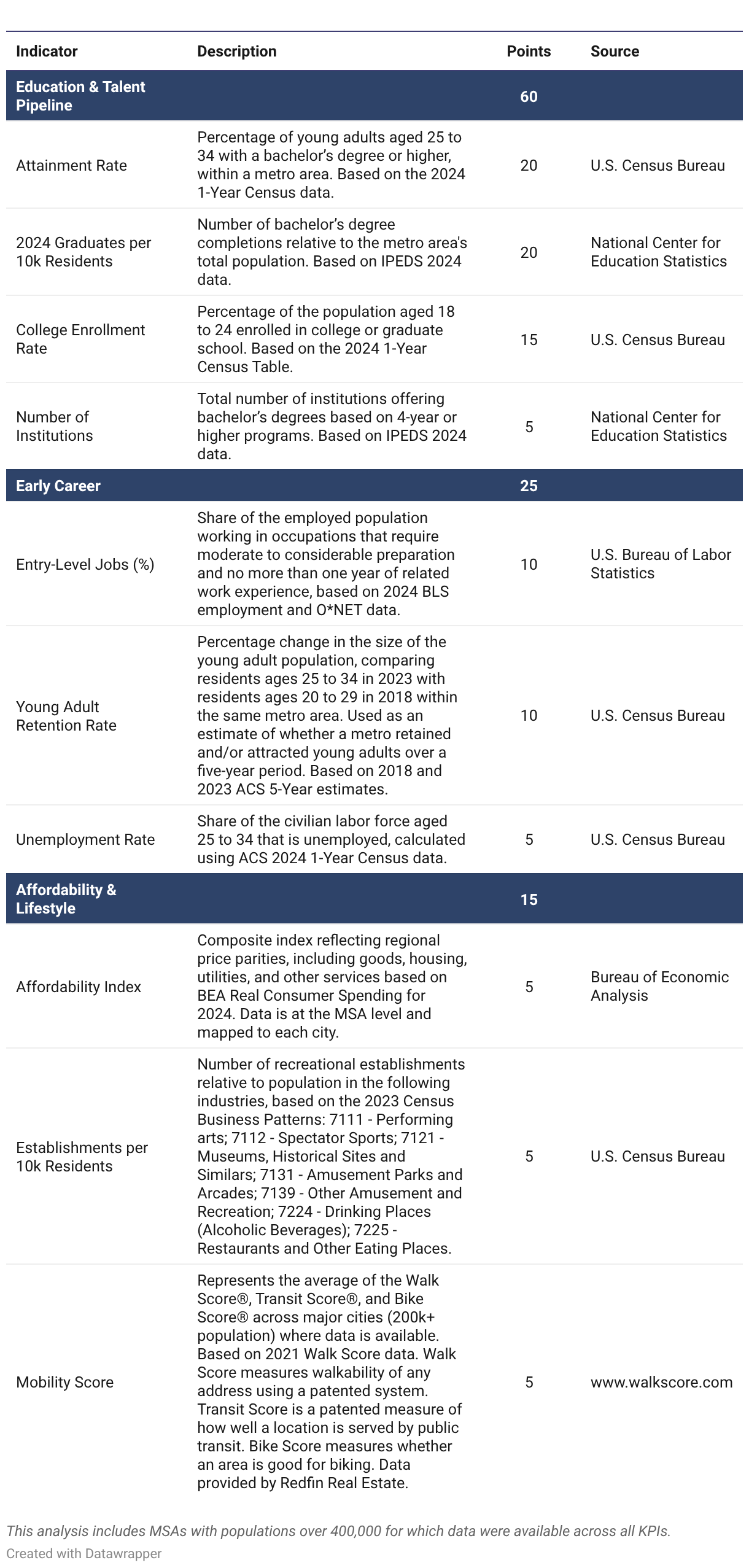
That said, some metros are breaking that pattern by producing graduates and creating the conditions for them to stay. To find them, we scored 73 of the largest U.S. metros across three categories:
Education & Talent Pipeline (up to 60 points): graduate output per 10,000 residents, college enrollment rate, share of 25- to 34-year-olds with a bachelor’s degree, and number of degree-granting institutions
Early Career (up to 25 points): entry-level job availability, unemployment among 25- to 34-year-olds, and young adult retention rate
Affordability & Lifestyle (up to 15 points): regional cost of living, density of recreational and cultural venues, and composite mobility score across walking, cycling, and transit
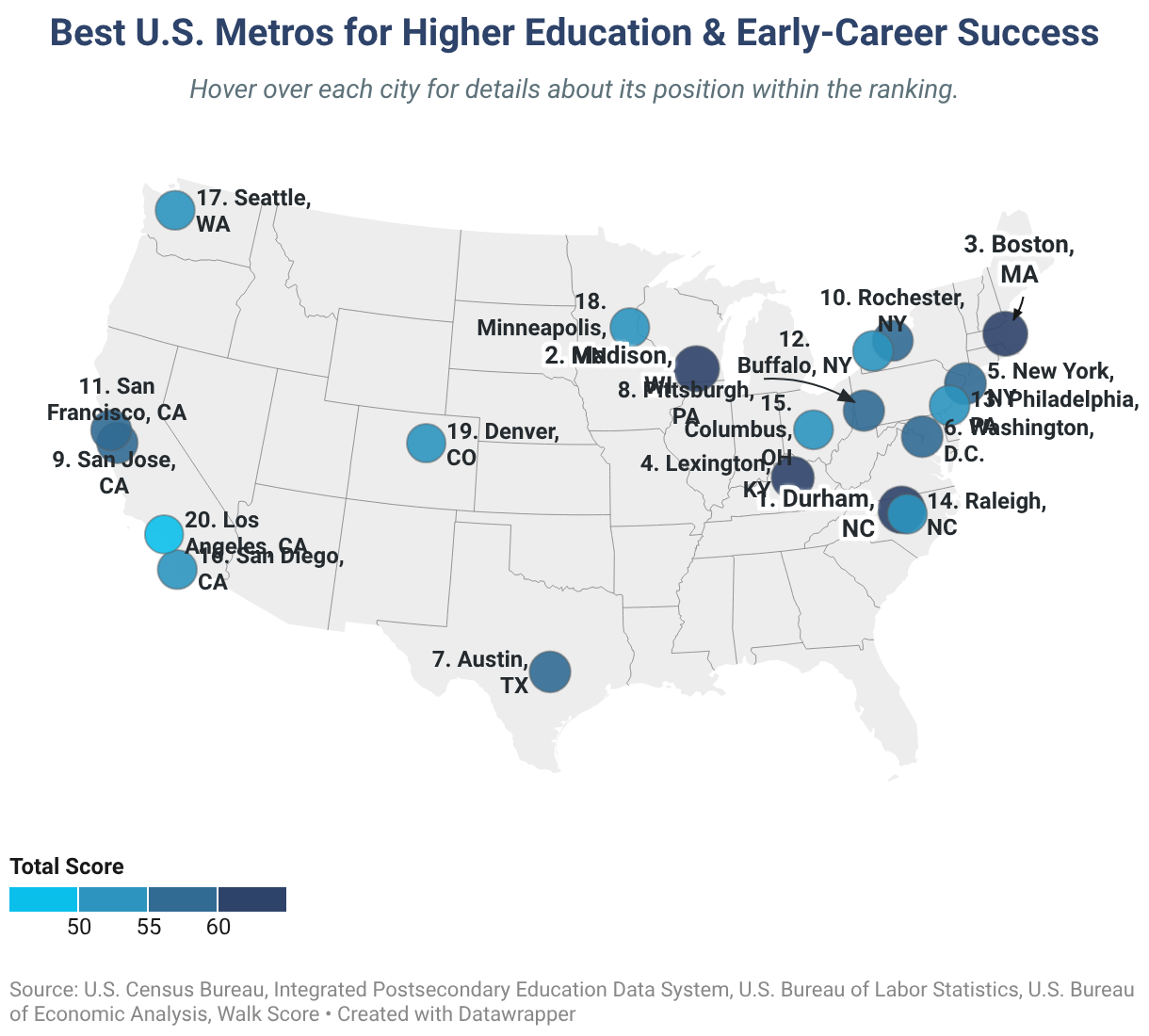
Keep reading for the national top 20, or jump straight to a region:
Durham, N.C., Takes #1 Overall With Most Graduates Per Capita & Lowest Young Adult Unemployment
1 – Durham, N.C.
Durham kicked off the rankings with what is an enviable production line of talent from just four degree-offering institutions. In fact, with 168 graduates per 10,000 residents, no other metro in the study even comes close in per-capita output. Nearly 60% of Durham’s 18- to 24-year-olds are enrolled in college, and attainment levels are among the highest we measured.
But, it wasn’t just the output of the likes of Duke University and UNC Chapel Hill that helped score the highest points total for Durham. The local job market also gives graduates a real chance to start their careers: More than 15% of roles in the metro are entry-level positions suitable for recent graduates with demand spread across sectors. Plus, life sciences employers — including Biogen, Novo Nordisk and Merck — operate alongside tech firms like IBM and Cisco across the Research Triangle. Accordingly, young adult unemployment sits at just 2% for the lowest in the study.
2 – Madison, Wis.
The only other metro to top 70 points, Madison is another education-centric location — and one that pushed Durham hardest on the education metrics. Specifically, graduate output here was second only to Durham, while educational attainment among 25- to 34-year-olds reached 64% for second in the entire study behind only San Jose, Calif. What’s more, Madison also joined Durham as one of a handful of metros where more than half of 18- to 24-year-olds are enrolled in college or graduate school.
Plus, for starting a career, Madison has the second-lowest young adult unemployment among the top 20 at 2.8%, although entry-level jobs are not as readily available here as they are in Durham with 14% of all roles in Madison being suitable for early-career starts. Notably, where Madison lost points was retention: It had one of the lowest retention rates of young adults among the top 20 metros. More precisely, the cohort aged 20 to 29 shrank by 9% as it moved into the 25-34 bracket five years later. UW Madison data helps explain part of this: Nearly 90% of in-state graduates stay in Wisconsin after graduating, but only 16% of those who arrived from outside the state remain. Granted, that’s state-level data, rather than university-specific, but it’s nevertheless pertinent to understanding the dynamics at play for UW Madison alumni.
3 – Boston
In third place overall, Boston is the first large metro in the ranking and has a considerably larger number of higher education institutions (52) to draw on for talent production. Even on a density measure, Boston produced 90.8 graduates per 10,000 residents — one of just three metros greater than 1 million in population above the 90 per 10,000 mark. Boston also ranked near the top on college enrollment and educational attainment, pointing to a strong talent pipeline that translates into career opportunity.
Furthermore, for graduates, the local job market is among the most welcoming in the study: More than 15% of roles are entry-level for the highest share among metros with populations above 2 million. That matters in a city like Boston, where breaking into a research-heavy economy rich in life sciences and R&D often depends on getting that first foot in the door. Boston also had the highest average composite score for walking, cycling and transit of any metro in the ranking, which speaks to another priority for young adults choosing where to live.
4 – Lexington, Ky.
At 533,000 people, Lexington is the smallest metro in the top 20, but its graduate output punches well above that weight. It ranked third in the study for graduates per capita at 122.8 per 10,000 residents. Here, the University of Kentucky enrolls close to 28,000 undergraduates, most of them from within the state, and graduating class sizes have been climbing. Lexington was also third in the study for student enrollment with 52.5% of 18- to 24-year-olds enrolled across its five degree-granting institutions.
Additionally, entry-level job share is third-best among the top 20 and living costs are the lowest in the top 20. But, Lexington also loses the largest share of its young adult cohort among the top 20 with the group shrinking by roughly 12% in the five-year measure. With graduate output this high relative to population, retaining every cohort locally is a tall order for any metro. Capacity is expanding, though: Legacy Business Park — a 200-acre development adjacent to UK’s Coldstream Research Campus — broke ground in 2025 and is expected to create 1,700 jobs.
5 – New York, N.Y.
New York is in a category of its own for size, which shows up in its 174 higher education institutions — more than twice as many as any metro, except Los Angeles. In the Big Apple, graduate output per capita sits toward the lower end of the top 20, although it’s far from the lowest and most of the other education metrics rank strongly.
On the early-career side, unemployment for young adults runs comparatively higher and the share of entry-level roles is in the middle of the pack. Even so, New York’s early-career retention rate was 101.6 (meaning the metro replaces every young adult who leaves and gains a small surplus on top) at a level very similar to Boston and Durham, N.C. The city’s density, cultural depth, and entertainment options likely play a role in this, and it ranked second only to Boston for its average score across walking, cycling and transit.
6 – Washington, D.C.
The nation’s capital has one of the most credentialed young adult populations in the country with nearly 59% holding at least a bachelor’s degree. That’s to be expected given the specialized nature of professional opportunities here, including government, defense and tech. The rest of the education metrics are above average with graduate output higher than that of metros with populations of 6 million or more. Washington, D.C. also has the fifth-highest number of higher education institutions among the top 20.
At the same time, the capital’s retention rate falls comfortably into attraction territory with the size of young adults net gain increasing by 6.1%. That can be chalked up to the metro’s specialized economy, which acts as a magnet for graduates from elsewhere who want to match their credentials with the federal-related firms and institutions concentrated here. Like other East Coast metros, Washington, D.C. also rates highly for urban mobility with a strong average score across walking, cycling and transit per Walk Score data.
7 – Austin, Texas
Austin has been one of the more popular places to live for young adults for some time now, and the retention metric reflects that: The metro recorded the second-highest percentage increase of its young adults among the top 20 throughout five years, growing by 23.8%. Much of that pull is driven by a tech workforce that has expanded considerably with tech jobs increasing by 29.1% from 2018 to 2023, alongside the inflow of companies relocating to the area.
Yet, that demand for talent outpaces local tech graduate output. Even though the University of Texas is a stalwart of the city and its innovation, Austin produces 74.9 graduates per 10,000 residents, which is in the upper half of the top 20. However, at 38.9%, Austin has the fourth-lowest college enrollment rate of the top 20.
8 – Pittsburgh
Pittsburgh’s case as a graduate-to-career metro starts with affordability. Here, living costs are more than 5% below the national average — second only to Lexington among the top 20 metros, which is significant given that Pittsburgh is nearly five times the size of the Kentucky metro. The talent pipeline in Steel City is strong, too: More than 45% of 18- to 24-year-olds are enrolled in college, drawing on institutions like Carnegie Mellon University and the University of Pittsburgh, while more than half of 25- to 34-year-olds hold at least a bachelor’s degree. That puts Pittsburgh among the more credentialed metros in the study.
Moreover, Pittsburgh’s retention rate of 106.4% means the young adult cohort grew throughout the five-year measure with arrivals outpacing departures.
9 – San Jose, Calif.
San Jose tops the study for educational attainment with 67% of 25- to 34-year-olds holding a bachelor’s degree or higher. Plus, enrollment among 18- to 24-year-olds is 53.6% — the second-highest overall. However, the metro produces only 49.8 graduates per 10,000 residents, which puts it below most of the top 20. In five years, the young adult cohort gained 11.3% in size with arrivals outpacing departures. So, like Austin, Texas, and Washington, D.C., San Jose imports a lot of its talent.
Granted, entry-level openings are thin here (the lowest share of any metro in the top 20), which can make starting a career in San Jose more difficult than it is in some of the other top metros. That said, new graduate hiring rose 13.1% in 2025 — the biggest jump of any U.S. metro — driven mostly by firms looking for technical, analytical and AI skills.
10 – Rochester, N.Y.
The Rochester metro produces 83.8 graduates per 10,000 residents (nearly on par with Boston), and enrollment among 18- to 24-year-olds is close to 50% across its 11 degree-granting institutions, including the University of Rochester. Thus, graduates who stay face a favorable local market: Youth unemployment is low and the share of entry-level openings is among the best in the top 20.
Still, the metro loses more than 7% of its young adults by their early 30s, which is similar to Madison, Wis. But, for a metro of 1 million, there’s room to retain more. To that end, Rochester’s Tech Hub designation positions western New York to become a national leader in semiconductor manufacturing, advanced technology and industrial innovation.
Interested in more details about the top 20 best metros for graduates and early career success? Use the buttons above the chart to see which metros from each region scored the best. Or, use the drop-down list of metrics to see which metros had the strongest results in individual measures.
Regional Rankings: Best Metros for College Graduates & Career Starts, by Region
The Northeast and the West each placed the most metros in the national top 20 with six, followed by the South with five. Then, the Midwest had three, although Madison, Wis., alone carried the region to second place overall. So, beyond the national leaders, we ranked the 10 best from each region to highlight strong performers that didn’t make the national list.
Southern U.S.: North Carolina Places 3 in Southern Top 10
North Carolina claimed three of the region’s top 10 with Durham finishing first overall nationally, Raleigh in 14th and Greensboro rounding out the Southern top 10. Lexington, Ky.; Washington, D.C.; and Austin, Texas, also landed in the national top 10 from the South. But, because those metros were already covered in detail, the focus here is on the strong regional performers that didn’t make the national list.
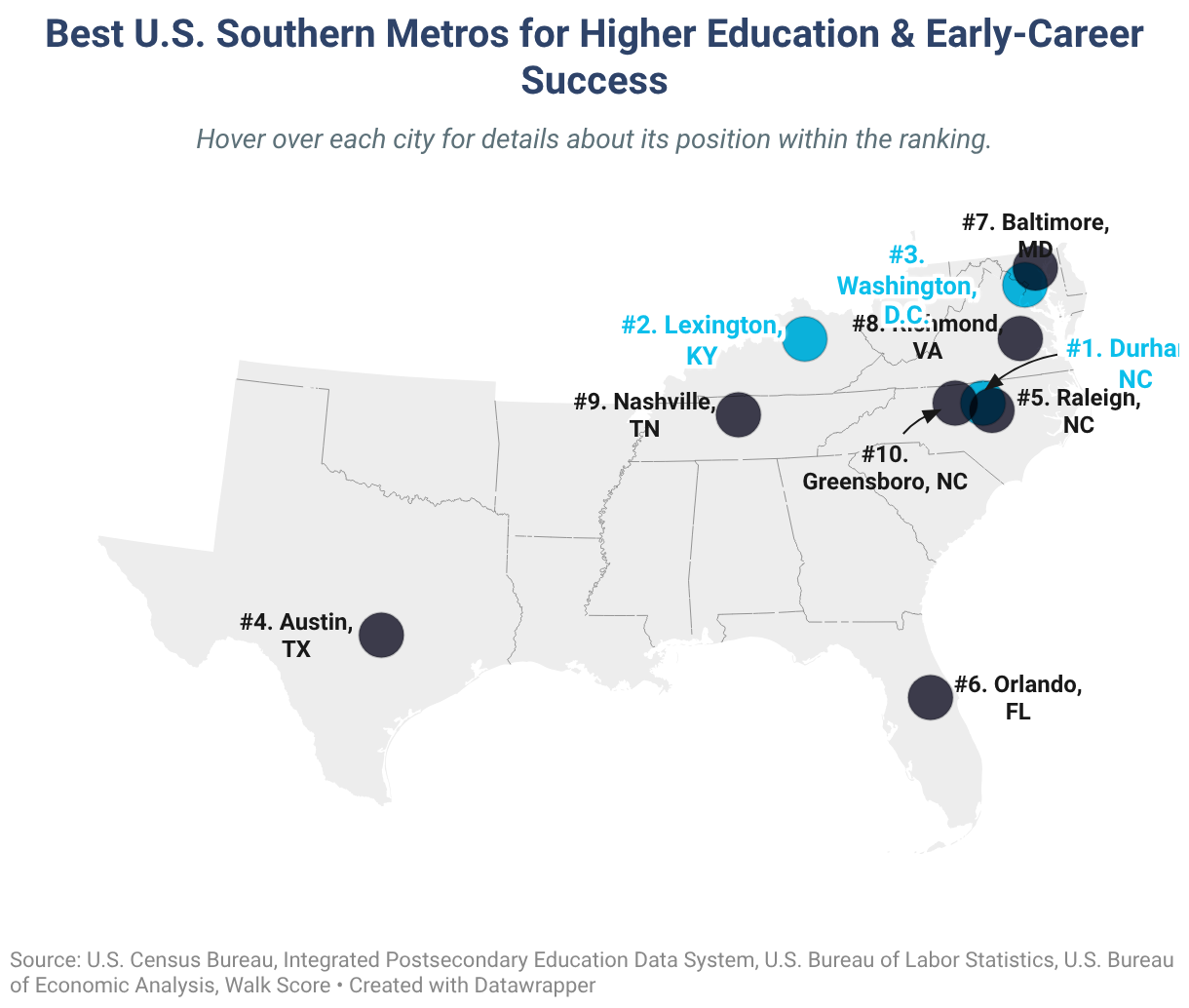
Raleigh’s strongest result was retention: The metro added 18.8% to its young adult cohort throughout the five-year measure for the second-best in the region. However, Raleigh doesn’t have Durham’s educational output and the entry-level job share is lower, although youth unemployment is low at around 3.5%. Even so, with Research Triangle Park sitting between the two metros and home to more than 300 companies across 7,000 acres, Raleigh and Durham function as a shared talent and opportunity ecosystem.
Outside of the national top 20 and sixth in the Southern region, Orlando, Fla., earned its place largely through the University of Central Florida — the largest university by enrollment in Florida with more than 70,000 students. As such, it’s a metro that punches above its weight on education metrics because of one enormous institution: Orlando’s graduate output at 74.3 per 10,000 was on par with Austin, Texas, while its college enrollment at 46.3% of 18- to 24-year-olds was a top-five regional result.
Further north, getting around without a car was a standout for Baltimore, which placed seventh in the region. The metro ranked second in the South’s top 10 on the composite walking, cycling, and transit score (behind only Washington, D.C.), making car-free living a practical option in a way that few Southern metros can match. Similarly, Richmond, Va., further down I-95, had the third-best entry-level job share among the South’s top 10, although weaker education metrics kept it from climbing higher.
Granted, few metros in the region delivered results as striking as Nashville, Tenn. Here, educational attainment among 25- to 34-year-olds cleared 50%; unemployment for that group was 2.7% (second only to Durham, N.C., in the South); and more young adults arrived than left during the five-year period, leaving the cohort nearly 15% larger. As you might expect, the density of cultural and recreational venues per capita was highest among the South’s top 10. While Nashville might have scored considerably higher overall, it had the lowest share of entry-level jobs in the region, which was the one metric that held it back: Five of the metro’s 10 largest employers are health care companies, an industry that tends to hire for experience, rather than potential.
Then, as the third North Carolina entry in the South’s top 10, Greensboro had the region’s third-best graduate output at 91.4 per 10,000 and college enrollment at 51.2%, although lower retention and attainment kept it from climbing higher. With that, the metro’s education metrics suggest a strong pipeline for talent production with the question being how much of that talent stays in the area after graduation.
Midwestern U.S.: Madison, Wis., Leads, but Des Moines, Iowa, & Omaha, Neb., Win on Career Conditions
Madison led the Midwest in graduate and early-career success and was the only Midwestern entry in the national top 10. Columbus, Ohio, came next at 15th, followed by Minnesota’s Twin Cities metro at 18th. Beyond those three, some of the region’s strongest producers lose graduates to larger markets, while smaller, more affordable metros are quietly winning on the conditions that matter most when you’re starting out.
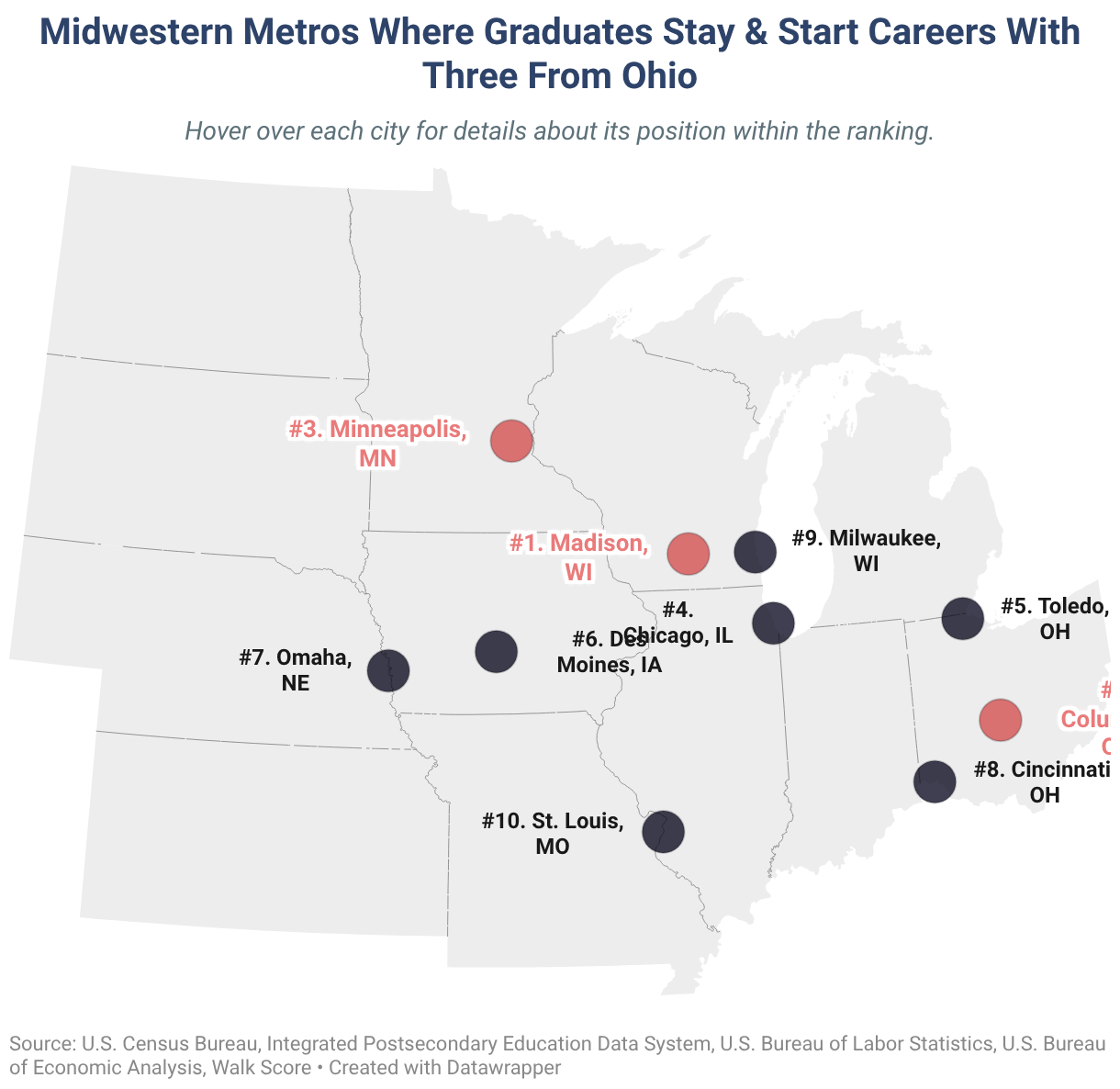
The final Midwestern entry in the national top 20, Minneapolis has graduate output in the regional top three at 76.9 per 10,000, as well as attainment among 25- to 34-year-olds landing at 50.8% (behind only Madison, Wis., and Chicago). In this case, the trade-off is cost: Minneapolis is among the more expensive metros in the region, with an affordability index of 104.8 and an entry-level job share of 13.4% , the lowest in the regional top 10.
Next, with nearly double the number of higher education institutions (47) of any other Midwestern metro, Chicago has the infrastructure to be the region’s dominant graduate market. Plus, the Windy City’s attainment at 51.2% ranks second in the region, and the Chicago metro leads the Midwest on urban mobility, while cultural venue density per capita is among the higher of those in the region. But, for a city of 9.4 million, the early-career picture is surprisingly flat: Entry-level job share at 13.8% is below most of the regional top 10, and retention sits at 99.4, which is just below replacement.
Meanwhile, in Iowa, Des Moines’ overall ranking of #23 is held back by graduate output of 24.9 per 10,000 for the lowest in the regional top 10. But, on the conditions a graduate weighs once they’ve decided where to start, Des Moines outperforms many of the national top 20. Furthermore, retention sits at 121.4, meaning the metro attracted 21.4% more young adults than it lost during the five-year period, the highest rate in the region. Entry-level job share at 14.8% is also the highest in the regional top 10, young adult unemployment is 3.5% and the affordability index of 91.7 puts living costs more than 8% below the national average.
Where Des Moines wins on retention, Omaha, Neb., leads on production and unemployment. Its graduate output at 67.0 per 10,000 is well above Des Moines’ and stronger than its overall regional rank suggests. Young adult unemployment at 2.9% is also the lowest in the regional top 10, behind only Madison. Affordability is also on par with Des Moines at 91.9, and Omaha’s entry-level job share at 14.4% is among the strongest in the region. And, its retention of 108.4 means the increase in young adults was third-highest among the regional top 10 during the five-year period.
Not to be outdone, Milwaukee and St. Louis rounded out the regional top 10. Milwaukee’s mobility score of 55.9 places it behind only Chicago and Minneapolis in the region, and its 24 recreational establishments per 10,000 residents is above the regional median. In the same way, St. Louis brings 24 higher education institutions to the region — the second-highest count after Chicago. With low youth unemployment at 3.6% and a mobility score of 55.3, the case for St. Louis is built on institutional depth and a stable urban core, rather than standout cohort growth.
Northeastern U.S.: 6 Qualifying Metros, All Inside National Top 20
The Northeast qualified the fewest metros of any region, but none finished lower than 13th nationally. In fact, even the lowest-ranked qualifier scored higher than the median metro in any other region. Boston led in third place overall with New York City; Pittsburgh; and Rochester, N.Y., all inside the top 10. Buffalo, N.Y., and Philadelphia (the two entries not covered in the national top 20) are profiled below.
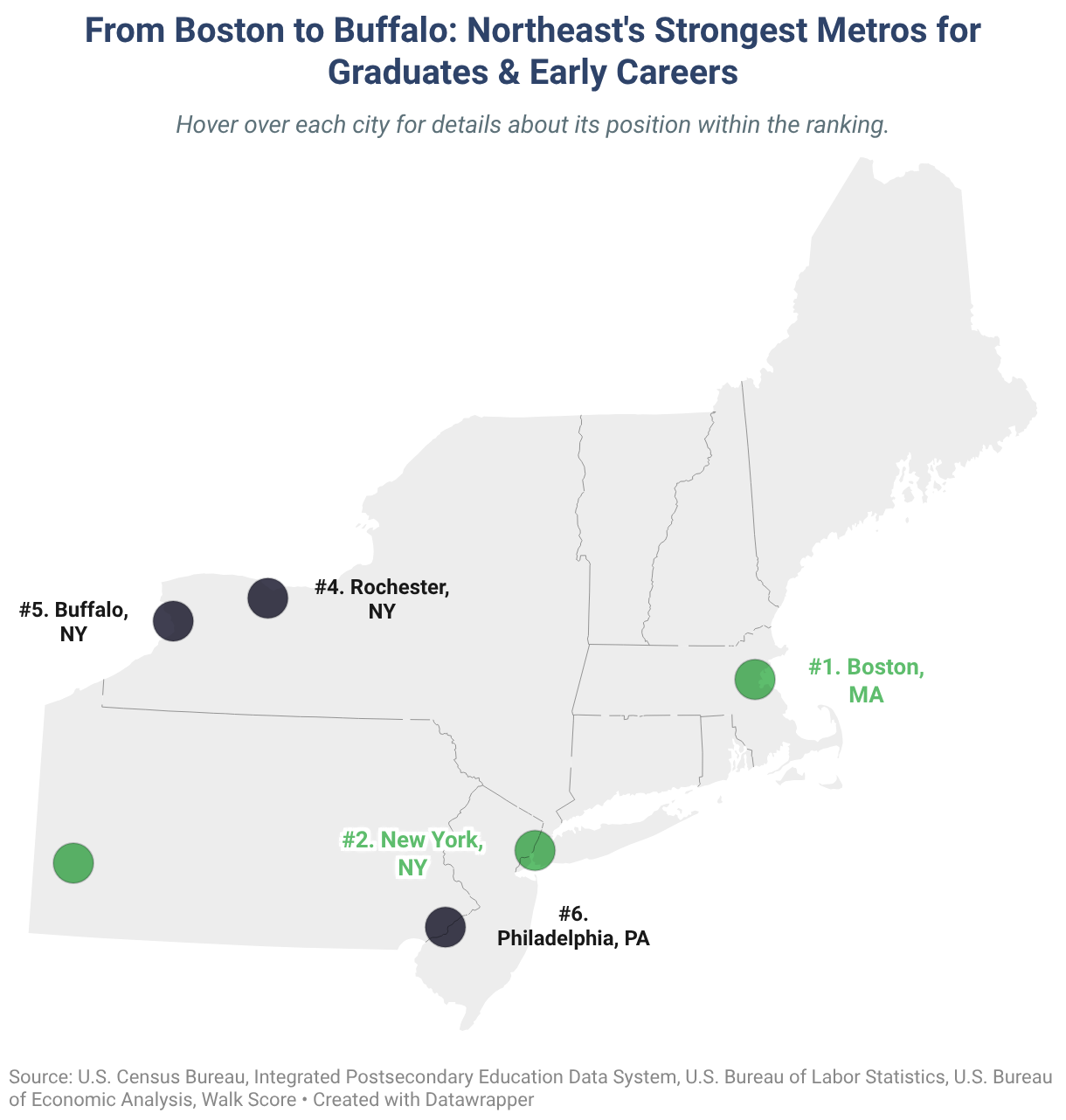
Buffalo’s result was built on affordability and mobility. Here, living costs are 4.2% below the national average, or the second-most affordable in the region after Pittsburgh. Plus, it posts a strong composite mobility score of 59.0. Moreover, graduate production is 74.0 per 10,000 and college enrollment is 49.7%, both helping to place Buffalo in the regional top three.
For comparison, Philadelphia has stronger attainment numbers than graduate production. Its graduate output is 61.3 per 10,000 (towards the middle to lower end of the region), while 51.8% of 25- to 34-year-olds hold at least a bachelor’s degree for third in the region. In addition, Philly’s retention was 103.6 for a 3.6% net gain in five years. Otherwise, entry-level job share is 14.2% and youth unemployment is 4.6%.
Western U.S.: California Claims Half of Top 10, but Best Career Conditions Are Elsewhere in Region
Six western metros made the national top 20, tying with the Northeast for the most from any region. Of these, California placed five metros in the regional top 10. In particular, coastal California metros lead on education and talent density, whereas inland and mountain metros lead on retention and entry-level conditions.
San Jose, Calif., headed the region and finished in the national top 10. Then, San Francisco, at 11th overall, paired the highest density of cultural and recreational venues in the national top 20 (29 per 10,000 residents) with the second-highest attainment rate in the West at 61.5%. And, a 9.5% cohort increase means the metro is attracting young adults even with the highest living costs in the region.
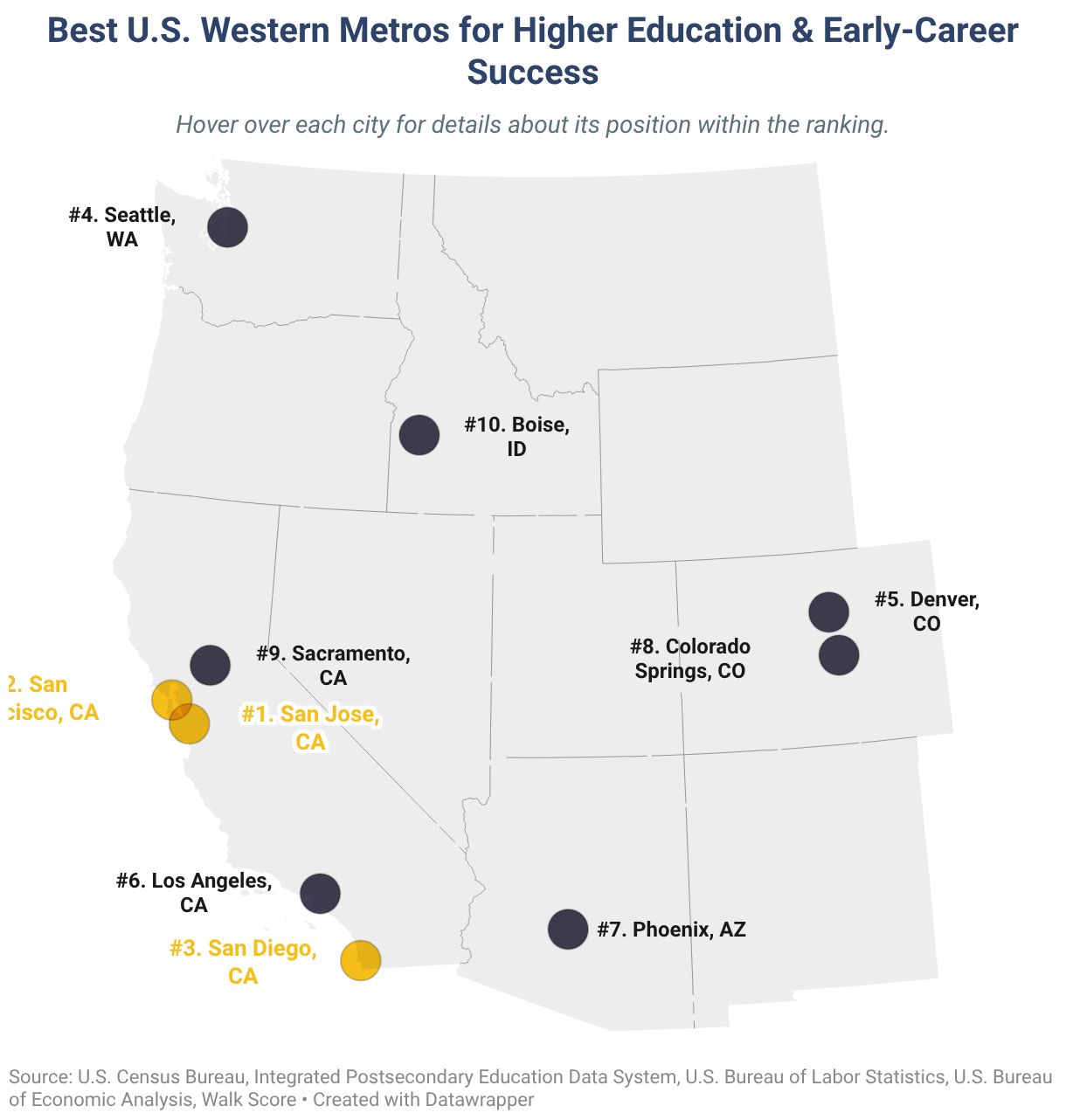
Third in the region and rounding out California’s top three, San Diego had graduate output of 94.4 per 10,000 and attainment of 50.4%. Retention was 96.2, a slight loss in the five-year measure.
Outside of the Golden State, Seattle and Denver are built on attraction, rather than production. In these metros, graduate output and college enrollment run lower than other Western metros, but attainment is still 54% in Seattle and 56.4% in Denver. Notably, Seattle’s retention rate of 121.5 pairs with the West’s highest urban mobility score at 68.4. Likewise, Denver’s retention rate of 125.6 is the highest of any in the full, 73-metro study.
Back in California, Los Angeles has 98 degree-granting institutions (more than three times any other Western metro) and ranks second nationally after New York City. In LA, college enrollment among 18- to 24-year-olds is 50.3% — second in the region to San Jose, Calif. Young adult unemployment in the City of Angels is 5.8% and retention is 98.8 for a slight loss in five years.
Other than California’s coastal metros, the West has strong individual results. For instance, Phoenix posted graduate output of 105.5 per 10,000, the best in the region. And, Colorado Springs, Colo., led the region on entry-level job share at 15.2%. Not to be outdone, in Idaho, Boise’s young adult unemployment of 3.7% was lowest in the regional top 10, and its retention rate of 118.7 was the third-highest. Lastly, Sacramento, Calif., came in third in the region for college enrollment at 49.8%.
Methodology



Matthew Preston
Content Writer, CRE News & Market Analysis
Matthew has covered commercial real estate for CommercialCafe since 2022. He focuses on the office and industrial sectors, reporting on leasing, development, and investment across national markets and individual submarkets. His work draws on data and original research. He also writes about demographic shifts and urban innovation in U.S. cities. The New York Times, The Real Deal, Bisnow, The Business Journals, and Yahoo Finance have cited his reporting.