

The office competes with working from home now, not only with other buildings. For anyone who can do the job from the kitchen table, coming in has to be worth the effort, and that one shift has changed what amenities are for.
Amenities used to be a detail that helped close a lease or fill a brochure. In a hybrid setup they carry real weight, affecting whether employees choose to come in, whether a company keeps its people, and whether a building holds its tenants. What counts as a good amenity has changed too: the ones that matter now cut the daily friction of working in a shared space instead of adding novelty.
Key Takeaways
- ▪Coming in costs employees time, money, and focus, so amenities have to pay that back with an experience better than home.
- ▪Higher-quality, well-served buildings tend to hold demand and rents better, while bare-bones space struggles to keep tenants.
- ▪Privacy is the bottleneck most offices underestimate. A day full of video calls needs enclosed space, not just open desks.
- ▪Food, coffee, and places to gather earn their keep by saving time and giving people a reason to cross paths.
- ▪Active-commute and wellness features, from secure bike storage to showers and quiet rooms, make the trip in easier.
- ▪A space sits empty without upkeep, so treat amenities as a managed service, and match the mix to the team you actually have.
The Commute Is Now a Trade-off
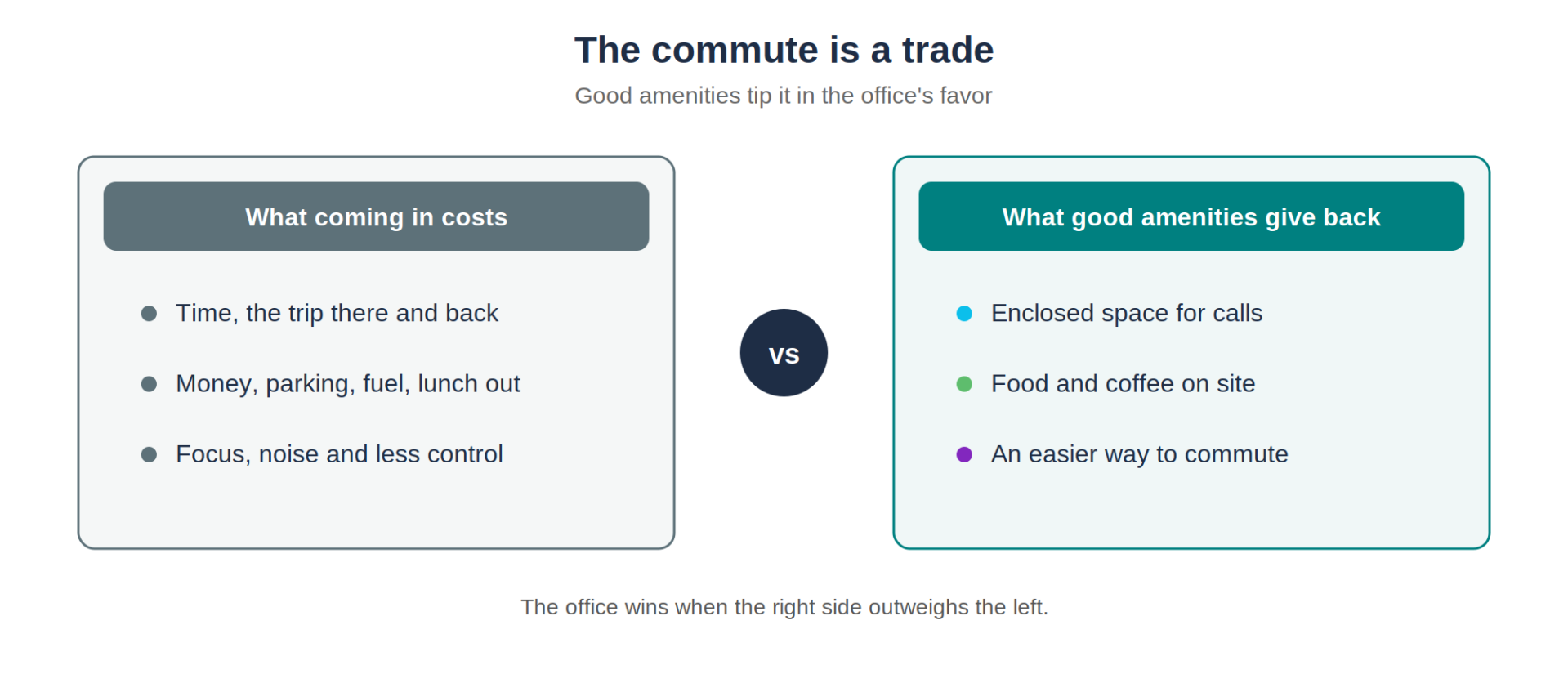
To see why people resist coming in, treat the trip from home to office as a trade. Going in costs something real.
Time. The hours spent getting there and back.
Money. Parking, fuel, fares, and pricier lunches out.
Focus. Noise on an open floor, a temperature you cannot control, and a less flexible day.
The office has to give back more than it takes. If someone battles traffic for an hour and then sits at an open bench taking video calls on mediocre coffee, the trip did not pay off, and they will think twice about the next one. Good amenities are what tip that trade in the office’s favor, by removing the friction that makes working from home feel easier.
 Why It Shows Up in the Market
The same pressure is changing demand across the market. When companies take less space, they often move up in quality rather than simply shrinking, putting the savings into better-served buildings. That favors higher-quality, amenity-rich space, the kind often labeled Class A or Trophy, which tends to hold demand and rents better. Older, bare-bones buildings have a harder time, and the gap tends to widen as tenants concentrate in the best space.
The split is measurable: Class A and trophy space now commands a rent premium of [ADD FIGURE] over older commodity buildings and holds occupancy better, according to Yardi Research data. For an owner, that makes amenities part of protecting a building’s value rather than a discretionary expense. A property that cannot offer competitive shared space risks slipping toward functional obsolescence, whatever its location. It also changes how a tenant should read a building when weighing whether to lease or buy.
The Amenities That Earn Their Keep
Preferences vary by industry and culture, but investment tends to pay off in three areas. Get these right before anything more elaborate.
Acoustic privacy and hybrid infrastructure
The early hybrid idea was that people would focus at home and come in to collaborate. In practice, calendars do not split that cleanly. Employees arrive to a day of video calls with clients, vendors, and remote colleagues, which turns an open floor into a running distraction. The fixes are specific: single-occupancy phone booths and pods with their own power, lighting, and ventilation, so no one has to take a call in a room built for ten; quiet zones designed for focus, with real acoustic treatment and separation from the social areas; and meeting rooms where plugging in one cable pairs a laptop with the cameras, microphones, and screens, so no time is lost at the top of every call.
Food, coffee, and places to gather
Food and coffee remain the highest-return amenities for what they cost. A good coffee bar becomes the natural meeting point of the building, saves the mid-morning trip out, and gives cross-functional teams a casual place to cross paths, something that does not happen on a screen. Beyond coffee, a subsidized or rotating food program, whether an on-site café, a grab-and-go market, or partnerships with local restaurants, solves the midday logistics that otherwise send everyone out at once.
Active commute and wellness
If the commute is the barrier, the building should make it easier to arrive. End-of-trip facilities matter most here: secure, badge-access bike storage, e-bike charging, and proper locker rooms with showers. Someone who can bike or run in, store their gear safely, and clean up is far more likely to make the trip a habit. Add fitness space, quiet rooms for a reset or for prayer, and mother’s rooms that go past the legal minimum for real comfort and privacy, and the office starts to support the whole day rather than just the desk.
Running the Space, Not Just Building It
A handsome lounge or a rooftop terrace does nothing if it sits dark, untended, or locked. The operators getting this right treat the workplace less like a fixed piece of architecture and more like a service that has to run every day. In practice that means moving past basic property management to keep the space maintained and friction-free, whether through dedicated on-site workplace management, quick tech support when the AV fails, or a reliably stocked, rotating food lineup. It also means budgeting for the cost of running all of it, not just the capital to build it. Traditional landlords and large occupiers are increasingly borrowing this operational playbook from flexible workspace models.
How Amenities Show Up in the Lease
For anyone comparing spaces, it helps to separate two kinds of amenities, because you pay for them differently. Shared building amenities, the lobby, conference center, fitness facility, amenity floor, or rooftop, are provided and run by the landlord, and their cost is folded into rent and operating expenses across all tenants. Suite amenities are what you build inside your own space, the phone booths, kitchen, and focus rooms, and those come out of your own fit-out budget.
That distinction changes how two buildings compare. A building rich in shared amenities may ask a higher rent but reduce what you need to build yourself, while a bare shell at a lower rate can cost more once you account for the buildout to make it workable. When you weigh a space, read both sides together, and factor in how the layout you inherit affects what you can do with it. The headline rent rarely tells the whole cost.
Sizing the Mix to Your Team
The goal is not the longest list of perks. Over-building spaces people do not use, an indoor putting green, an elaborate game room, ties up capital and can miss what the team actually needs. A short, structured process keeps the spend where it counts.
| Step | What to do | Why |
|---|---|---|
| Audit the friction | Run anonymous pulse surveys and look at which spaces actually get used. | Shows where people hit friction, whether that is finding a quiet room or getting lunch quickly. |
| Fix baselines first | Make connectivity, cell coverage, acoustic privacy, and coffee flawless before anything else. | These are the minimum for a working day. Terraces and fitness suites come after. |
| Match your workforce | Tailor the mix to who is actually there. | An engineering team needs a different privacy ratio and layout than a legal or finance group. |
| Budget for running it | Set aside capital for upkeep, food-vendor curation, and programming. | Keeps the space valuable instead of letting it fade after opening. |
Handled this way, the amenity mix stays tied to what people use rather than what looks good on a walk-through. Start with the friction your team feels most, and build out from there.
Frequently Asked Questions
What is the flight to quality, and how does it relate to office amenities?
It is the market’s move toward modern, well-served buildings and away from older, commodity space. Top-tier buildings tend to hold occupancy and rents better because they offer the tech, amenities, and active management that help employers bring people back.
Why are single-person privacy pods considered essential now?
Employees spend much of the day on video calls. Without acoustically insulated phone booths, they either take those calls at open desks, which disrupts everyone nearby, or occupy multi-person rooms one at a time, which wastes space. Pods cover both cases.
How can a landlord or employer tell if an amenity is worth the investment?
Watch how much it gets used, alongside employee feedback. Novelty features often start strong and fade, while functional ones, privacy pods, commute support, and good food, see steady daily use because they solve real bottlenecks.
What does it mean to treat amenities as a service?
It means building the space is only half of it; the space also has to be run. Instead of handing over an empty lounge, it means budgeting for ongoing upkeep, technical support for shared AV, and consistent food and beverage curation, so the space stays functional and reliable every day.



Matthew Preston
Content Writer, CRE News & Market Analysis
Matthew has covered commercial real estate for CommercialCafe since 2022. He focuses on the office and industrial sectors, reporting on leasing, development, and investment across national markets and individual submarkets. His work draws on data and original research. He also writes about demographic shifts and urban innovation in U.S. cities. The New York Times, The Real Deal, Bisnow, The Business Journals, and Yahoo Finance have cited his reporting.