


As Gen Z moves into the years when careers are supposed to start and take off, holding onto that talent is a future investment. Consequently, cities that can offer opportunity to this generation amid a challenging job market — one facing added uncertainty from AI — stand to benefit the most. But, opportunity only counts if a young professional can afford to stay for it, and that math increasingly favors midsized markets. Specifically, those that provide a genuine entry point without an outsized cost of living give young talent a reason to stay, earn, settle and, eventually, invest back into the community.
Following up on our annual analysis, we evaluated U.S. cities with populations between 250,000 and 400,000 across nine metrics spanning affordability, opportunity and quality of life. Below, we break down the national top 10 rankings, followed by key takeaways from each geographic region.
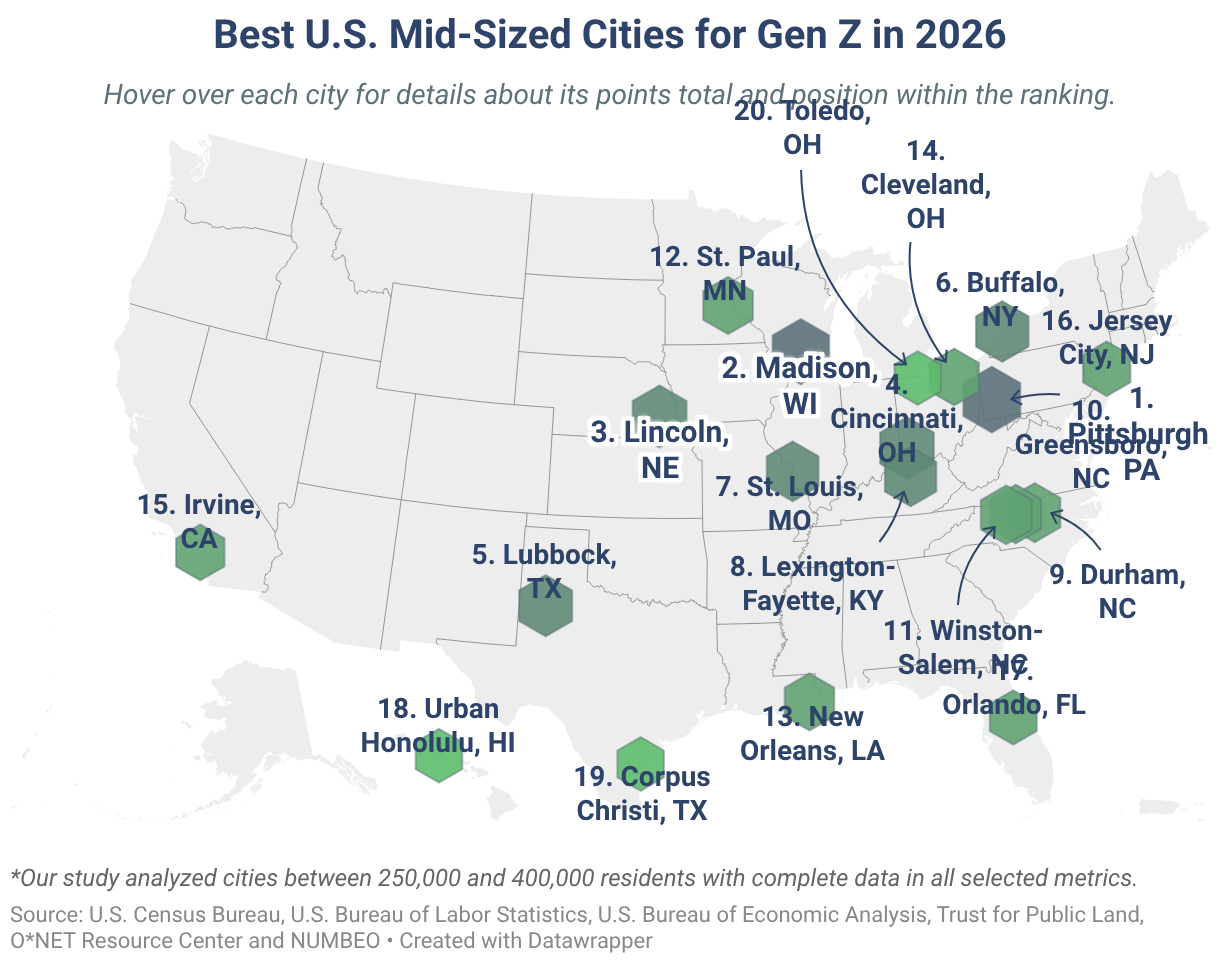
Pittsburgh Edges Madison, Wis., by 1 Point to Lead Best Midsized Cities for Gen Z
Pittsburgh won overall without finishing first in a single metric. Instead, it secured four top-five finishes and was the only city to place in the top half of all nine measures. Even so, it was a two-horse race at the very top with Pittsburgh at 69.4 points; Madison, Wis., at 68.4; and then a 6.9-point cliff to Lincoln, Neb.
#1 Pittsburgh
This is Pittsburgh’s year as it claims the top spot among midsized cities for Gen Z. After finishing as runner-up to Madison last year, it moved ahead of the Wisconsin entry in what was a tight race. Notably, Pittsburgh didn’t top any of the nine metrics. Instead, its victory came from consistency with the narrowest gap between its highest and lowest ranking of any city in the study.
Where Pittsburgh stands out as a top choice among midsized cities for Gen Z is for its array of 10 colleges and universities. On this front, roughly 65% of its young adults are studying. That age bracket also makes up almost 11% of Steel City’s population, which makes it the fourth-most concentrated Gen Z city in the study. Post-classroom life looks promising, as well, with youth unemployment at 4.8% — among the lowest of all cities. There’s plenty on offer for recreation and socializing, too: The city has around 2,100 such establishments, which is the third most among all entries. Meanwhile, and importantly for young people, getting about without a car is easy: 24% of working residents commute by non-car methods for the third-highest rate in the study.
#2 Madison
In the runner-up spot, Madison took a slightly different path, coming out as the outright winner in two separate Gen Z measures. First, it holds the highest share of Gen Zers in the study at 16% of the total population. Second, young adult unemployment here sits at a tiny 2%. Putting those numbers into context, Madison is synonymous with the University of Wisconsin – Madison, and roughly half of that age group is in college. Additionally, throughout the decades, the city has built a reliable bridge from campus to career. That showed up in our graduate-friendly job metric, where 31.5% of local roles suit recent grads for the third-highest share in our study. Retention also helps: 87% of in-state University of Wisconsin graduates are still living in the state five years later. But, it isn’t only about keeping local talent. Epic Systems, just outside of the city, recruits nationally and pays to relocate people.
Madison also does well on green space with 10.8 parks for every 10,000 residents, which is the sixth most in the study. Located on an isthmus between Lake Mendota and Lake Monona, much of its park network runs along the shoreline.
#3 Lincoln, Neb.,
Lincoln was another city that retained its spot on the podium. That’s because the city delivers on early-career accessibility with 31% of those employed in roles suited to graduates. And, that’s good news for grads coming out of the likes of the University of Nebraska who want to stay in the area. Added to the city’s attraction for Gen Z are living costs, which, at 8.4% below the national average, are lower than either of the other cities that share the podium. Overall, it’s also a highly concentrated city for Gen Z with the age group making up 11.5% of all residents (the third-highest share).
#4 Cincinnati
Hot on the heels of Lincoln, Neb., and just outside of the top three was Cincinnati, which keeps the same place it finished last year. Cincy falls much more into the amenity-rich category with 2,086 establishments for entertainment and culture, from the restaurants, bars and music venues of Over-the-Rhine (OTR) to the Cincinnati Art Museum. There are also roughly 13 parks for every 10,000 residents, putting the city alongside St. Louis and Buffalo, N.Y., at the top of the study on that measure. It was also the last of the cities to have more than 10% of all residents as Gen Zers, and living costs sit at 4.6% below the U.S. norm. Getting around works for those on a budget, too: Cincinnati was the last city to clear 10% of commuters using non-car modes. For example, the city’s 3.5-mile Connector streetcar, free to riders, runs from the riverfront through downtown, OTR and Findlay Market.
#5 Lubbock, Texas
The first entry in the ranking from the South, Lubbock, Texas, is a stalwart destination for Gen Z. Here, the local share of Gen Zers is the second highest in the study behind only Madison, Wis., with 14% of residents falling into this demographic — more than 60% of whom are students. Texas Tech is the primary magnet, supported by Texas Tech University Health Sciences Center and Lubbock Christian, which draw students from across the south plains and panhandle. Lubbock is also a major regional economic hub. Serving a wide area across West Texas and eastern New Mexico, the city hosts two major health systems (Covenant Health and University Medical Center). As a result, nearly 17% of the local workforce is employed in health care — roughly 1.4 times the national average. However, perhaps most appealing to students and young professionals, living costs are about 8.7% lower than the national average. That places Lubbock second in affordability across the entire study, behind only fellow Lone Star State city Laredo.
#6 Buffalo
Buffalo is the second Northeastern entry on our list after Pittsburgh. Its Gen Z appeal is less about one standout number and more about several good metrics coming together. For instance, some 30.4% of jobs here are suitable for recent graduates, which lands in the top 10, as does the city’s density of recreational, cultural and entertainment venues. Many of these settings line the historic arts district or sit in Elmwood Village, where walkable blocks run past Buffalo State. Yet, where Buffalo scored best was for its parks: Its roughly 13 per 10,000 residents tied for the highest in the study. Rather than isolated green spaces, Buffalo has a connected system that runs from Delaware Park through Elmwood down to Allentown. Plus, Bidwell Parkway even hosts a regular farmers market, fitness classes and summer concerts. What’s more, almost 14% of residents commute without a car, and with the Metro Rail, getting around in winter is easier than the latitude suggests.
#7 St. Louis
When it comes to recreation, St. Louis is hard to beat. Its 2,248 recreational and cultural venues claim the second-highest tally in the study, made all the more impressive by a modest population of 280,000. The icing on the cake is how many are free — the Saint Louis Art Museum, the Missouri History Museum and the Science Center among them. All three sit inside Forest Park, which, at 1,300 acres, is roughly 500 acres larger than Central Park. This year, the park was also voted the country’s best city park for the third time in five years. That said, Forest Park though is just one aspect in a network of green space that gives Independent City close to 13 parks per 10,000 residents — among the highest on the list.
#8 Lexington-Fayette KY
Lexington-Fayette once again lands in the top 10, standing out as a Gen Z hot spot thanks to one of the largest student shares in the study. With 56.8% of its Gen Z cohort enrolled in school, the city tied for fifth nationally, anchored by the University of Kentucky (UK), Transylvania University, and Bluegrass Community & Technical College. Gen Zers also account for 10.3% of the total population, which ranked fifth, as well. While that looks like a college town setup on paper, a population of nearly 330,000 makes it one of the larger markets in our midsized study. Advanced manufacturing, biotech and life sciences broaden the economic base, although UK is still the largest employer by a clear margin. Finally, living costs remain approachable for young adults, sitting 7.1% below the national average.
#9 Durham
Durham ascended into the top 10 after just missing out at 11th last time around. Arguably, it’s one of the best places to be if you’re a graduate in search of your first career opportunity. In fact, Durham remains atop the entry-level jobs metric with the city having as many as 32.1% of jobs in the suitable category for graduates. Add that 54.7% of Durham’s Gen Zers are in education, and graduates of Duke, North Carolina Central and Durham Tech are well placed to find work at local employers, such as IBM, Cisco and IQVIA, just to name a few. Still, as we see across many cities, it’s health systems and education that hire the most staff and are known for entry-level places. To that end, Duke is the largest employer in Durham by a distance, and unemployment among young adults is 5.3% — one of the lower rates in the study.
#10 Greensboro
Fellow North Carolina entry Greensboro followed up next in another new appearance in the top 10 after having placed 12th last year. In comparison with Durham, Greensboro had more Gen Zers, lower internet costs, higher school enrollment and lower living costs. Similar in size, Greensboro also edged ahead of Durham for its number of recreation establishments, in addition to claiming nearly double the number of parks as a ratio to residents. Compared to all midsized cities, internet costs of $63.20 per month, on average, are among the lowest, while a 59.4% education enrollment of Gen Zers is the fourth-highest share. Only Lubbock, Texas; Pittsburgh; and Irvine, Calif., were above that. On that front, Greensboro has six colleges and universities, namely the University of North Carolina at Greensboro, as well as North Carolina Agricultural and Technical State University, which has grown enrollment for 12 consecutive years. Yet, where Greensboro falls behind Durham is graduate-friendly jobs at 28.3% as compared to the study leader’s 32.1%.
Four of the Midwest’s Eight Entries Finished in the National Top 10
There were eight Midwest cities in our best midsized city for Gen Z ranking (fewer than the South or the West), and four of them finished in the national top 10. Madison, Wis.; Lincoln, Neb.; Cincinnati; and St. Louis are all covered above. Three more — St. Paul, Minn.; Cleveland; and Toledo, Ohio — claimed spots inside the top 20. At #23, Fort Wayne, Ind., was the only city from the region to miss the cut.
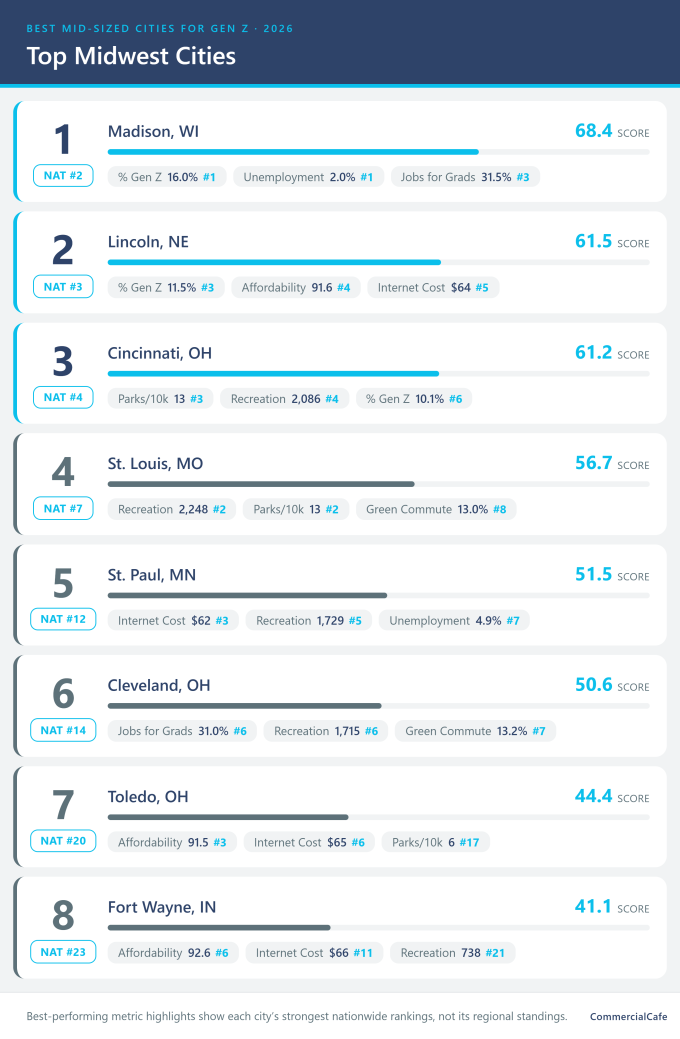
While most of the top Midwestern entries scored well for their low cost of living, St. Paul, Minn., was a notable exception with living costs sitting 4.8% above the national average. However, the Minnesota capital helped offset that higher price tag with the region’s cheapest internet, averaging $62 per month. St. Paul also benefits from a strong job market with relatively low unemployment, alongside the region’s third-highest concentration of recreational venues.
Meanwhile, Cleveland, with around 365,000 residents, is the largest city to make the top 20, and it’s another spot where access to recreation is solid. But, what really gives the Ohio entry its edge is its entry-level job market. Roughly 31% of local jobs are a good fit for recent graduates — a share effectively tied with Lincoln, Neb., and just behind Madison, Wis. As we’ve seen nationwide, health care has acted as a key job market safety net for young adults entering the workforce. Here, Cleveland Clinic leads that charge. As the region’s largest employer, its massive scale means it hires far beyond patient care by actively recruiting graduates across finance, marketing, IT, biology and business administration.
After Cleveland, one more Midwest location made the national top 20: Toledo, the third entry from Ohio, displayed typical Midwestern strength with the lowest living costs in the region and internet costs that are almost equally competitive.
Eight Southern Cities in the National Top 20
With 15 cities, the South had the advantage of more cities in the study than any other region. Moreover, eight made the national top 20 for the highest representation from any region.
Looking at the best-performing Southern city in each of the nine metrics, there were eight distinct leaders. As covered earlier, Lubbock, Texas, led Gen Z share and school enrollment; Durham, N.C., led the South (and the nation) for graduate-friendly job share; while Plano, Texas, was tied for lowest average internet costs.
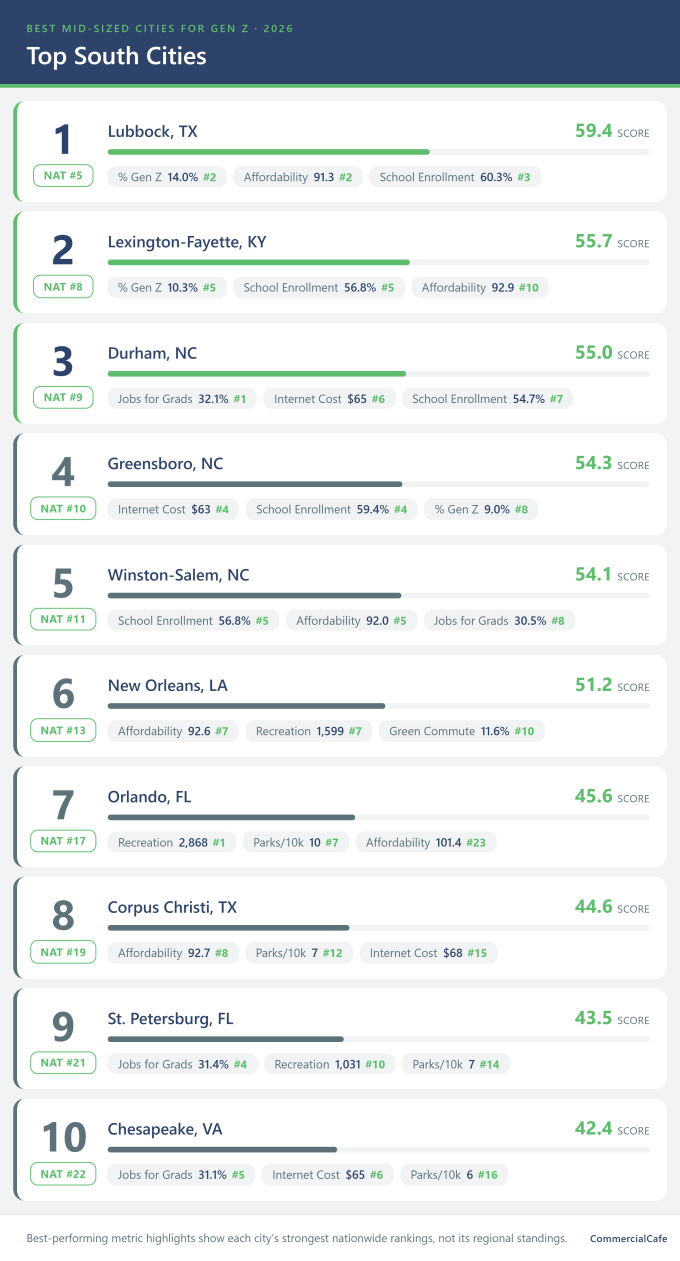
At $55.75 per month, on average, Texas’ Irving and Plano share the cheapest internet in the study, whereas, further south, Laredo, has the lowest living costs anywhere at 13% below the U.S. average.
To the east, a Southern city that did make the national top 20 was Orlando, Fla. A perennial leader among midsized cities for its count of recreational establishments with more than 2,800, the city is well ahead of the competition. Orlando was also the leader among Southern cities for parks per residents. Here, Lake Eola Park downtown, the Orlando Urban Trail, Loch Haven Park (home to the longest-running fringe festival in the country) and the Cady Way Trail all show that there’s plenty to do outside of tourist hotspots.
Not to be outdone, two more cities led the region without topping the nation. Although green commuting isn’t a habit for many Southern cities, New Orleans leads the region with 11.6% using non-car methods of getting around. Back in the Dallas Metroplex, Garland, Texas — the smallest city in the ranking with approximately 250,500 residents — had the South’s lowest 20-to-24-year-old unemployment (4.2%).
Back east, Winston-Salem (#11 overall) rounded out a North Carolina streak alongside Durham (#9) and Greensboro (#10). Winston-Salem’s biggest asset is a massive student presence. At 56.8%, its share of Gen Zers enrolled in education ties Lexington-Fayette, Ky., for fifth nationally.
Next, and at 19th overall, Corpus Christi, Texas, was the final Southern entry in the top 20 nationally, getting there on costs and green space. Its living costs run 7.3% below average, and it boasts 7.2 parks per 10,000 residents.
Another highlight came from St. Petersburg, Fla., #21, which has the second-highest share (31.4%) of jobs for graduates in the South. That’s even as the city’s young adult unemployment is above 10%.
Irvine, Calif., Claims Top Gen Z Student Rate as West Places 2 in Top 20
The West snuck two entries into the top 20 this year — Irvine, Calif., and Honolulu.
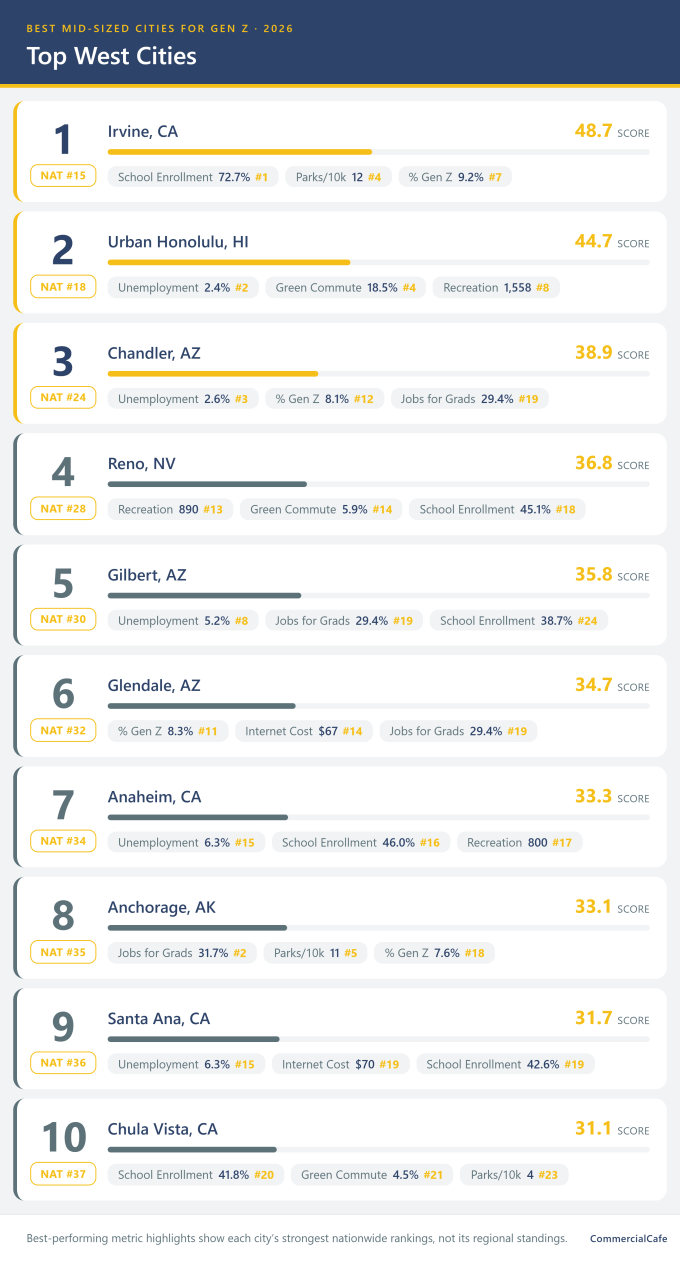
Irvine, Calif., landed at #15, largely because of one standout stat: Almost 73% of everyone aged 20 to 24 living here is in school. That’s higher than anywhere else in our study, even topping heavyweights like Pittsburgh. Most of those numbers come down to UC Irvine. In a city of roughly 318,000 residents, UCI’s 30,000+ undergrads make up a huge chunk of the young population, and nearby schools like Irvine Valley College and Concordia only push that student count higher. All told, 20-to-24-year-olds make up 9.2% of the total population — the biggest Gen Z share in the West.
Out in the Pacific Ocean, Honolulu made the top 20 by beating every other Western city across four key areas — low unemployment; non-car commuting; places to go out and visit; and affordable internet. More precisely, youth unemployment sits at just 2.4% for the second-lowest rate among midsized cities. On top of that, 18.5% of residents commute without a car, placing Honolulu fourth nationally and ahead of every midsized city outside of the Northeast. Then, factor in more than 1,500 spots for food, nightlife, and arts, and the island capital easily stands out as one of the best places for young adults to actually live.
Back on the mainland, three Phoenix suburban cities made the ranking. Arizona’s Chandler, Gilbert and Glendale all landed in the overall ranking from 24th (Chandler) to 32nd (Glendale). Chandler’s young adult unemployment of 2.6% was the third lowest in the study, which is partly due to the growing Price Corridor that’s home to major firms, such as NXP, Intel and Microchip. Similarly, Gilbert’s rate was also comparatively low at 5.2%. Otherwise, Glendale had the largest Gen Z share of the three with the generation making up 8.3% of the population.
Not too far away, Henderson, Nev., was the Western city that was closest to what Americans pay, on average.
And, while it finished 35th overall, Anchorage, Alaska, had the region’s most accessible entry-level job market for graduates with 31.7% of working roles suitable for graduates. That’s the best in the West and second nationally, behind only Durham, N.C. Naturally, it’s also a place with plenty of open space that includes a parks-to-10,000-residents ratio of 11.2 — the fifth best nationally and second in the West.
Northeast Cities Take Top Spots for Car-Free Commuting
The Northeast fielded just four entries in our ranking (the fewest of any region), but they all share one major advantage — freedom from car ownership. Namely, Jersey City, N.J.; Newark, N.J.; and Pittsburgh swept the top three spots nationally for non-car commuting with Buffalo, N.Y., coming in sixth.
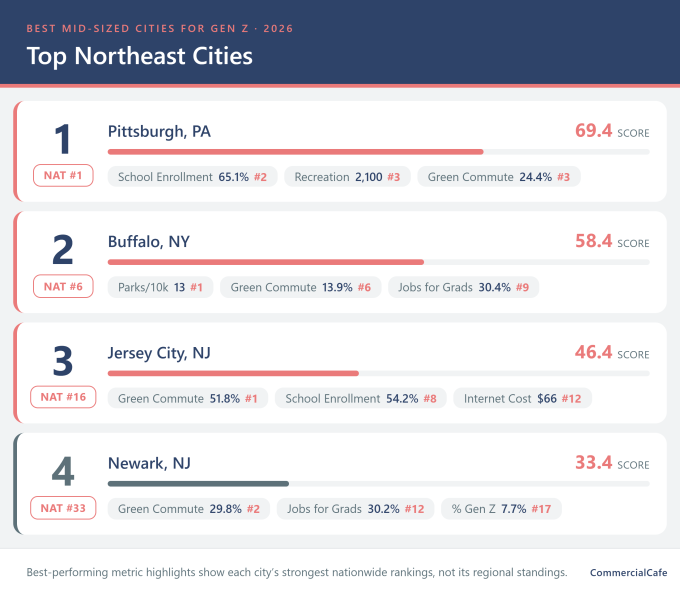
Last, but not least, Jersey City, N.J., (16th overall) took the top spot in the country with 51.8% of residents commuting without a car. With Manhattan, N.Y., just two miles away and comprehensive regional transit, living here puts New York City within easy reach. Newark, N.J., (33rd overall) followed in second place nationally at 29.8%.
Granted, that proximity to Manhattan comes at a price. Living in Jersey City or Newark means taking on a cost of living that’s roughly 12.6% above the national average — a stark contrast to more affordable regional alternatives, like Pittsburgh and Buffalo, N.Y.
Methodology
We ranked midsized U.S. cities with populations between 250,000 and 400,000 residents in which data was available for all metrics. Metrics were selected based on their potential to provide Gen Zers with career opportunities and quality of life, while the population cutoff was chosen to focus on midsized cities that still offer a broad range of options for education, employment and entertainment. Each metric was assigned a weight based on its relevance in determining the overall attractiveness of a city for members of Gen Z.
Gen Z Economic Indicators:
- Affordability Index – A composite index reflecting regional price parities, including goods, housing, utilities and other services. The index is expressed as a number higher or lower than 100, where figures above 100 represent living costs above the national average and figures below 100 represent living costs below it. (15% of the total index.) Source: BEA Real Consumer Spending for 2024. Data is at the metro level and mapped to each city.
- Jobs for Recent Graduates – Share of the employed population currently working in a job requiring a bachelor’s degree, associate’s degree, or vocational training, as well as a considerable amount of work-related skill and knowledge, but no more than four years’ experience. (15% of the total index.) Source: BLS Occupational Employment and Wage Statistics, 2025. Because data for this metric is only available at a metro level, it was mapped to each city based on the metro that it’s part of.
- Unemployment Rate – Unemployment rate among the population aged 20 to 24. (5% of the total index.) Source: U.S. Census Bureau, 2024 1-Year S2301 Table.
Share of Gen Z Residents: The percentage of the population aged 20 to 24 in each city in 2024. (15% of the total index.) Census provides population data in age groups spanning five years each. The age range was chosen to be illustrative of a city’s population of adult Generation Z members as a community while not overlapping with other age groups. Source: U.S. Census Bureau, 2024 1-Year S0101 Table.
Gen Z Educational Enrollment: The percentage of the population aged 20 to 24 enrolled in a form of education as of 2024. (15% of the total index.) Source: U.S. Census Bureau, 2024 1-Year S1401 Table.
Internet Cost: The price of internet by city with connection speeds of at least 60 Mbps for unlimited data. (10% of the total index.) Source: Numbeo.
Things to Do: The number of establishments for recreation, arts and sports, including performing arts; spectator sports; museums, historical sites and similar institutions; amusement parks and arcades; other amusement and recreation; drinking places (bars); and restaurants and other eating places. (10% of the total index.) Source: County Business Patterns 2023 of the U.S. Census Bureau. Data for this indicator is available at a ZIP code level. The number of establishments within a city is the sum of the establishments in all of its associated ZIP codes.
Green Category:
- Green Commuting – The combined percentage of public transportation, walking and cycling as a means to travel to work for each city in 2024. (10% of the total index.) Source: U.S. Census Bureau, 2024 1-Year S0801 Table.
- Number of parks per 10,000 residents. (5% of the total index.) Source: Trust for Public Land 2026 park data. For Honolulu, the metric was taken from TPL City Park Facts as the city was not included in the 2026 ParkServe dataset.



Matthew Preston
Content Writer, CRE News & Market Analysis
Matthew has covered commercial real estate for CommercialCafe since 2022. He focuses on the office and industrial sectors, reporting on leasing, development, and investment across national markets and individual submarkets. His work draws on data and original research. He also writes about demographic shifts and urban innovation in U.S. cities. The New York Times, The Real Deal, Bisnow, The Business Journals, and Yahoo Finance have cited his reporting.