


Moving a business is a logistics project stacked on top of running the business itself. Your team keeps serving customers while you plan the move around them, and neither one pauses for the other. How early and how thoroughly you plan is what decides whether the move barely registers or costs you lost mail, downtime, and customers who cannot find you.
Whatever is prompting your move, more room, a smaller footprint for a hybrid team, a better location, or a lease running out, it is worth treating as a project with its own plan rather than something squeezed in around everything else. This guide covers the move itself, not where to go. If that part is still open, choosing the right office location and finding the space that fits your team come first.
Key Takeaways
- ▪Start early. A smooth move usually begins three to six months out, mostly because of lease notice periods and IT lead times.
- ▪Read your current lease first. Notice requirements, early-termination fees, and restoration clauses can cost real money if you miss them.
- ▪Build the timeline backward from your move date, and put one person in charge of the whole thing.
- ▪Update your address everywhere, not just the obvious places. Licenses, insurance, banking, your website, and your Google Business Profile all matter for being found.
- ▪Set up and test IT and internet first at the new site, and move essential equipment last to limit downtime.
- ▪Tell employees, customers, and vendors with enough lead time, and keep the message consistent.
Plan the Move in Phases
Working backward from your move date keeps the whole thing manageable. Here is how the tasks tend to fall across the months leading up to the move.
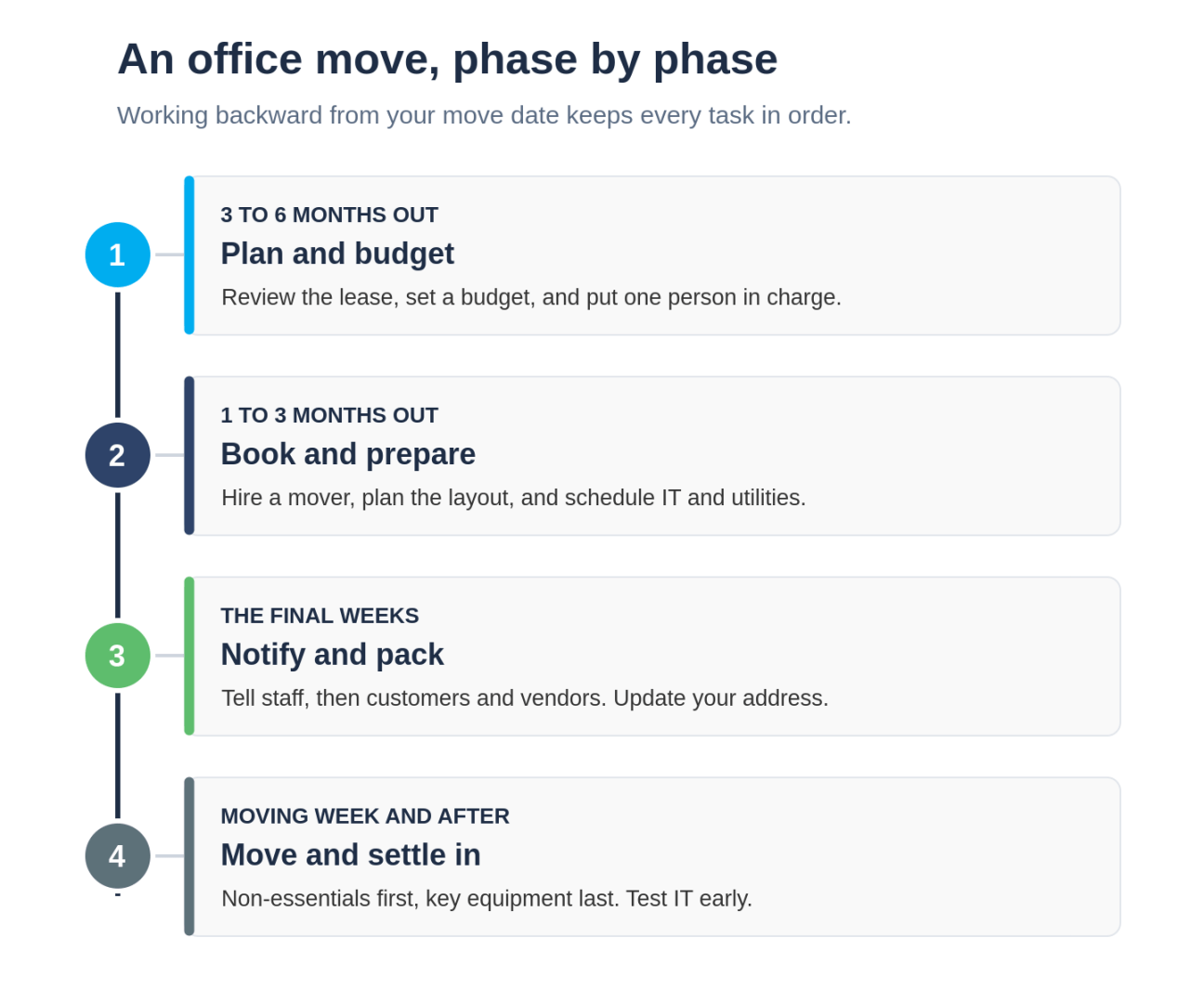 Three to six months out
- Review your current lease for notice, fees, and restoration clauses.
- Set a budget and build a timeline from the move date backward.
- Appoint one person to own the move, and decide what to keep versus purge.
One to three months out
- Book a commercial mover experienced with office furniture and IT.
- Plan the new floor plan, assign desks, and order any new furniture.
- Schedule IT, internet, and utilities at the new site; inventory and photograph equipment.
The final weeks
- Notify employees, then customers and vendors, with a clear, consistent message.
- Update your address everywhere: licenses, permits, insurance, banking, website, listings, and Google Business Profile.
- Pack and label boxes by contents and destination; confirm utility start and stop dates.
Moving week and after
- Move non-essential items first and essential equipment last to limit downtime.
- Set up and test IT and internet before anyone needs to work.
- Walk through the old space, clean and photograph it if the lease requires, and gather employee feedback.
Start With Your Lease
Before you set a move date, read your current lease closely. Your notice period is what really sets when planning starts, not the date you have in mind. A lease that requires 90 days’ written notice means your clock begins three months before you want to be out, and missing that window can trigger an automatic renewal or a penalty.
Watch for early-termination fees, responsibility for any damage caused during the move, and a restoration or “make-good” clause that requires returning the space to its original condition, which is one of the most commonly overlooked move-out costs. If the lease language is unfamiliar, the different types of commercial leases each split these costs in their own way, and budgeting the new space comes down to how commercial rent is calculated.
Lease terms and their penalties vary widely by agreement and by state, so have a real estate attorney review anything you are unsure of before you commit.
Plan for IT and Address Updates Early
Two things derail more moves than anything else, and both have long lead times. The first is technology. Internet installation and IT setup at a new location can take weeks to schedule, and it is not a task you can speed up at the last minute the way you can with packing. Book it first, before anything else on the calendar, and test everything before move day.
The second is your address. Update it everywhere it appears, including business licenses and permits, insurance and banking, your website and email signatures, online listings, and especially your Google Business Profile, which is what local customers rely on to find you. An address that is wrong or missing online quietly costs you business in the weeks after a move.
Communicate the Move
Tell your employees first, and give them enough time to adjust, ask questions, and plan their own commutes. A walkthrough of the new space before move day helps ease the transition.
Then let customers and vendors know, well ahead of the date, through the channels they already use. Keep the message consistent and frame it around what the move means for them, whether that is more capacity, a better location, or simply a clear note of your new address and reopening date.
Moving Day and After
On the day itself, the order of operations protects your uptime: non-essential items go first, and the equipment your business runs on, computers and phones, goes last and gets reconnected first at the new site.
Once you are in, confirm the new address is live across every platform, close out the old space according to your lease, and check in with your team on what is and is not working in the new setup. Handled this way, a move settles into routine within a few weeks, and the planning you did up front is what makes that happen.
Frequently Asked Questions
How far in advance should you plan an office move?
Ideally three to six months, driven mainly by your lease’s notice period and the lead time to set up IT and internet at the new space.
What should you check in your lease before moving?
The notice period for leaving, any early-termination fees, who covers move-related damage, and any restoration clause that requires returning the space to its original condition.
Who do you need to notify when relocating a business?
Employees first, then customers and vendors, plus updates to licenses and permits, insurance, banking, the post office, your website, listings, and your Google Business Profile.
How do you minimize downtime during a business move?
Move non-essential items first and essential equipment like computers and phones last, and set up and test IT and internet at the new location before anyone needs to work there.
Should you hire a commercial moving company?
For most offices, yes. Commercial movers understand how to disassemble and reassemble office furniture and handle IT equipment, which a residential mover may not.



Matthew Preston
Content Writer, CRE News & Market Analysis
Matthew has covered commercial real estate for CommercialCafe since 2022. He focuses on the office and industrial sectors, reporting on leasing, development, and investment across national markets and individual submarkets. His work draws on data and original research. He also writes about demographic shifts and urban innovation in U.S. cities. The New York Times, The Real Deal, Bisnow, The Business Journals, and Yahoo Finance have cited his reporting.