STEM Student Density & Talent Inflows Propel Ann Arbor to Top of Midwest Innovation Rankings


Once defined by their academic institutions or industrial pasts, cities throughout the Midwest are turning those foundations into credible tech economies. Ann Arbor, Mich., convinced semiconductor giant KLA to establish its U.S. headquarters there. Chicago is building out quantum computing capacity. Newer centers like Fargo, N.D., are pulling in both innovative enterprises and the talent they need.
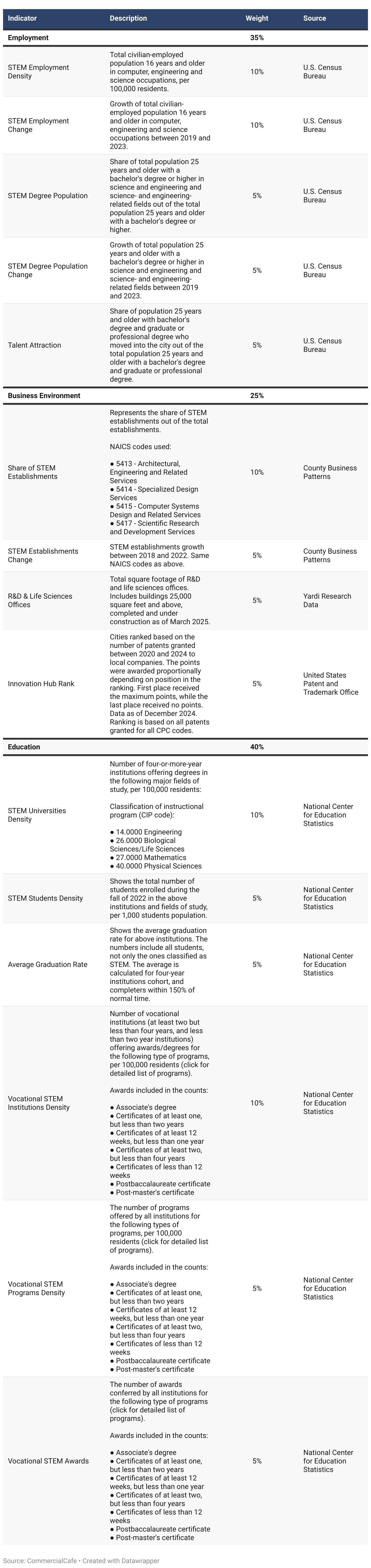
Having previously looked at emerging innovation centers across the South, we now turn to hubs across the Midwest. These rankings draw on 15 indicators across three categories: employment, business environment and education.
Here are some of the findings:
- Ann Arbor, Mich., tops the overall ranking, buoyed by high graduation rates, strong talent inflows and the region’s densest share of STEM students.
- STEM job concentration is highest in Madison, Wis., which also hosts 2.3 million square feet of combined R&D and life sciences, the largest footprint in the region.
- Indianapolis awarded more vocational STEM credentials than any other Midwest city in 2023, totaling 5,697.
- Fargo, N.D., doubled its STEM employment between 2019 and 2023.
- Dayton, Ohio, leads on STEM program density at 87 vocational programs per 100,000 residents.
- From 2020 to 2024, Cincinnati generated 3,121 patents, third behind Minneapolis at 3,956 and Chicago, which led by a wide margin at 10,861.
Keep reading for the full top 20, along with a breakdown of each city’s performance across key metrics. For details on methodology, sourcing and scoring, see the final section of the report.
STEM Talent, a 92% Graduation Rate and the Highest Share of Inbound Movers Secure Ann Arbor, Mich.’s Top Spot
One pattern emerges from the top 20: No single state or corridor dominates. Innovation talent is showing up across the region in cities of different sizes, with different strengths. Even so, one city stood out.
Ann Arbor, Mich., led the region with a strong across-the-board performance, ranking first in education, second in business activity and third in employment. It also topped four individual metrics across these categories. The University of Michigan’s influence is unmistakable: a 92% STEM graduation rate, and a STEM student density of 229 per 1,000 students. The city also holds the highest share of STEM degree-holders in the Midwest.
Yet Ann Arbor is no longer just a university town. It now functions as a full-fledged innovation hub, attracting talent from across the country. It ranked first in talent attraction, with 41% of recently relocated STEM graduates choosing to move there.
Madison, Wis., placed second. It led the region in STEM job concentration, with more than one in 10 residents working in the field. Madison also had the largest footprint of R&D and life sciences space in the Midwest at 2.3 million square feet. Other metrics were similarly strong: an 88% graduation rate (second overall), 54.5% STEM degree-holders (third) and top-three placement for vocational STEM awards.
Fargo, N.D., placed third with the steepest growth trajectory. Between 2019 and 2023, STEM employment more than doubled, rising 121.5%, while the share of residents with STEM degrees rose 43%. It also ranked second in STEM student density, supported by the likes of North Dakota State University.
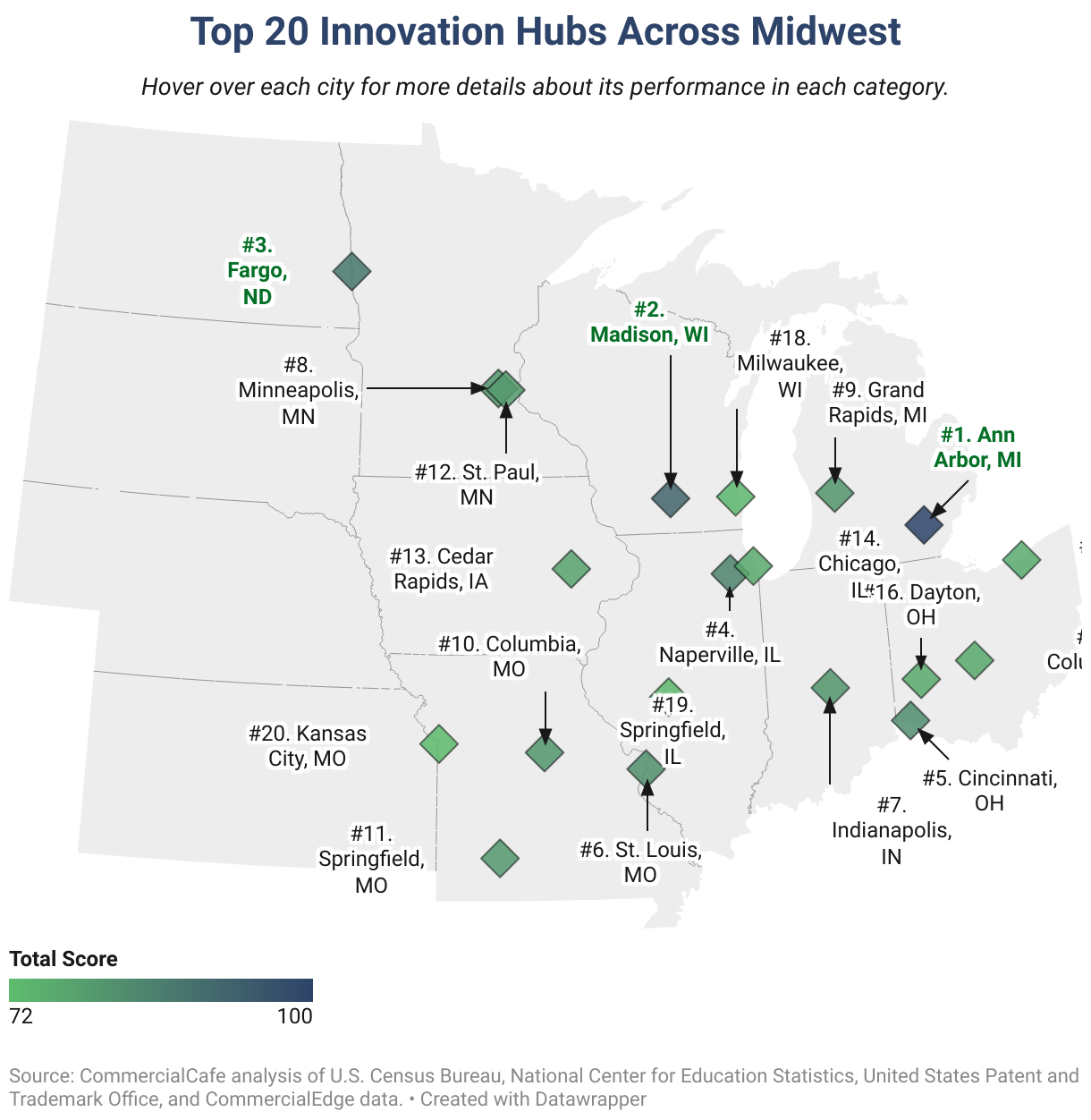
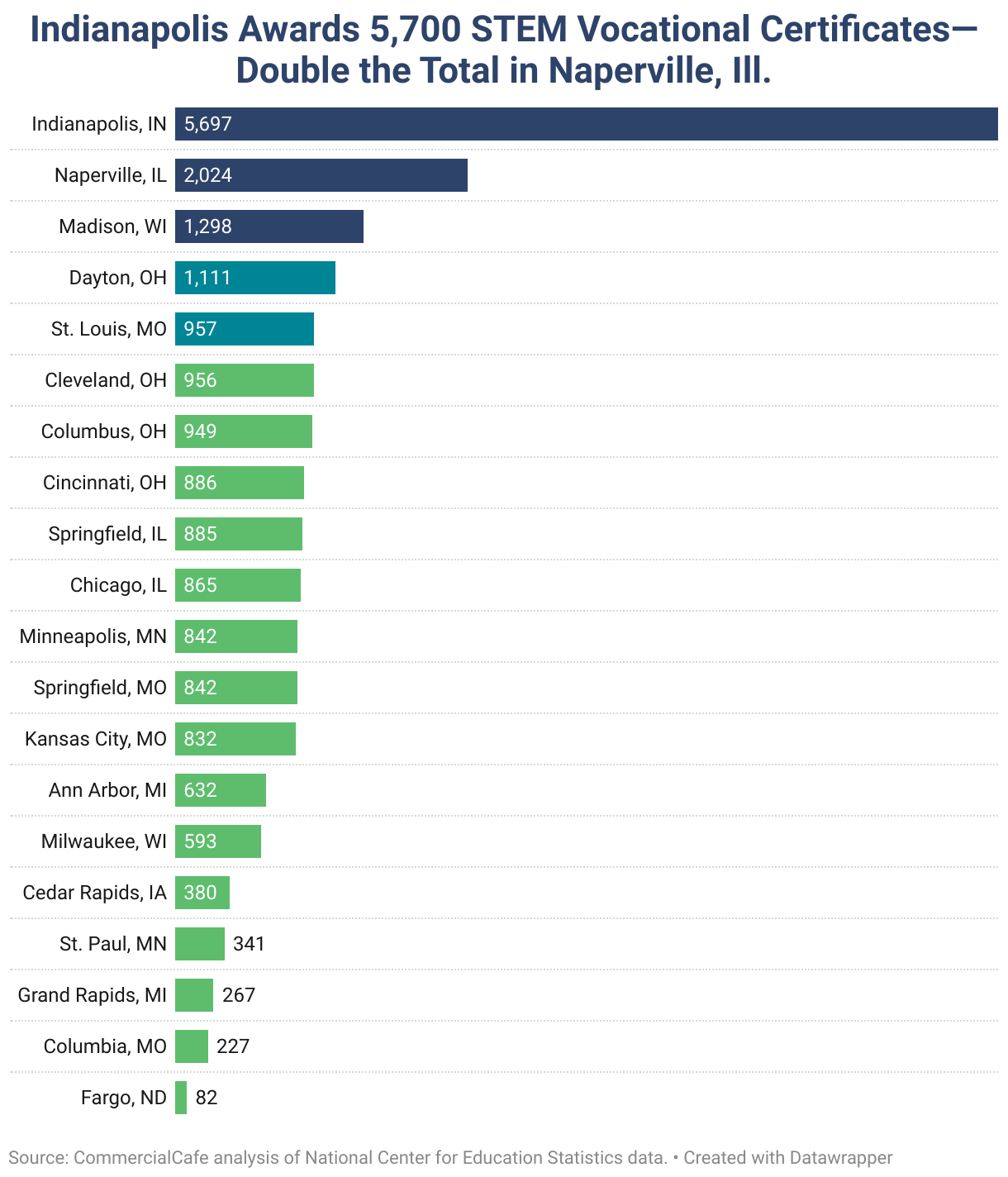
Naperville, Ill., ranks fourth overall, driven by a strong business environment and STEM workforce. It led the region in STEM business density, the only city where more than 10% of businesses operate in the field, and recorded the second-highest share of residents in STEM jobs. While it lacks a major research university, institutions like DeVry University-Illinois helped Naperville issue more than 2,000 vocational STEM awards, the second-highest total in the Midwest.
Cincinnati follows close behind, standing out for its innovation output and technical training. The city recorded 3,121 patents between 2020 and 2024, third highest, and ranked second for vocational STEM institution density.
In sixth, St. Louis placed second in the education index, behind only Ann Arbor, Mich. It also had the highest concentration of universities offering STEM degrees at 3.2 per 100,000 residents, and ranked near the top in other education metrics.
Tied for seventh were Indianapolis and Minneapolis. Indianapolis led the region in total vocational STEM awards, with 5,697 credentials issued in 2023, the highest across all cities studied. Minneapolis posted one of the most balanced profiles in the ranking: While it didn’t top any single metric, it placed just outside the top three for both STEM employment and business share, and posted strong patent numbers.
Grand Rapids, Mich., and Columbia, Mo., round out the top 10. Grand Rapids had the region’s second-fastest STEM business growth rate, while Columbia led the top 20 in that category with a 9% increase between 2018 and 2022. Columbia also scored near the top for STEM employment and degree attainment growth, marking its emergence as a fast-moving innovation hub.
Outside the top 10 but with top individual finishes, Chicago ranked first in patent output, with 10,861 grants between 2020 and 2024. Springfield, Ill., led in vocational institution density, while Dayton, Ohio, ranked highest for STEM program offerings.
Employment (click to expand)
“Brain drain” has long been a topic of discussion when it comes to the Midwest, and it’s true across rural areas and cities alike. However, research from Josie Schafer at the University of Nebraska has found that workers tend to stay where there is job density, not just a single opportunity.
On that front, Madison, Wis., stands out. Of every 100,000 residents, 10,554 are employed in science, technology, engineering or math, the highest STEM concentration in the Midwest and the only city in the region where more than one in 10 people work in these fields. This depth has built up gradually through the University of Wisconsin-Madison and the STEM jobs it helps to produce. UW Health and Epic Systems (a health care software firm founded by UW-Madison alumni four decades ago) now employ more than 10,000 people. Altogether, Madison supports nearly 30,000 STEM jobs, with projections of further growth through the federally backed Wisconsin Biohealth Tech Hub.
Naperville, Ill., is next at 8,881 STEM workers per 100,000, a full 1,500 below Madison but still well above most peers. Although Naperville benefits from its access to Chicago’s labor market, its R&D roots run deep. Companies began forming the I-88 Research Corridor here in the 1960s, and Argonne National Laboratory sits just outside city limits. Today, a diverse mix of innovators such as Endotronix (medical devices) and KeHE Distributors (food logistics technology) is stepping in to carry the corridor’s legacy forward.
Ann Arbor, Mich., also ranked near the top, with 8,393 of every 100,000 residents in STEM roles. KLA’s 600-person semiconductor R&D site, which opened in 2021, brings a roster of talented workers that keeps growing, and Toyota and Hyundai maintain engineering centers nearby. Cybersecurity firms like Duo, along with biotech startups and cloud software providers, also call Ann Arbor home.
Fargo, N.D., posted the fastest STEM job growth in the region between 2019 and 2023, a 121.5% increase that more than doubled its technical workforce. Biotech firm Aldevron played a central role, expanding from roughly 60 positions to several hundred as it ramped up RNA and gene-editing operations. Microsoft’s long-established enterprise software campus provided stability and scale, while agtech company Bushel grew its development team following a major funding round.
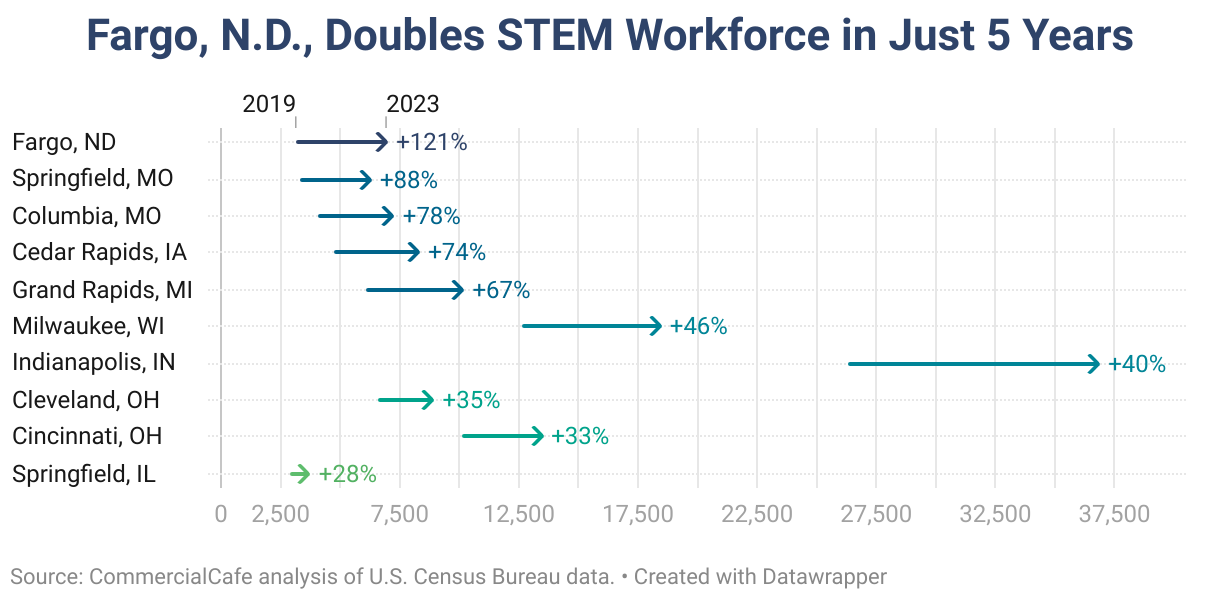
Missouri placed two cities in the top three. Springfield’s STEM jobs rose by 88%, driven by expanding tech roles at CoxHealth and Mercy, alongside support from Missouri State’s eFactory, which has helped launch more than 250 startups.
Further north, Columbia has seen momentum from both major employers and startup activity. IBM and the University of Missouri System, including MU Health Care, help drive the city’s STEM economy. Local firms and university spinouts are also playing a role: Healium, a mindfulness platform, has worked with the MU Medical School and area hospitals on research projects. In April, EquipmentShare opened a $100 million tech center at its Columbia HQ, building on earlier growth and anticipated to add 500 jobs, 400 of which had already been filled at launch.
Just behind Columbia, Cedar Rapids, Iowa, has become one of the Midwest’s most concentrated defense-tech markets. Collins Aerospace remains the city’s largest STEM employer, and in 2021, BAE Systems opened a $139 million R&D facility, bringing 650 high-skill roles in software, engineering and systems integration. This defense-oriented STEM footprint is unmatched by most Midwest peers, with the possible exception of Dayton, Ohio. Cedar Rapids has stronger software integration and engineering talent per capita.
Grand Rapids, Mich., rounded out the group with a 67% increase, growing from 6,000 to more than 10,000 STEM jobs. Growth stemmed from coordinated efforts by Gentex and regional economic development group The Right Place.
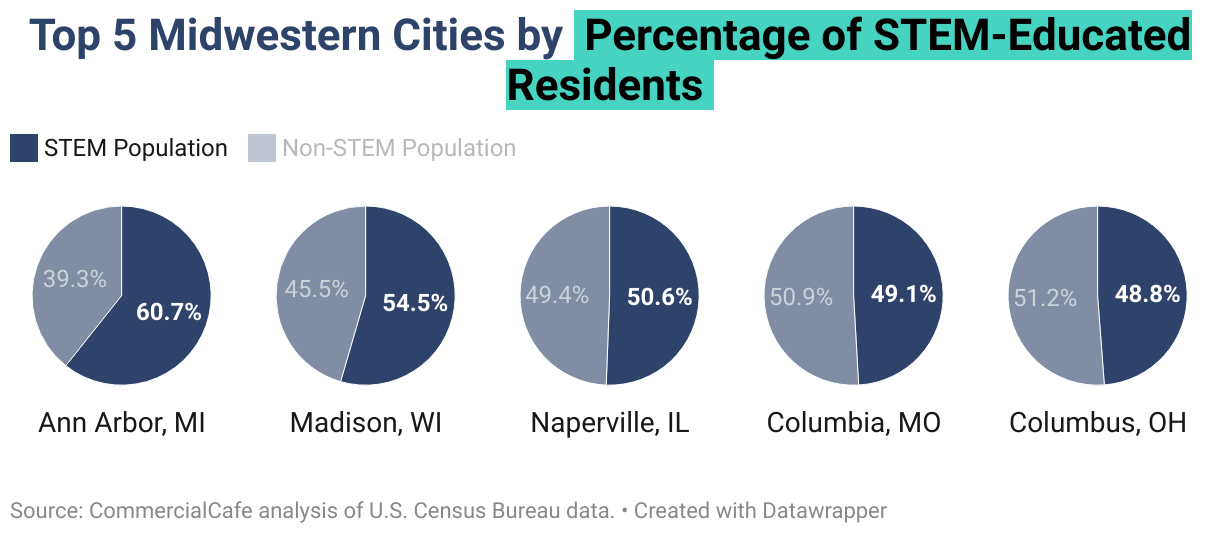
No other city studied has a higher concentration of STEM-educated adults than Ann Arbor, Mich., where 61% of residents older than 25 who hold a bachelor’s degree earned it in a science or engineering field. That works out to more than 32,000 people.
Madison, Wis., follows next at 54.5%, but does so with a larger base overall, totaling 58,000 STEM degree-holders.
Naperville, Ill., claims third place at just over 50%, while Columbia, Mo., and Columbus, Ohio, round out the top five, each finishing just below that threshold. In raw numbers, Columbus has more than 116,000 STEM degree-holders, second only to Chicago.
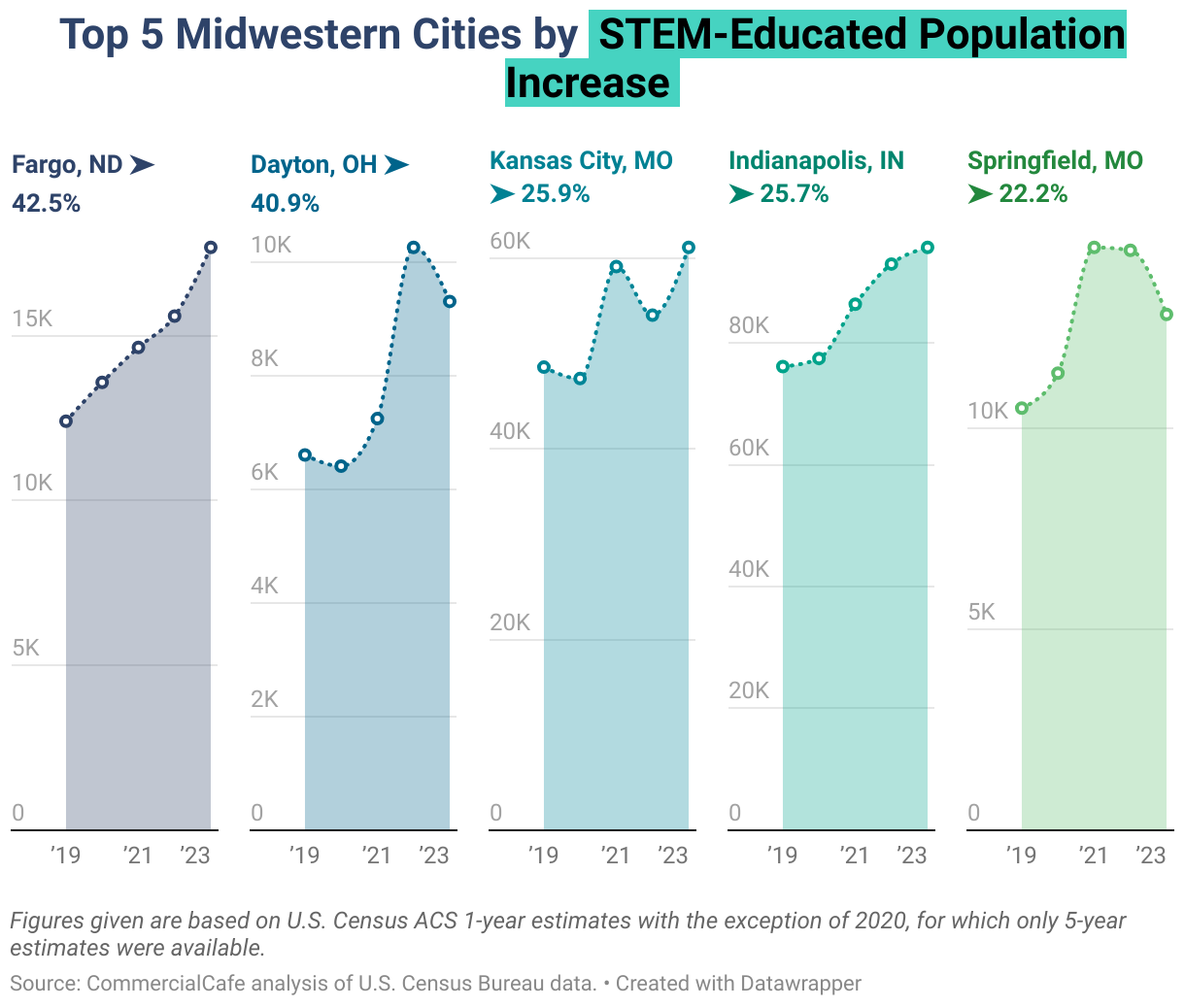
The fastest-growing STEM-educated population belongs to Fargo, N.D.: Between 2019 and 2023, the city saw a 42.5% increase in residents with science or engineering degrees, a top-tier growth rate nationally. Fargo’s climb has been steady, fueled by hiring in health care, software and advanced manufacturing.
Dayton, Ohio, followed closely with a 40.9% increase during the same period. The long-standing presence of Wright-Patterson Air Force Base and the Air Force Research Lab continues to create demand for technical talent.
The STEM talent pool in Kansas City, Mo., expanded nearly 25% in five years. And in Indianapolis, steady annual gains brought the total number of STEM degree-holders to 95,600 by 2023. Springfield, Mo., rounded out the top five with 22% growth.
Among Midwest cities, Ann Arbor, Mich., and Columbus, Ohio, stand out for drawing in highly educated newcomers, and not just because of their major research universities. In both cases, decades of university-led R&D and commercialization have helped grow broader innovation ecosystems that now attract professionals trained elsewhere.
According to the latest data, 42% of Ann Arbor’s college-educated residents moved to the city recently, the highest share among the ranked cities. Columbus, Ohio, ranks just behind at 41%, while Columbia, Mo., comes in third at 38%.
While the Midwest hasn’t experienced the same broad, post-2020 migration boom as the South did, more than half of the Midwest’s top 20 cities saw recent arrivals make up 30% to 40% of their college-educated population, evidence that talent is increasingly drawn to cities with dense or growing innovation ecosystems.
Business Environment (click to expand)
Naperville, Ill., leads in STEM business density, with 10.3% of its companies classified in science and engineering sectors. That is the highest share among the region’s top 20 cities, surpassing even much larger metros like Chicago, which ranks fifth on this metric. Altogether, Naperville is home to roughly 600 STEM-focused firms.
Traditionally anchored by corporate campuses along the I-88 corridor, Naperville’s innovation economy has diversified in recent years. The city has seen expansion across advanced manufacturing, life sciences and digital infrastructure. Incubator hub88 (now part of Chicago’s 1871 network) continues to support early-stage companies, while nearby Fermilab remains a global center for particle physics and emerging quantum computing research.
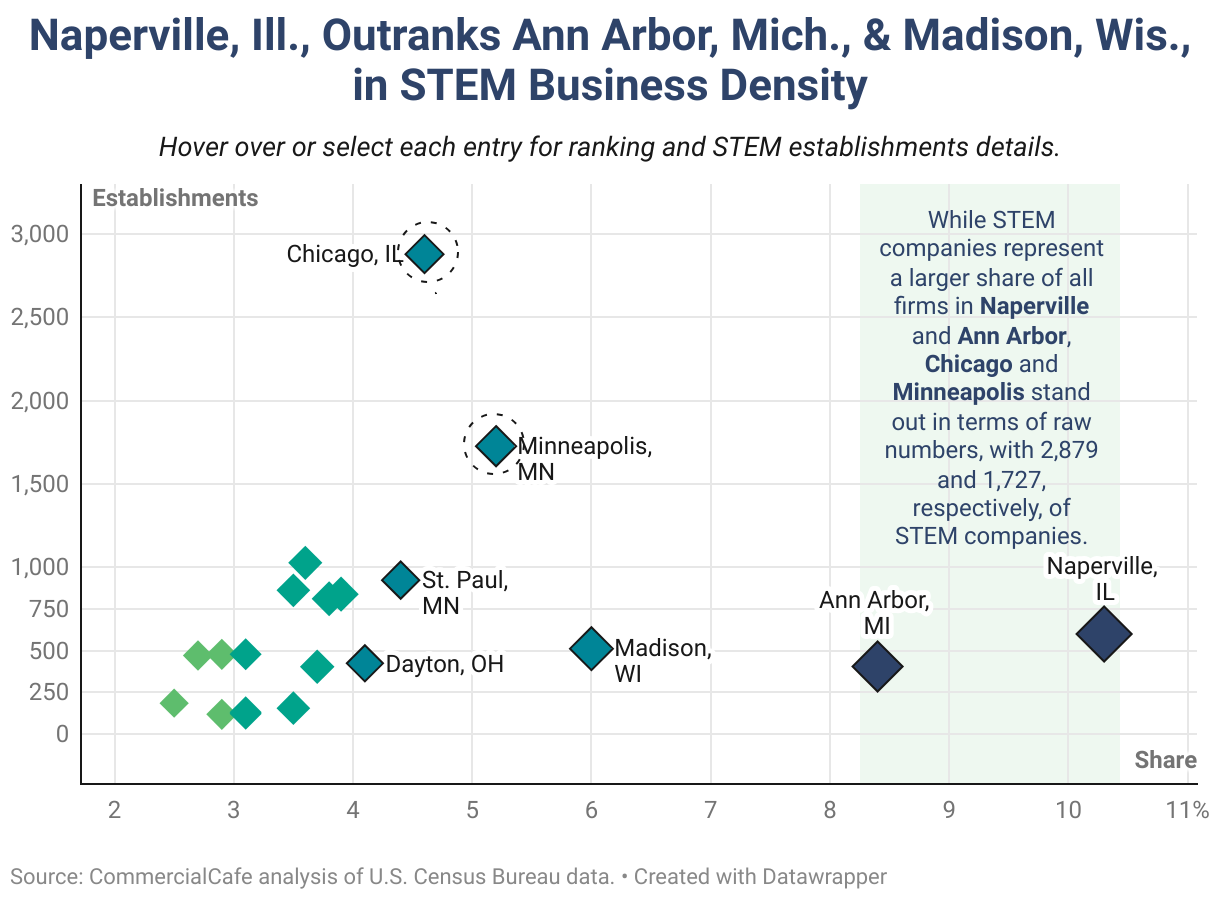
Ann Arbor, Mich., ranks second, with 8.4% of local businesses in STEM fields. Its tech ecosystem now spans cybersecurity, biotech (ONL Therapeutics and Genomenon) and robotics (Refraction AI). Homegrown startups are also scaling: May Mobility, an autonomous vehicle firm with more than 260 employees, has raised $387 million in funding and continues to hire locally.
Madison, Wis., follows with a 6% STEM share and about 500 science and engineering businesses citywide. University Research Park anchors around 100 of these firms, but major employers like biotech giant Promega, founded in 1978, have created today’s robust ecosystem. At the startup level, StartingBlock hosts more than 100 startups and has become a central node for Madison’s entrepreneurial scene.
To the west, Minneapolis came in fourth in density at 5.2%. Even so, it had the second-highest absolute number of STEM businesses among the Midwest cities studied, 1,727 in total, behind only Chicago’s raw total (2,879 for a 5% share of all companies in the Windy City).
As with the STEM-density metric, two cities stand out from the rest. None of the top 20 Midwestern cities saw growth in STEM establishments above 10% between 2018 and 2022, though that may be partly because renewed momentum in STEM sectors postdates our analysis window.
Columbia, Mo., led the list with a 9.2% increase in STEM businesses during the period. The city’s total rose from 119 to 130 firms, not a large base but a meaningful uptick given Columbia’s smaller size. Statewide, more than $50 million in early-stage funding helped fuel activity across biotech, edtech, fintech and AR/VR. In Columbia itself, companies like Nex4 highlight the city’s growing tech mix.
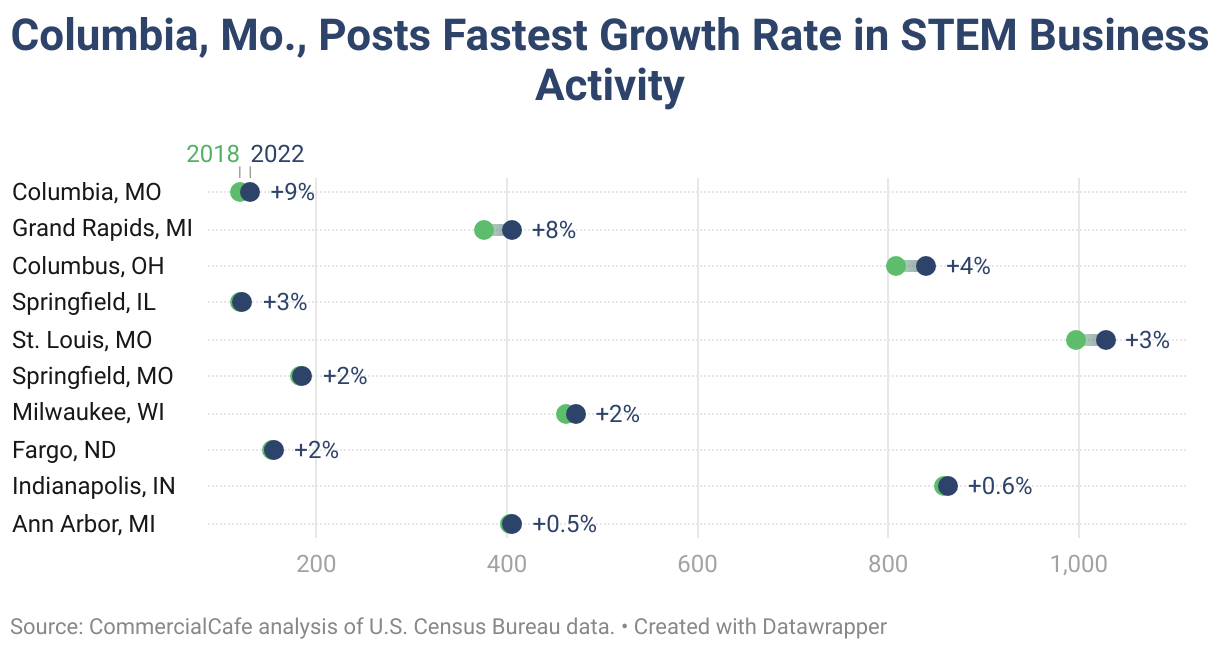
Grand Rapids, Mich., ranked second, posting a 7.7% increase that added around 30 tech-related businesses to the local economy. Standout firms that launched or expanded during that period include BAMF Health, CertifID, Claira, The Patient Co. and WedgeHR. Last year, growing ticketing platform Ludus chose Grand Rapids for its new headquarters, beating out larger markets like Austin, Texas, and Chicago.
From there, the numbers drop off. Cities like Columbus, Ohio (4%), in third place, added around 30 STEM firms. That said, 11 of the 20 cities on our list saw a net decline in STEM business counts during the five-year period. Many of those same cities posted strong gains in STEM employment, suggesting that while company formation may have slowed, hiring still grew.
Madison, Wis., tops the Midwest for life sciences and R&D space, with roughly 2.3 million square feet either completed or under construction as of March 2025. The city’s research footprint has grown steadily in recent years, anchored by the University of Wisconsin-Madison and a maturing biohealth sector. In 2019, Exact Sciences helped set the pace with a 169,000-square-foot clinical lab, followed by Element Labs’ 151,000-square-foot startup facility at University Research Park, which opened in 2024. Fujifilm Cellular Dynamics is now building a new, 138,000-square-foot headquarters across town, aiming to double its local workforce by the end of the decade.
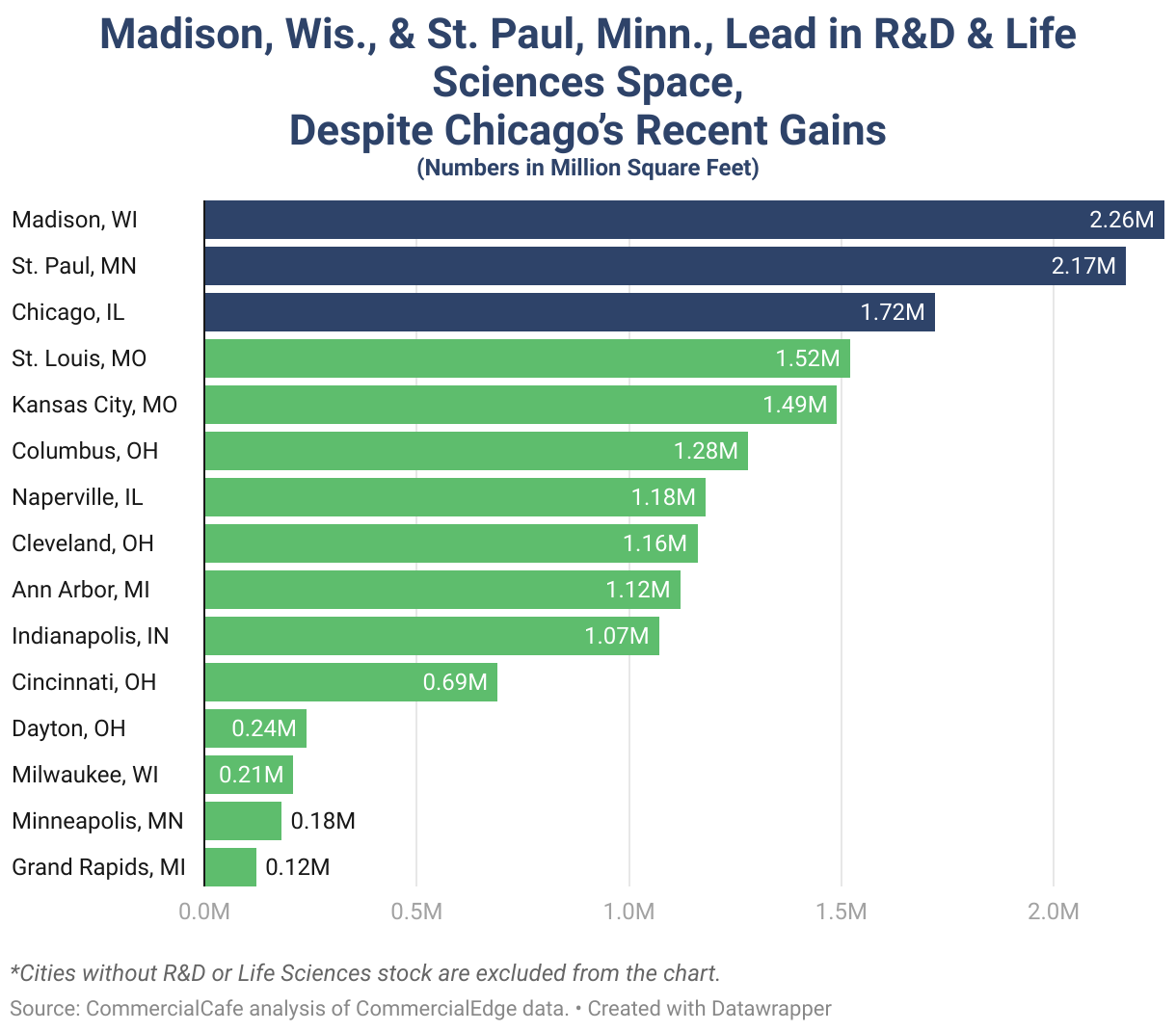
Further west, most of St. Paul, Minn.’s 2.2 million square feet is tied to long-standing institutional players. Boston Scientific’s Arden Hills campus accounts for more than half of the total at 1.14 million square feet, where the company developed its Watchman heart device. 3M’s Building 280, opened in 2015, adds another 460,000 square feet and houses around 700 researchers across disciplines.
Chicago comes in third at 1.7 million square feet, although its recent activity has outpaced the rest of the region. Since 2020, the city has added more than 1 million square feet across three new facilities, including two Fulton Labs buildings in West Fulton and a life sciences project at 1229 W. Concord in Lincoln Yards. On the South Side, Hyde Park Labs is under construction at 5217 S. Harper Ave., adding 300,000 square feet to the University of Chicago’s innovation footprint. It is anticipated to deliver by mid-2025.
St. Louis sits just behind, with 1.5 million square feet of life sciences and R&D space. The standout is the 609,000-square-foot Jeffrey T. Fort Neuroscience Research Building, completed in 2023 by Washington University School of Medicine. Located in the Cortex Innovation District, it is one of the largest life sciences facilities completed in the Midwest in recent years.
Kansas City, Mo., rounds out the top five at 1.49 million square feet. The largest single contributor remains Oracle’s 805,000-square-foot R&D campus, delivered in 2017.
Chicago took the lead in Midwest patent production, logging 10,861 patents granted between 2020 and 2024. The city’s scale in this category is no surprise. A deep network of research universities, Fortune 500 R&D centers and intellectual property infrastructure has long made it the region’s anchor for innovation output.
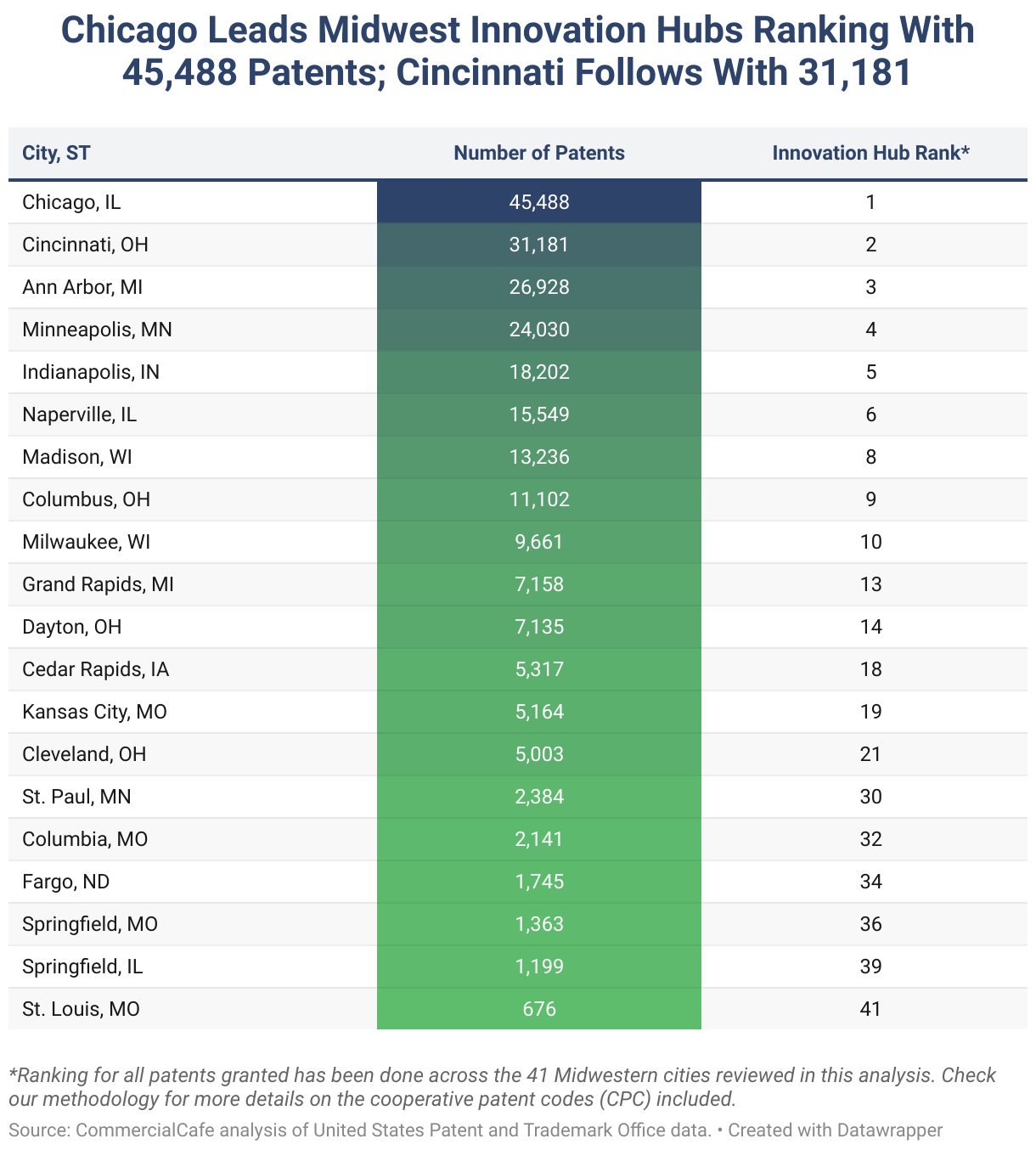
In second place was Minneapolis, albeit a fair distance from Chicago, with nearly 4,000 patents. More notable, perhaps, is who came next: Cincinnati ranked third with 3,121 patents granted, well ahead of larger peers like Indianapolis. The University of Cincinnati has played a central role, nearly doubling its patent output in recent years. Expanded research funding, a revamped tech transfer office and deeper corporate ties (particularly with Procter & Gamble, Microsoft and Kroger) have sharpened the city’s ability to turn academic research into market-ready technologies. Many of those partnerships are housed at the university’s 1819 Innovation Hub, now a core piece of Cincinnati’s innovation infrastructure.
Education (click to expand)
According to the most recently available data from the National Center for Education Statistics (NCES), for every 100,000 residents in St. Louis, there are 3.2 four-year institutions offering degrees in engineering, life sciences, mathematics or physics. Springfield, Mo., follows with 2.9, finishing ahead of St. Paul, Minn., and Columbia, Mo., and putting Missouri in three of the top four spots.
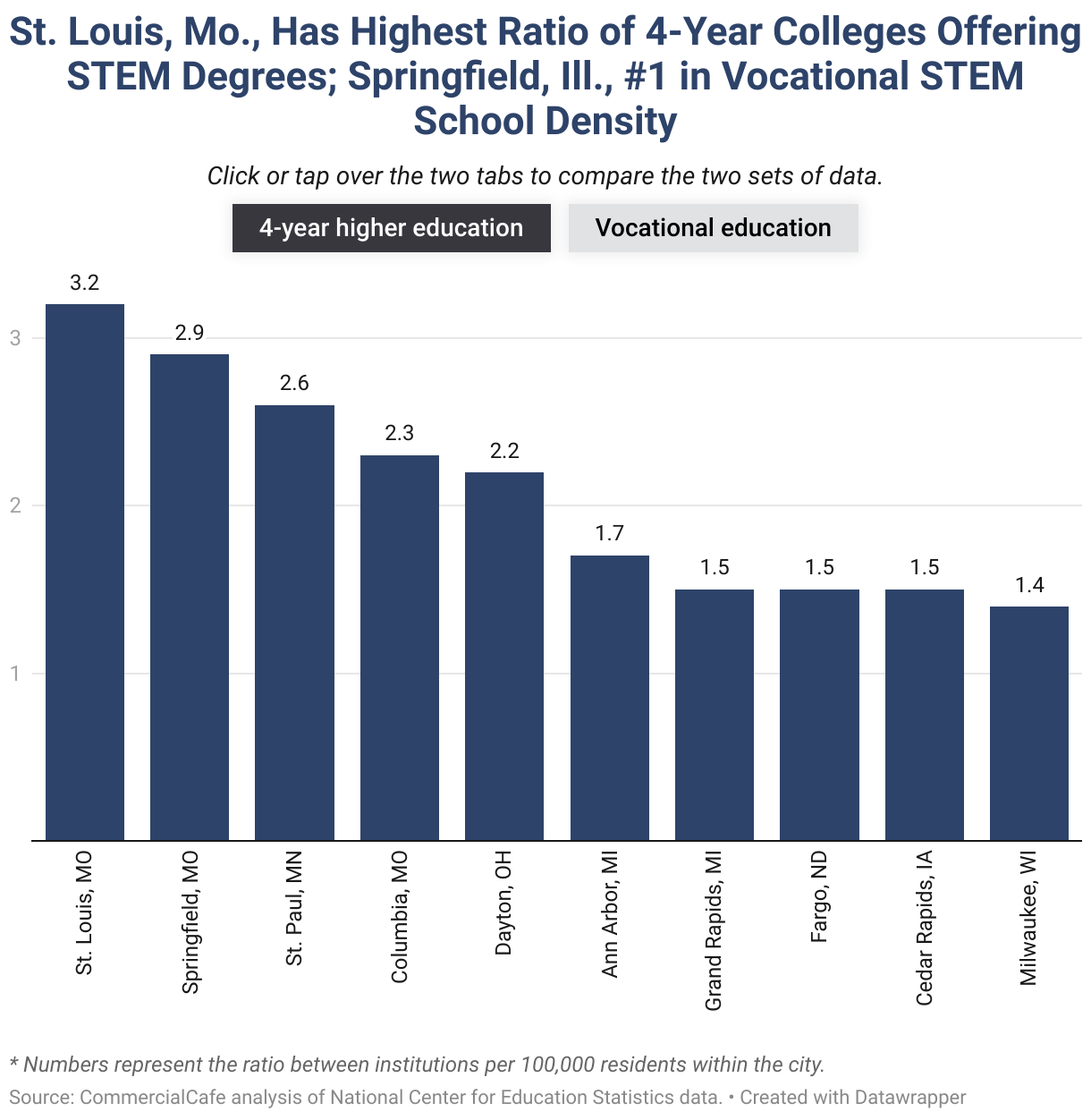
We also looked at vocational providers offering STEM-aligned programs, a category that includes health care, IT, advanced manufacturing and skilled trades. Because vocational programs often serve adult learners, we used per-resident (not per-student) figures to show where the deepest technical pipelines are.
Springfield, Ill., ranked first with 1.8 such institutions per 100,000 residents. Cincinnati came in second, adding to its strong showing across education metrics.
These programs have become an increasingly important on-ramp into the tech workforce, especially as students weigh faster, lower-cost alternatives to four-year degrees. In places like Springfield, Ill., and Cincinnati, it isn’t just about headcount. It’s coordination.
Springfield’s Lincoln Land Community College runs short-term training programs backed by state workforce grants and maintains close ties with public-sector employers. In Cincinnati, co-op programs, union apprenticeships and tech transfer pipelines all plug into a broader system that starts in high school and extends through adult reentry and upskilling.
The Midwest’s strongest talent pipelines often start in the classroom, and in a few cities, STEM students make up a striking share of the college population. Nowhere is that more true than in Ann Arbor, Mich., where 229 out of every 1,000 students are enrolled in science or engineering programs. The University of Michigan drives much of that. Its computer science and engineering departments rank among the best in the country, and in 2023 alone, the school awarded more than 1,200 degrees in computing fields. That scale of output, paired with a high graduate retention rate, helps sustain a steady stream of talent for local and national employers.
Fargo, N.D., isn’t far behind at 217 STEM students per 1,000 enrolled. Here again, North Dakota State’s programs are deeply tied to the region’s economy, from biosystems and ag tech to computer science. A 2022 NSF grant of $1.4 million helped expand student research in the life sciences, and demand from firms like Microsoft’s Fargo campus has kept enrollment strong. The result is a homegrown workforce aligned with the region’s tech and applied science sectors, one that has grown fast in recent years.
In Madison, Wis., 184 out of every 1,000 college students are pursuing STEM degrees. The University of Wisconsin-Madison has seen continued interest in computer science, now one of its most selective majors. Research in engineering and biosciences remains a core strength, backed by a $1.3 billion research budget and a long track record of public-private collaboration. Local firms like Epic Systems and Exact Sciences offer hands-on internships, while the university continues to enroll large numbers of in-state students, with 3,813 in the 2023 freshman class.
Ann Arbor, Mich., leads the region with a 92% graduation rate for four-year programs, followed by Madison, Wis. (88%), Columbus, Ohio (85.2%), and Minneapolis (80%). At the other end, cities like Springfield (both Illinois and Missouri), Dayton, Ohio, and Naperville, Ill., average closer to 50% to 53%.
Part of that gap comes down to structure. Flagship schools like Michigan (with its $17 billion endowment), Wisconsin and Ohio State are selective, well-funded and built around full-time residential life. They admit students who are more likely to finish, and then give them the support to do it.
Other cities don’t always have that same setup. Wright State in Dayton, Ohio, has a six-year graduation rate of around 44%. Many students commute, attend part-time or balance school with work. Advising is also thinner and funding is tighter. Although the University of Dayton posts stronger outcomes, it draws a smaller, more traditional pool and doesn’t move the city average by much.
After looking at how many vocational institutions operate in each city, this next measure shifts the focus to what they offer: how many of those programs are STEM-focused relative to the local population.
Dayton, Ohio, was well ahead of all cities with 87 STEM vocational programs per 100,000 residents, almost double Madison, Wis. In Dayton, Wright-Patterson Air Force Base and the city’s legacy in aerospace and manufacturing have shaped steady demand for hands-on skills. Community colleges and career tech centers work directly with employers to offer programs in areas like engineering technology, avionics and cybersecurity. At the same time, the city’s older workforce and lower bachelor’s-degree attainment help sustain demand for short, job-focused training that offers a clear path into the workforce.
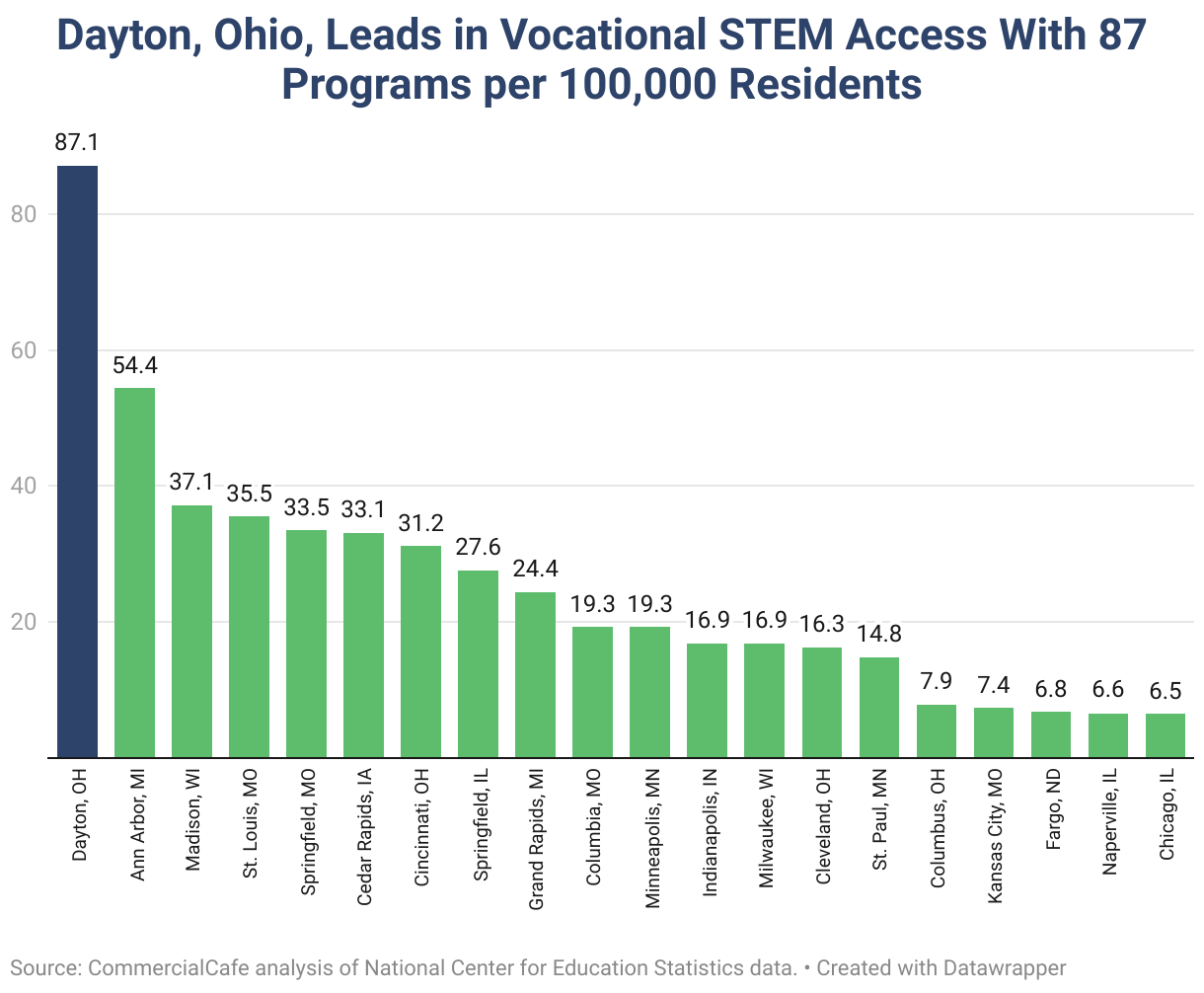
Next is Ann Arbor, Mich., with 54 STEM vocational programs per 100,000 residents. Washtenaw Community College (Michigan’s largest transfer school to the University of Michigan) anchors much of that system. It offers more than 60 programs across advanced manufacturing, IT, cybersecurity, health care and mobility, with around 1,000 students enrolled in STEM-focused tracks at any given time.
Recent state grants totaling nearly $2 million will help WCC expand into semiconductors and battery tech, aligning with Michigan’s broader push into EV and clean-energy industries. Public funding keeps tuition low, while partnerships with local employers support internships, apprenticeships and direct placement. Bridging programs like STEM Scholars and M-STEM Academies further link two- and four-year outcomes.
Indianapolis awarded more vocational STEM degrees and certificates than any other Midwestern city in 2023, roughly 5,700 in total, according to NCES data.
That puts it well ahead of cities like Naperville, Ill. (2,024), Madison, Wis. (1,298), and Dayton, Ohio (1,111), and notably above Chicago, which ranked 10th despite its size.
Methodology



Matthew Preston
Content Writer, CRE News & Market Analysis
Matthew has covered commercial real estate for CommercialCafe since 2022. He focuses on the office and industrial sectors, reporting on leasing, development, and investment across national markets and individual submarkets. His work draws on data and original research. He also writes about demographic shifts and urban innovation in U.S. cities. The New York Times, The Real Deal, Bisnow, The Business Journals, and Yahoo Finance have cited his reporting.