
Santa Clara, Berkeley & Tempe Lead Among Western Innovation Hubs


In 1968, when Doug Engelbart, an engineer at the Stanford Research Institute, took the stage at a computer conference in San Francisco, the region that would become Silicon Valley was still undefined.
At the time, most engineers were working on defense systems, but Engelbart had something else in mind. He argued that computers didn’t have to be military tools — instead, they could help us think better. His demo introduced the mouse, hyperlinks and real-time collaboration. The goal was to make people smarter.
Innovation in the West has never been tightly managed and it’s more corporate now — thanks, in part, to those early breakthroughs. However, the 1968 setting is a reminder: We don’t always see the next turning point as it’s happening.
Today, Silicon Valley contains more market value than most countries. But, the spirit of invention has taken hold elsewhere, too, such as in cities like Bend, Ore., as well as in more developed hubs, like Tempe, Ariz., or Salt Lake City.
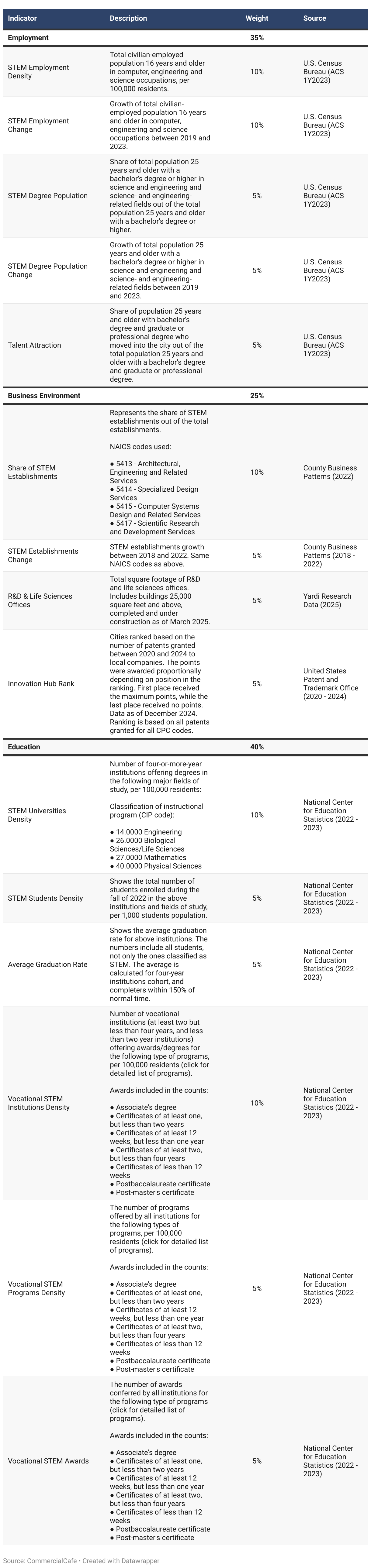
With that in mind, this report ranks the 20 most innovation-dense cities in the West based on 15 indicators across employment and talent; education; and business activity.
Some standout findings:
- Santa Clara, Calif., took the top spot overall, with leading scores in STEM employment, degree attainment, and talent attraction.
- Tempe, Ariz., ranked first in education, home to the highest density of vocational STEM schools
- In Fremont, Calif., science, engineering, and tech firms accounted for 14% of all businesses — the highest STEM share among all cities analyzed
- Since 2020, San Jose, Calif., has logged almost 28,000 patents, far surpassing any other city in the ranking
- Boulder, Colo., leads in STEM student density, with 253 out of every 1,000 students enrolled in a STEM program
- Salem, Ore., posted the fastest STEM job growth — up 158% from 2019 to 2023
- San Diego and San Jose, Calif., dominate in R&D and life sciences space, each with roughly 16.5 million square feet completed or under construction
Keep reading for more top 20 highlights, along with a breakdown of which cities did best across the individual metrics. For definitions, sourcing, and point allocation, see our methodology section.
STEM Talent Density & Strong Education Pipelines Set Santa Clara, Berkeley & Tempe Apart
Several top-ranked cities are located in established tech corridors along the coast, where spillover has helped places like the Bay Area and greater Seattle support multiple cities with dense innovation infrastructure — including talent. Even so, inland cities made a strong showing, too. Namely, Tempe, Ariz., and Salt Lake City stood out for their vocational education systems and ability to attract talent with Tempe landing at #3 overall.
And, while California’s Bay Area cities were expected to perform well, it was two of the region’s more modestly sized cities — Santa Clara and Berkeley — that rose to the top. Their rankings reflect the study’s emphasis on density across talent, business presence and educational infrastructure.
In first place, Santa Clara, Calif., stood out for the depth of its STEM workforce and the strength of its business base. Here, more than 20,000 out of every 100,000 residents work in science or engineering — the highest share in the study. Nearly 70% of local degree-holders studied in those fields.
The city also ranked first for talent attraction, which measures the share of newcomers older than age 25 with at least a bachelor’s degree. At the same time, about 14% of local firms are science- or tech-focused (second only to one other city). And, while its education scores were more middle of the pack, Santa Clara still placed third for both vocational STEM institution density and graduation rate.
Next, runner-up Berkeley, Calif., leaned heavily on the education side: About 231 out of every 1,000 students are enrolled in STEM programs — the second-highest share among the top 20 cities. It also tied for the highest graduation rate at 94% and had the second-most STEM-focused universities per capita.
Of course, UC Berkeley plays a big part in that, not just as a top-tier research institution, but as a consistent source of technical talent. The city also landed in the top five for both STEM business share and growth — showing how its academic base feeds directly into the local economy.
In third, Tempe, Ariz., led all cities outside of California. In fact, it topped the education category overall, thanks to standout scores in vocational training — first in vocational STEM institution density, second in programs offered and second in awards granted. Tempe also ranked third for talent attraction, pointing to strong academic and technical pipelines, as well as the ability to bring in skilled newcomers.
Further inland, Salt Lake City proved to be a consistent performer across metrics. Specifically, the city led in the density of vocational STEM programs and ranked among the top three for both university STEM institution density and talent attraction, indicating a strong foundation for long-term workforce development.
Rounding out the top five was Fremont, Calif., located between San Jose and Berkeley. This city had the highest share of STEM-related businesses in the ranking with about 14% of firms operating in science or tech. Fremont also ranked second for STEM degree attainment and third for STEM employment density with 17,235 workers per 100,000 residents.
Beyond the top five, several cities led in individual indicators: Pasadena, Calif., (#8) matched Berkeley, Calif., for the highest graduation rate at 94%, while Tacoma, Wash., (#9) recorded the highest per-capita density of institutions offering STEM courses — highlighting its role in the Seattle metro’s educational network.
Not to be outdone, San Diego, in 10th, displayed its biotech strength with the largest total of R&D and life sciences space among all cities analyzed (roughly 16.5 million square feet combined).
Further down the list, San Jose, Calif., (#13) stood out with the most patents granted since 2020. Otherwise, Bend, Ore., posted the fastest growth in STEM businesses in the last five years, while Las Cruces, N.M. (#20), saw a 46% increase in the share of residents holding STEM degrees during the same period.
Employment (click to expand)
With more than one in five (20,354 out of every 100,000 working-age residents) working in science, tech, engineering or math, Santa Clara, Calif., had the highest STEM employment density in the West. Many of them work at global headquarters for firms like Intel and NVIDIA.
Bellevue, Wash., came next with 18,289 STEM workers per 100,000 residents — well ahead of nearby Seattle, which had 14,073. Bellevue’s edge likely stems from spillover demand tied to Amazon, Microsoft and T-Mobile’s headquarters, while Seattle’s total holds weight given its much larger population.
Further down the coast, Fremont, Calif., followed closely with 17,235 STEM workers per 100,000 residents. In this case, the city’s base in advanced manufacturing remains strong (Tesla is a major employer), but firms in biotech, cleantech and precision hardware also contribute to the city’s high ratio.
However, the places seeing the biggest recent gains in STEM employment weren’t necessarily the most established hubs. Namely, Salem, Ore., posted a 158% jump in the share of residents working in STEM between 2019 and 2023. Part of the growth came from Oregon state agencies hiring for roles in cybersecurity, GIS and environmental science. It also followed the opening of Agility Robotics’ factory — the first in the world dedicated to humanoid robots — which is expected to bring around 500 new jobs.
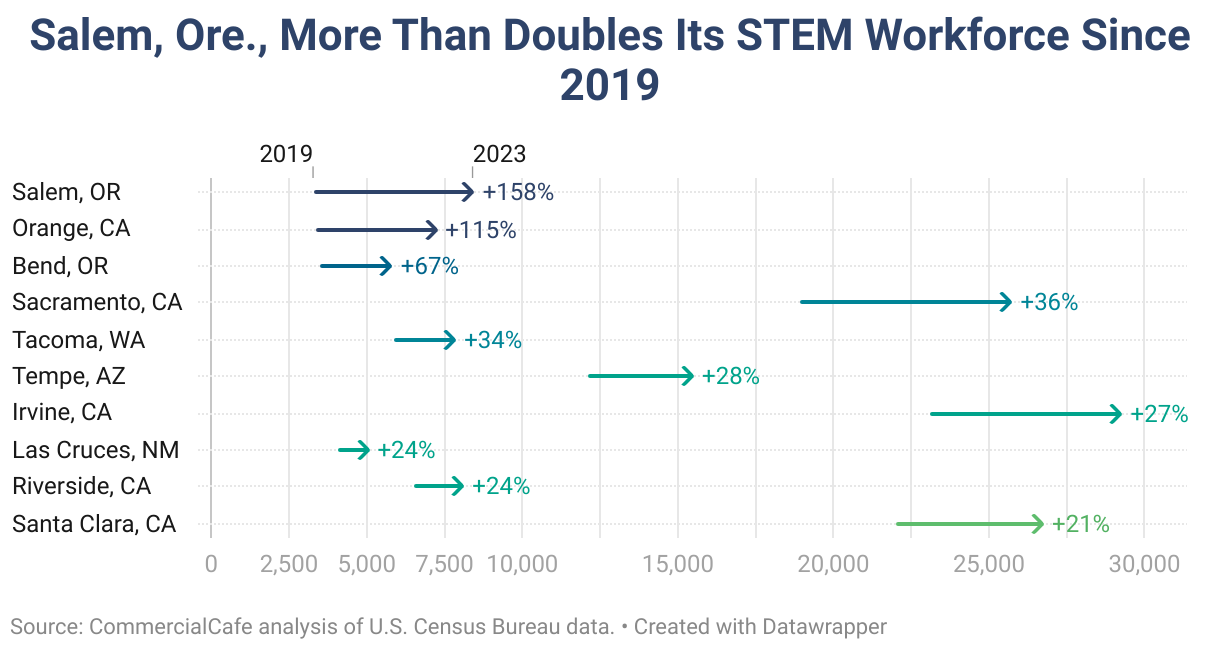
Similarly, Orange, Calif., also saw STEM employment density more than double (up 115%) during the same period. Here, the growth is linked to local anchors like CHOC and Chapman University, which support roles in diagnostics, biotech and data-driven health services.
Meanwhile, in Bend, Ore., STEM job density rose by 67%. That’s because local firms like Tech Soft 3D, Amplion, and Epic expanded during that time, and the Milken Institute now reports that software publishing accounts for 3.5% of the metro’s GDP. Bend also hosts the largest angel investment event in the Pacific Northwest — the Bend Venture Conference.
In no less than 14 of the top 20 cities, according to Census Bureau data, at least half of all residents (age 25 and older) have a bachelor’s degree with a qualification in science or engineering fields.
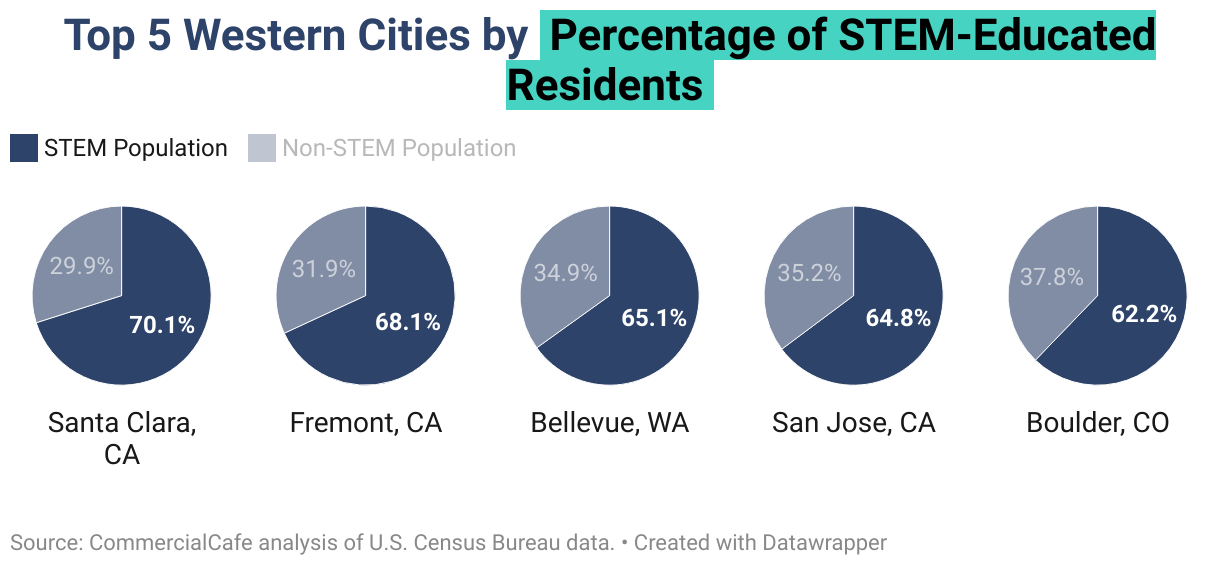
In fact, in Santa Clara, Calif., the share is well above the halfway mark — around 70%, or 44,795 college-educated adults with a STEM degree. Fremont, Calif., wasn’t far behind at 68%, but while the percentage was slightly lower, the raw number was higher with more than 75,000 residents. Bellevue, Wash., and San Jose, Calif., came next, both at roughly 65%.
In fifth, Boulder, Colo., stands out geographically. With 62% of college grads holding STEM degrees, it’s one of the only cities in the top tier that’s outside of California or Washington. As we’ll see later, Boulder also has a high STEM student share, suggesting that a good portion stick around after graduation.
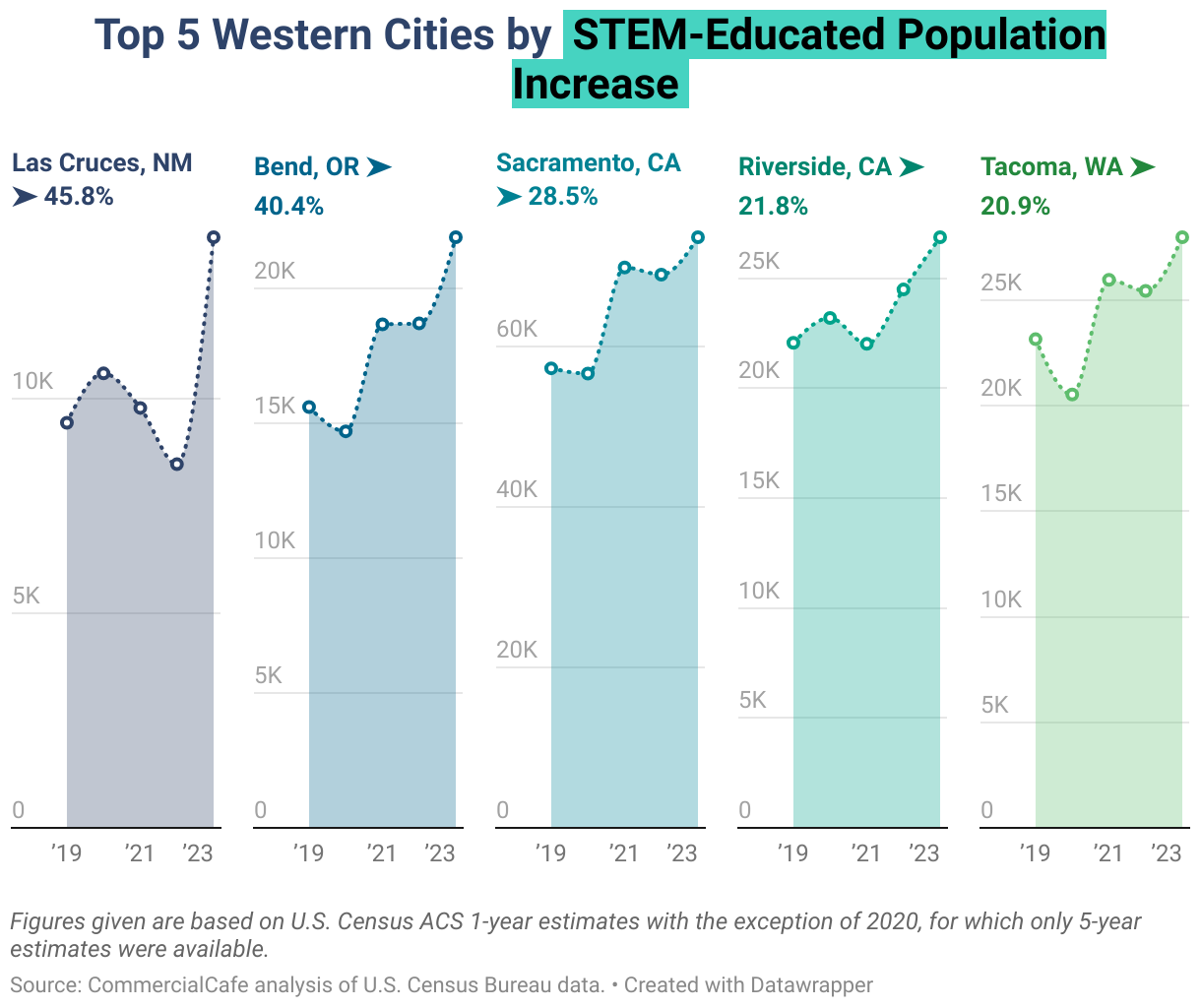
In Las Cruces, N.M., nearly half of college-educated residents older than 25 hold a degree in science or engineering. But, that number has climbed fast: Between 2019 and 2023, the city saw a 46% jump in its STEM-educated population.
One likely factor — the New Mexico Opportunity Scholarship — launched statewide in 2022. The program covers 100% of tuition and required fees at any public college or university in the state. That includes both New Mexico State University and Doña Ana Community College, both of which are based in Las Cruces.
Back in Oregon, Bend now has just more than half of its college-educated adults holding STEM degrees, following a 40% increase during the same period. That tracks with the broader innovation growth in the city, tied to both local industry and OSU-Cascades’ expanding engineering and computer science programs.
Not to be outdone, Sacramento, Calif., saw a 29% gain in its STEM-educated population, landing it third for growth. Farther south, Riverside, Calif., posted a 22% increase. While it still had the lowest overall share of STEM-educated residents among the top 20 cities, that jump marks a strong upward shift.
Keeping talent is one thing with graduates sticking around after school, but drawing it in is a different test. So, using the latest data (2023), we also looked at the share of college-educated residents who recently moved into each city. The metric includes all degrees, not just STEM.
If the assumption is that California leads when it comes to attracting educated newcomers, that didn’t quite hold. Even so, Santa Clara, Calif., did top the list with 44% of college-educated residents having moved there in recent years. That’s no surprise given the job base, but nevertheless a strong showing.
Seattle came next at just more than 40%, ahead of San Francisco; San Diego; and even San Jose, Calif. It’s been a consistent draw for years, and still holds that edge. Salt Lake City followed at 39%, showing it’s more than a lower-cost alternative. As a matter of fact, Adobe, Qualtrics, and others have turned SLC into a real player (with outdoor access still part of the appeal).
Tempe, Ariz., made the top group, as well, with 37% of its college-educated population new to the city. Of course, the university sets a strong foundation, but companies like GoDaddy and First Solar have helped make the case for staying. Rounding out the top tier were Washington’s Bellevue and Tacoma — two more Seattle metro cities demonstrating the region’s continued pull, whether it be for jobs, livability or both.
Business Environment (click to expand)
California’s Fremont and Santa Clara lead the West with science and tech businesses making up about 14% of all establishments in each. Granted, both differ slightly in the local makeup of STEM companies: In Fremont, it’s advanced manufacturing, now built around the Tesla factory. This “lean” may be tied to available space as it’s about four times the size of Santa Clara. Meanwhile, built around chip design and computing, Santa Clara is home to NVIDIA — which is now one of the most valuable companies in the world — and Intel, a fixture of the region’s early semiconductor economy.
Outside the Bay, Boulder, Colo., ranks third at 11%. A university-focused city with strong technical labor, its economy is diverse, but grounded in research. Additionally, Ball Aerospace and Blue Canyon Technologies work on satellite systems and instrumentation, which are often tied to defense or climate monitoring. And, AtomTCAD (a CU Boulder spinout) is developing software that uses AI and quantum physics to simulate heat flow in nanoscale chips. Backed by a $1 million DARPA grant, the company is targeting thermal failure in next-gen chip design.
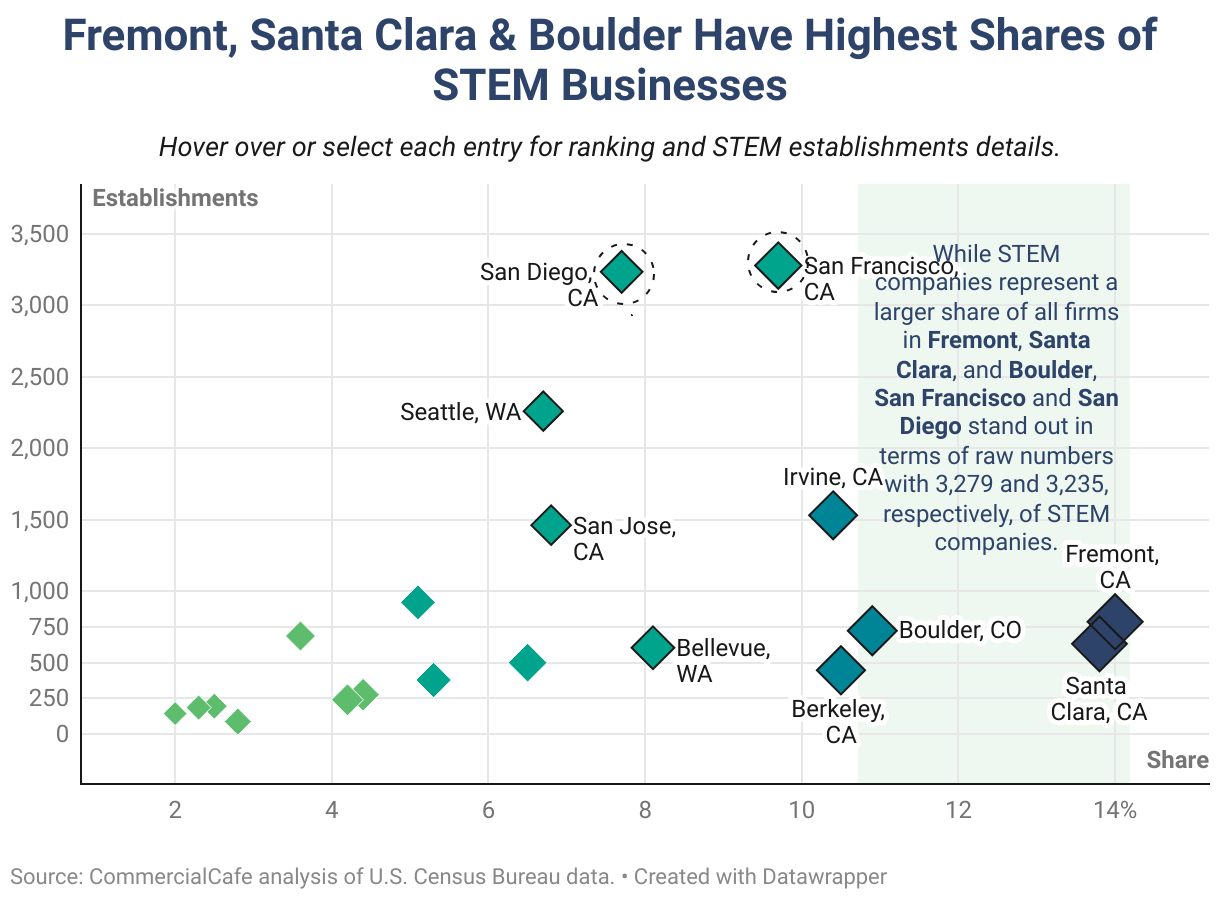
In terms of recent growth, the top three haven’t moved much: Boulder, Colo., held steady, and California’s Santa Clara and Fremont slipped. Staying in California and just below them, Berkeley and Irvine moved in the other direction. Berkeley now ranks third in the West for firm density, Irvine fourth — both at 10%.
However, the biggest increase in STEM business count between 2018 and 2022 came in Bend, Ore., and Sacramento, Calif., which tied with 16% growth. In Bend, the city backs up its STEM job growth with real expansion, both in new firms and opportunity: In raw numbers, 38 new companies were added during the period, equating to a 16% increase. That includes a host of local startups, like Dutchie, Bend’s first homegrown unicorn that’s now valued at more than $3.75 billion. And, in 2020, fresh off a $50 million round, Bay Area drone startup Volansi opened a Bend office. From drone logistics to med-tech, there’s no dominant industry here, but tight-knit, relationship-based funding circles have driven a lot of its growth.
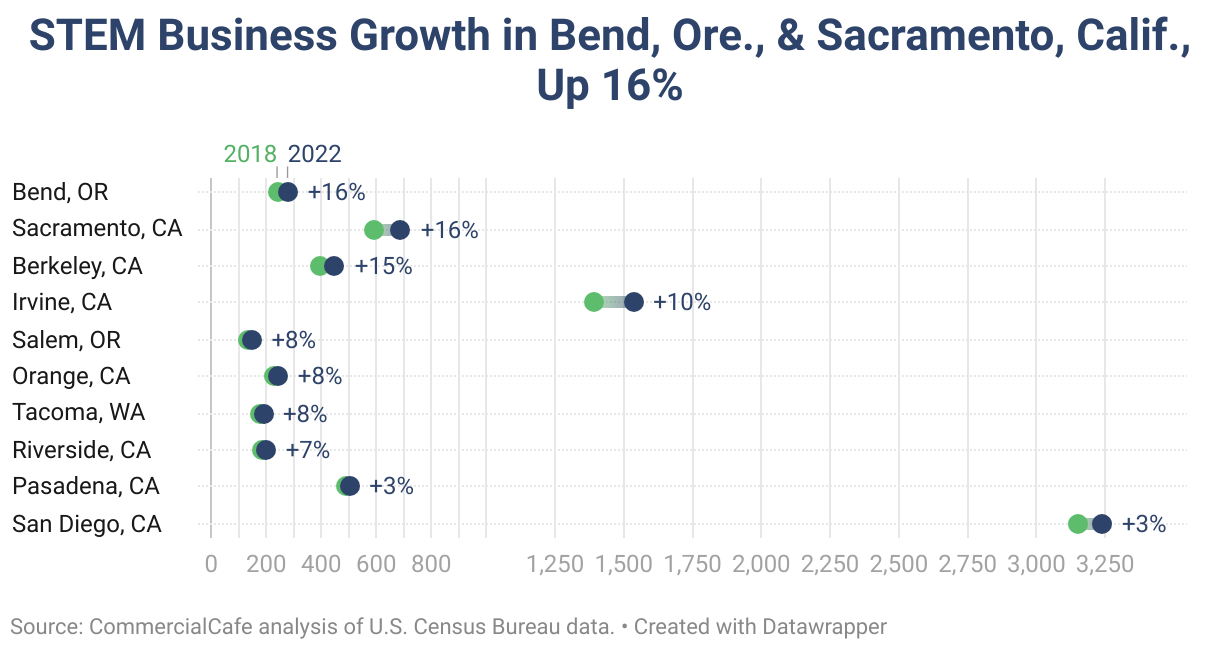
In Sacramento, STEM business growth has centered on agtech, healthtech, cleantech, and hardware with steady activity in cybersecurity and government tech. Agtech, in particular, continues to build off of UC Davis’ expertise and the city’s proximity to Central Valley agriculture. To that end, earlier this year, UC Davis opened Aggie Square — a $1.1 billion project bringing researchers, startups and industry into one space.
After that, the aforementioned Berkeley and Irvine round out the top four in STEM business growth among the cities ranked.
Not to be outdone, San Diego brings its biotech specialization to the top of the list for R&D and life sciences space. Specifically, the city has about 16.5 million square feet spread across approximately 100 properties. Plus, it’s the second-largest city by land area in California (after LA), which gives it an advantage in this metric. Still, most of the space is concentrated in Torrey Pines and around University City with a strong lean toward life sciences.
Although demand has cooled since the pandemic-driven boom of 2021, development hasn’t stopped. In fact, two large projects are under construction — Alexandria Point (427,000 square feet) in University Town Center and Bioterra’s 323,000-square-foot, all-electric lab in the Sorrento Mesa neighborhood.
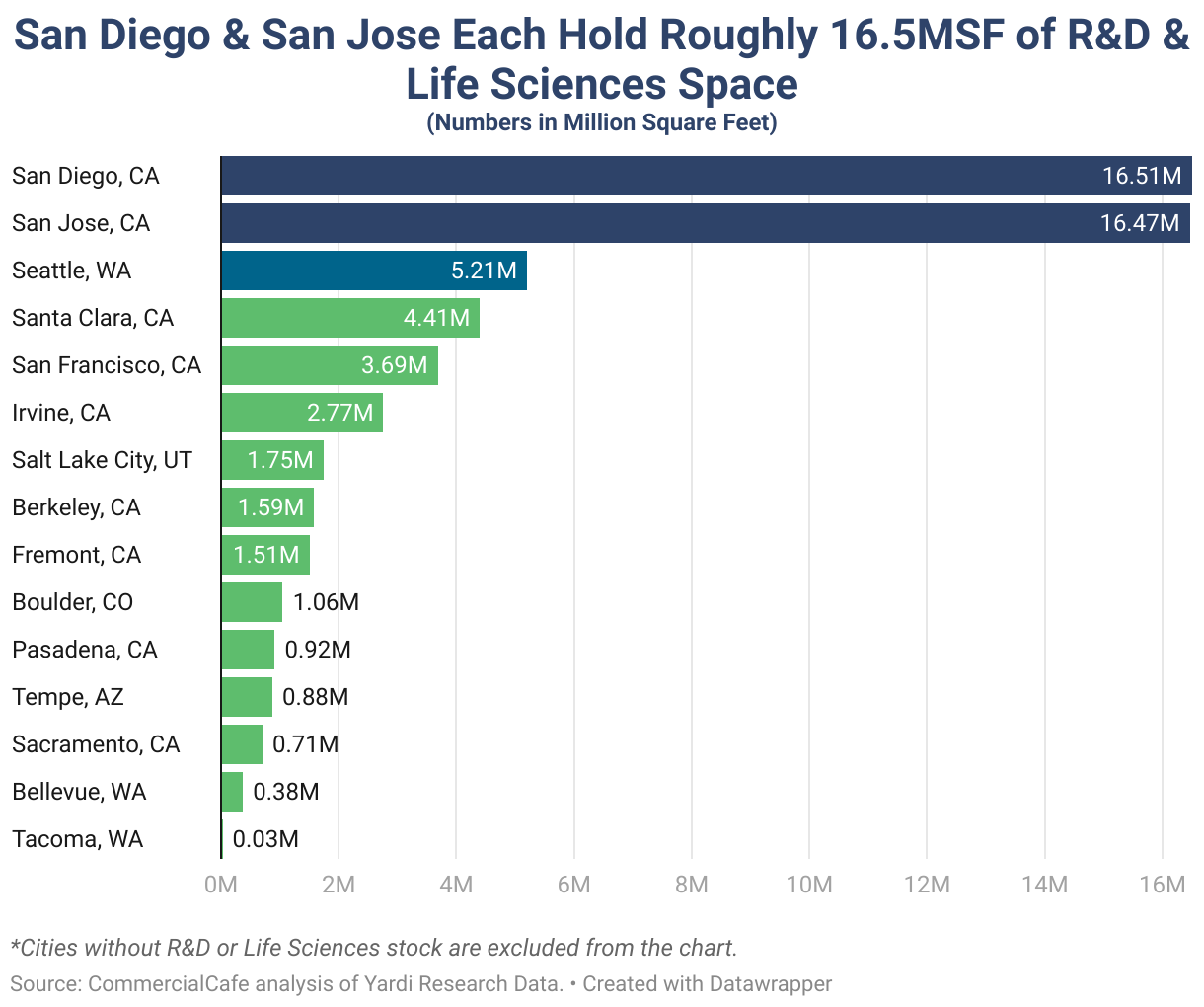
Very close behind is San Jose with nearly 16.5 million square feet of similar space, most of which leans toward R&D. And, while the number of properties is similar, many of the largest were built in previous decades by firms like IBM, Cisco, Apple and Samsung’s semiconductor division. The newest and biggest addition — Adobe’s 700,000-square-foot campus — was completed in 2023.
Then, there’s Seattle, quickly adding onto its Microsoft and software base to become a life sciences city. Here, projects in South Lake Union and Eastlake have turned both into recognized biotech submarkets, especially for work around cell and gene therapy.
San Jose and Santa Clara, with 27,913, and 26,514 tech patents, respectively, were out in front in their own tier. San Diego in third place, with 22,079 tech patents was the final hub to have more than 20,000 patents granted 2020-2024. San Francisco was fourth with 19,825, while Seattle in fifth (12,091 patents) broke the run of California entries.
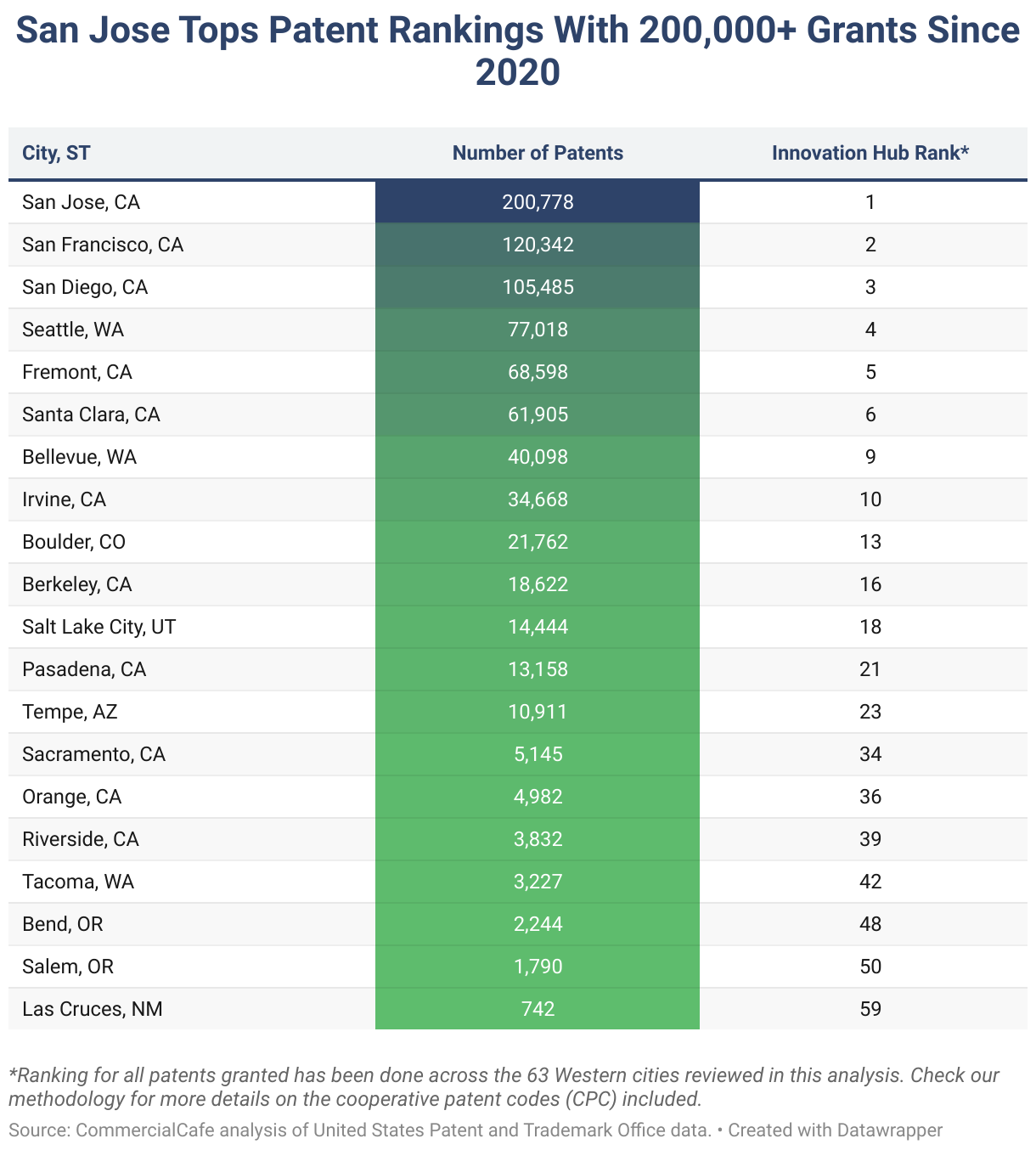
No surprises at the top, it took until 10th place to leave the West Coast with Salt Lake City granted with 1,493 tech patents. Boulder, Colo., (1,362)was the second city others outside the West coast to have more than 1,000 tech patents granted.
Education (click to expand)
Some cities benefit from long-established research universities with deep funding, whereas others are building capacity through vocational training, especially in fields where technical skill matters as much as academic pedigree. Both approaches have become more relevant as costs rise and employers seek job-ready talent, as opposed to credentials alone.
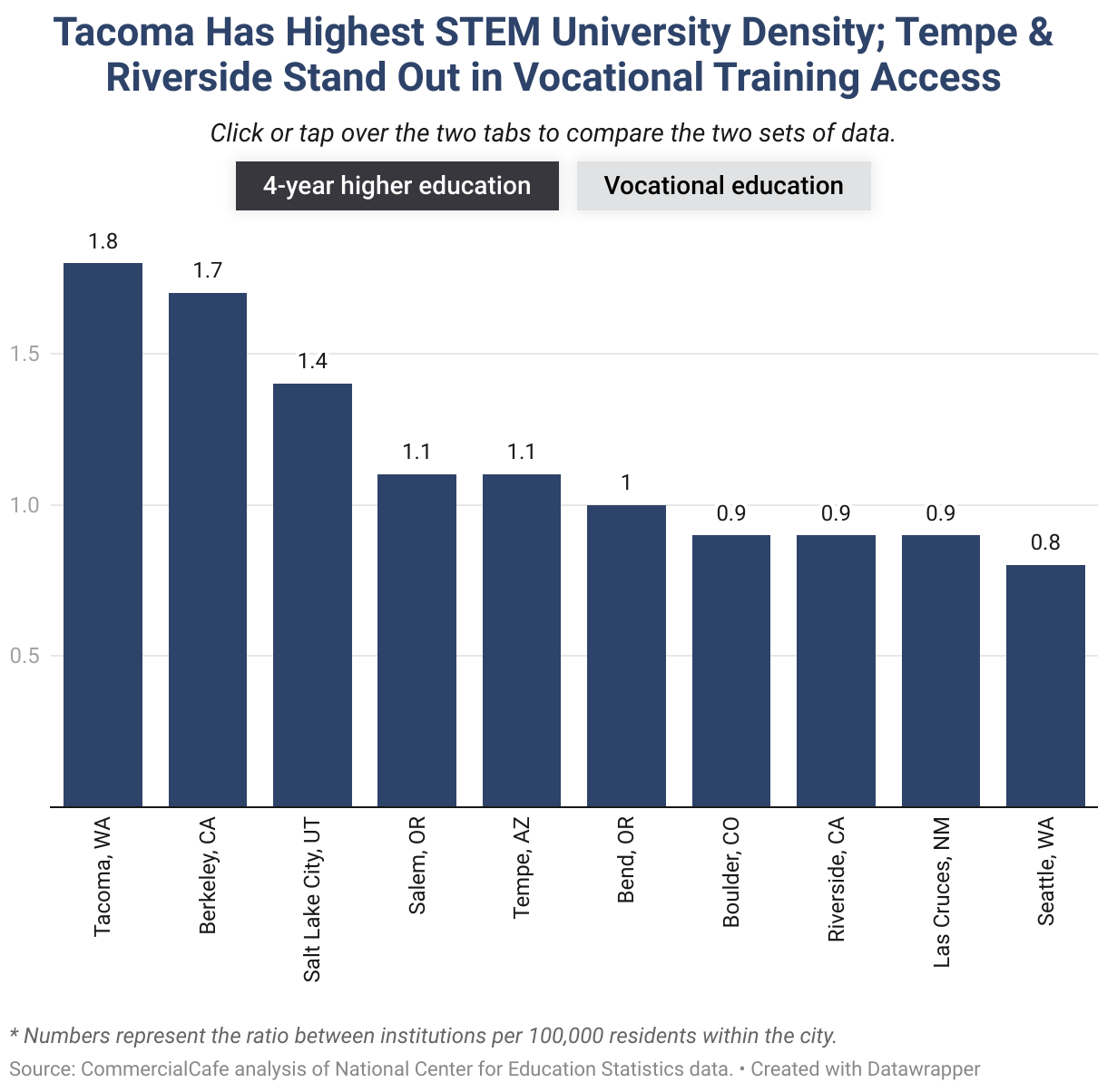
First up, we looked at STEM university density. According to NCES data, Tacoma, Wash., ranks first with 1.8 qualifying institutions per 100,000 residents. Berkeley, Calif., follows at 1.6, then Salt Lake City at 1.4. All three are anchored by major public research universities and benefit from sustained investment in science and engineering education.
But, while university pathways remain important, vocational training is also gaining ground: Vocational enrollment rose nearly 16% in the fall of 2023 and continued to climb in 2024. As of the spring of 2025, enrollment in public, two-year institutions focused on vocational training was up nearly 20% compared to 2020, reaching its highest level in five years.
In this regard, Tempe, Ariz., leads for vocational STEM institutions per capita with 1.6 per 100,000 residents. It also ranks fifth for STEM university density, supported by Arizona State’s expanding footprint in downtown Tempe. That combination tracks with demand across the Phoenix metro for skilled labor in fields like engineering tech, solar and advanced manufacturing.
Then, Riverside, Calif., follows with 1.5 vocational institutions per 100,000 residents. It’s also part of a broader push across California metros to grow nontraditional career pipelines. Likewise, Santa Clara, Sacramento, and Pasadena also rank high in this respect, each positioned to benefit from new funding under California’s Apprenticeship Innovation Program — a $52 million initiative targeting sectors like IT, health care and green tech.
In Colorado, CU Boulder has helped make the city a hub for federally backed research and innovation: It brings in more than $700 million a year in research funding from agencies like NASA and maintains close ties with national labs such as NIST, NOAA, and NCAR, all of which are located on or near campus. That scientific infrastructure supports not just discovery, but also commercialization: 36 startups were launched in 2023-24 through CU’s Venture Partners program to place the university fifth nationally for university-based startup creation. With that foundation in place, Boulder also leads all 20 cities in this analysis for student STEM enrollment with 253 out of every 1,000 students pursuing degrees in science, technology, engineering or math.
Further west, Berkeley, Calif., ranks second in STEM enrollment with 231 out of every 1,000 students pursuing science, tech, engineering or math degrees. That concentration is driven by UC Berkeley’s strengths in engineering, computing and the physical sciences, as well as its proximity to Lawrence Berkeley National Laboratory. The university also ranks first globally for the number of venture-backed startups founded by undergraduate alumni, according to PitchBook’s 2024 report.
Staying in California, Riverside comes next with 186 out of every 1,000 students in STEM fields. Even though the numbers trail Boulder and Berkeley, it still outpaces larger names, like San Jose and San Diego. Plus, UC Riverside has been expanding quietly by adding programs in engineering, environmental science and quantum research. The campus also leads a state- and federally backed initiative focused on clean energy and agtech, in addition to hosting a startup incubator tied to both.
California’s Pasadena and Berkeley tied for the highest average graduation rate (including, but not limited to, STEM degrees) at 94%. At Caltech, which anchors Pasadena’s numbers, the school admits fewer than 1,000 undergrads, has a 3:1 student-faculty ratio, and boasts a shared academic core designed to keep students on track. With an acceptance rate of just 2.3%, it’s a small, focused system.
Meanwhile, Berkeley is different in scale, but not in outcome. Despite a much larger student body, UC Berkeley’s graduation rate matches Caltech’s — thanks, in part, to retention-focused programs, like Engineering Student Services, Cal NERDS and the Biology Scholars Program.
The previous metric looked at how many vocational institutions in each city offered STEM programs. But, access isn’t just about the number of schools — it’s also about the volume and variety of training opportunities available. For this reason, we moved our focus to total programs by counting all STEM-focused vocational programs offered across institutions — from short-term certificates to associate and post-grad awards per 100,000 residents.
In this metric, Salt Lake City came out on top with about 47 programs per 100,000 people. It’s worth noting here that the state has made STEM education a priority through the Utah STEM Action Center, a strong community college system and early career exposure that reaches well beyond traditional classrooms.
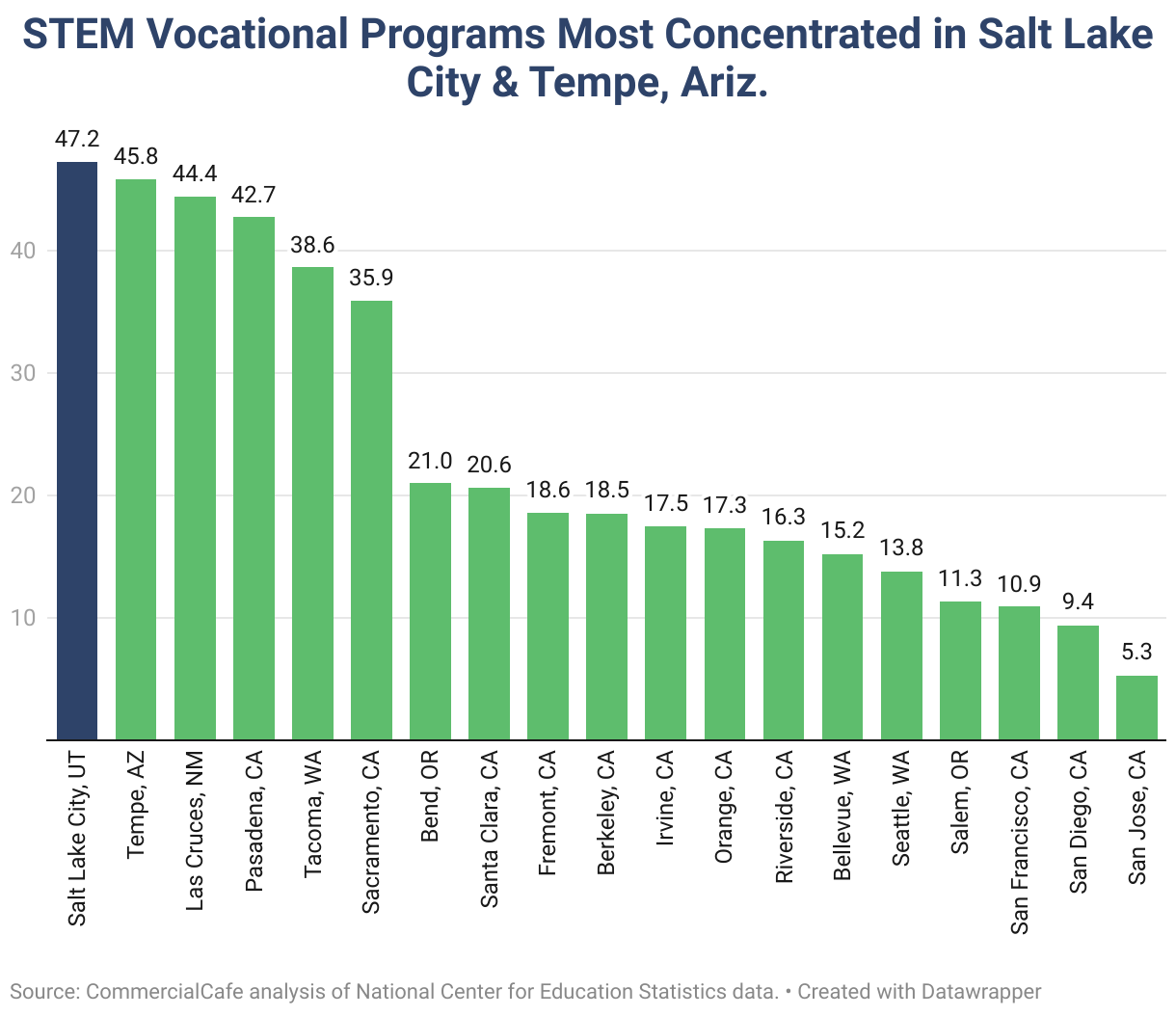
Next, Tempe, Ariz., followed closely with 46 programs. Here, career training is tightly linked to local industry — from Boeing and Honeywell to semiconductor firms. High school career and technical education pathways and institutions like the East Valley Institute of Technology play a central role in making those connections real.
Then came Las Cruces, N.M. With nearly 44 programs per 100,000 residents, it’s growing a training ecosystem that’s tuned to STEM workforce need — from Doña Ana Community College to nonprofits offering hands-on technical learning.
Vocational STEM awards offer a view into how well cities are equipping workers for hands-on, technically skilled roles. These include credentials in fields like health sciences, IT, engineering technology and biotech — awards most often issued by community colleges and technical institutions.
Between 2022 and 2023, Sacramento, Calif., recorded the highest total (2,199 completions) among Western metros. Then, Tempe, Ariz., came in just behind with 2,161, which is impressive given its population of under 200,000. Clearly, Arizona’s push to build talent pipelines around advanced manufacturing and clean energy has expanded credential-based training, especially in semiconductors and electronics.
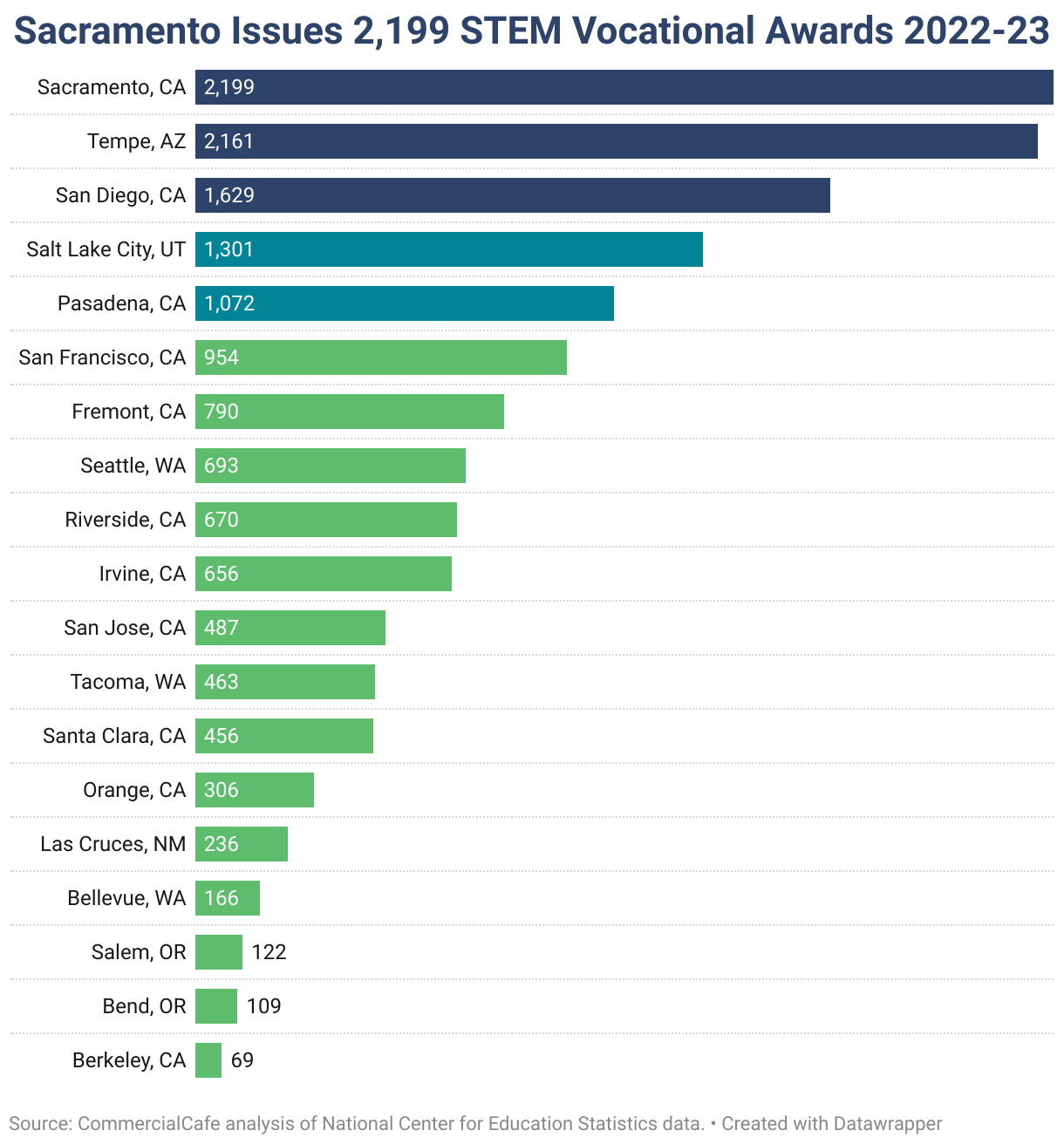
San Diego ranked third with 1,629 awards. Here, vocational output continues to center on biosciences, supported by ongoing demand from health systems and research firms.
Only two other metros — Salt Lake City and Pasadena — crossed the 1,000-award threshold, although San Francisco came close.
Methodology



Matthew Preston
Content Writer, CRE News & Market Analysis
Matthew has covered commercial real estate for CommercialCafe since 2022. He focuses on the office and industrial sectors, reporting on leasing, development, and investment across national markets and individual submarkets. His work draws on data and original research. He also writes about demographic shifts and urban innovation in U.S. cities. The New York Times, The Real Deal, Bisnow, The Business Journals, and Yahoo Finance have cited his reporting.