


Key Takeaways
- Coworking spaces offer flexible, month-to-month memberships starting around $220/month nationally, with no build-out costs or long-term lease commitments.
- Traditional office leases provide control, privacy, and brand presence but require more capital, longer commitments, and full operational responsibility.
- More than half of global occupiers now use flexible workspace, according to Cushman & Wakefield. The coworking vs. traditional office decision is no longer limited to startups.
Coworking vs. Traditional Office Space: What’s the Difference?
Coworking spaces are shared, flexible workplaces available on monthly memberships, with amenities included and no long-term lease required. Traditional office space is a dedicated suite leased directly from a landlord, giving a business full control over its environment but requiring more capital, longer commitments, and greater operational responsibility.
Choosing between coworking and a traditional office is one of the most practical decisions any business has to make. The CRE market now offers more variety than it did even a few years ago, and that flexibility cuts both ways: more options means more room to find the right fit, but also more room to commit to the wrong setup.
The question goes beyond cost. It touches how your team works, how fast your headcount is moving, how much your brand depends on a specific address, and how far ahead you can realistically plan. If you’re early in the search process, how to find office space for a small business covers the fundamentals. With that in mind, here’s a breakdown of both options: what each one gives you, what it costs you, and who each one is built for.
The Workspace Landscape Has Shifted
Both options exist in a market that looks very different from where it was before the pandemic. The traditional office market has been under real pressure, though conditions are improving. National office vacancy has fallen to 17.6%, down 200 basis points year-over-year, according to CommercialCafe’s monthly office market report. New office deliveries have dropped to multi-year lows, and the national construction pipeline has contracted sharply, with only a handful of markets sustaining significant development activity.
Coworking, meanwhile, has been growing steadily. There are now nearly 9,000 coworking locations in the U.S., covering roughly 160 million square feet, according to CoworkingCafe. Coworking represents just over 2% of total U.S. office inventory, with Miami leading major markets at roughly 4%.
That context matters for this decision. If you’re signing a traditional lease in a market with elevated vacancy, you likely have more negotiating leverage than you did a few years ago. And if you’re considering coworking, you’re entering a market that has matured quickly, with better operators, larger spaces, and more enterprise-grade options than the sector offered even recently.
Coworking vs. Traditional Office: Side-by-Side
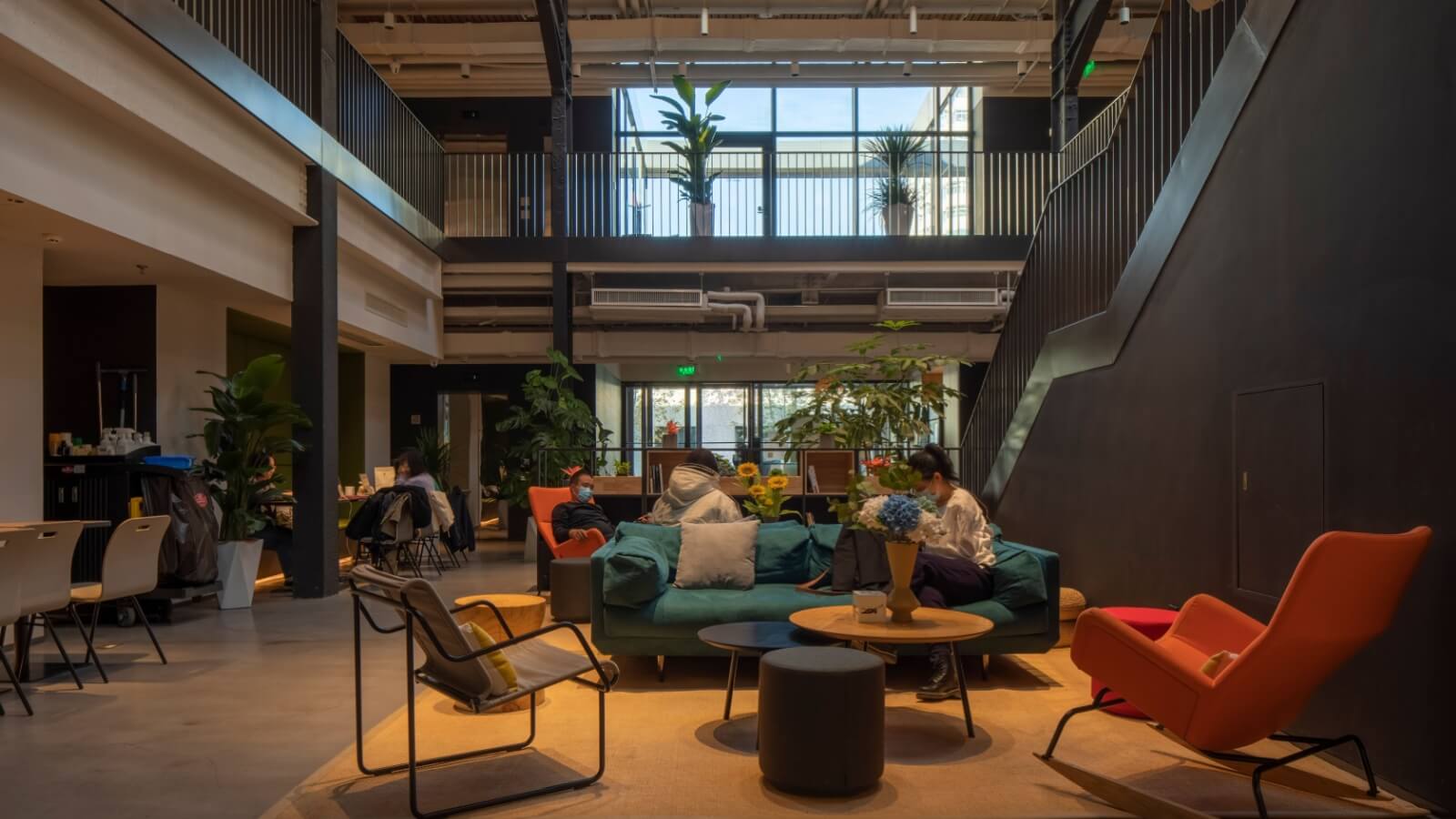
Coworking Space Advantages
Flexibility Is the Core Product
Coworking spaces are membership-based workplaces where businesses and individuals rent desks, private offices, or shared areas on flexible terms. The national median membership price runs around $220 per month, with day passes at roughly $30 and meeting room access near $45 per hour, according to CoworkingCafe.
What makes coworking attractive isn’t just the price. You’re not hiring a facilities manager, negotiating a cleaning contract, or worrying about internet uptime. The operator handles all of that. You show up, plug in, and work.
That structure works well for businesses that are growing quickly, testing a new market, or running a distributed team that only needs a physical base part of the time. More than half of global occupiers now use flexible workspace, according to Cushman & Wakefield, and the user base has expanded well beyond startups and freelancers into mid-size and enterprise firms.
The Cost Advantage Is Real, Especially in Certain Markets
Coworking can be significantly cheaper than a traditional lease, depending on the market. A CoworkingCafe analysis comparing the cost of 10 dedicated desks against 2,000 sq ft of traditional office space found coworking to be up to 70% more affordable in some West Coast markets. East Coast metros like Boston showed gaps above 60%, translating to potential savings above $95,000 per year for a 10-person team.
Even in markets where the gap is smaller, coworking’s all-inclusive pricing makes budgeting more predictable. A traditional lease’s base rent is the starting point. CAM charges (Common Area Maintenance, covering shared building costs like lobbies and elevators), insurance, utilities, and build-out costs all add up on top of that.
The Trade-Offs to Know
Coworking has real limitations. Open-plan layouts are standard, and if your work requires confidential conversations, client presentations, or a quiet focus environment, you’ll need to pay for a private office, which narrows the cost advantage. Security is another consideration: shared networks and open access points require more diligence around data protection.
And coworking spaces, by design, are shared. You may cross paths with competitors in the same space. The community dynamic is one of coworking’s strengths, but it also means you can’t fully control who’s in the room. For a full breakdown, the pros and cons of coworking covers the operational details.
Traditional Office Space Advantages
Control, Privacy, and Permanence
A traditional office lease gives your business a dedicated, private space. You control the design, the layout, the branding on the door, and the culture inside it. For firms where the physical environment reflects the business (law firms, financial services, healthcare), that degree of control isn’t optional. It’s a competitive requirement.
Traditional leases come in several structures. Gross leases bundle all operating costs into one predictable monthly payment. Net leases, particularly triple-net (NNN) leases where tenants pay base rent plus property taxes, insurance, and maintenance, give more control but make budgeting less predictable. Understanding how insurance fits into your lease structure is especially important under a net arrangement. Most commercial leases run three to ten years, sometimes longer for larger tenants.
The upfront investment is significant. Build-out costs, furniture, technology infrastructure, and security deposits can add up to $50 to $150+ per square foot before you’ve paid a month’s rent. Most landlords will also require a personal guarantee, which means the business owner’s personal assets are on the line if the company defaults. For businesses weighing whether leasing is even the right model, buying vs. leasing office space breaks down the full financial comparison.
The Current Market Works in Tenants’ Favor
With national office vacancy still elevated relative to pre-pandemic norms, landlords in many markets are negotiating. Tenant improvement allowances (TI, cash contributions from landlords toward build-out costs), free rent periods, and flexible break clauses are available in most markets. For businesses signing a traditional lease, tenant leverage has improved meaningfully in recent years.
That said, signing a long-term lease still requires confidence in your headcount trajectory and market commitment. Knowing what to look for and ask for before you sign can protect you from the most common and costly lease pitfalls.

Environment, Culture, and Team Fit
Who Works Better Where?
The workspace environment affects how people work, and different roles demand different settings. Coworking spaces are high-energy and collaborative by design. That works well for roles that benefit from external stimulation: creative work, sales, business development, and early-stage product thinking. The exposure to people outside your company can spark ideas and connections you wouldn’t get in a closed environment.
Traditional offices create a more controlled culture. Your team is surrounded by colleagues working on the same problems, following the same practices, and building toward the same goals. For teams that need deep focus, handle sensitive client data, or run processes that benefit from physical consistency and proximity, a dedicated office provides an environment that coworking can’t replicate.
Hybrid work has complicated this picture. Many businesses no longer need, or want, a single primary workspace. A growing number are combining a smaller core traditional office with coworking memberships in other cities for satellite workers or traveling employees. That combined approach is increasingly common among mid-size companies looking to balance cost control with geographic reach.
Which Option Is Right for Your Business?
Coworking Makes Sense When…
You’re a startup, freelancer, or solo operator who needs a professional base without long-term financial exposure. Your team is distributed or hybrid, and you need a physical home base for a few days a week rather than full-time occupancy. You’re entering a new market and want to test it before committing to a traditional lease. Your headcount is growing or fluctuating quickly, and flexibility is more valuable than permanence. Or you want the built-in community, networking, and cross-industry exposure that a shared environment provides.
Traditional Office Makes Sense When…
Your business requires strict confidentiality for legal, financial, medical, or other client-facing work involving sensitive data. Your brand identity depends on a specific address, interior design, or signage that reflects the quality of your firm. You have a large, stable team that needs consistent, permanent space and benefits from proximity and shared culture. You’re planning for long-term stability and can commit to a lease term that justifies build-out investment. Or client visits to your office are a regular part of your business development, and the space needs to make an impression.

Frequently Asked Questions (FAQ)
Is coworking cheaper than renting a traditional office?
In most markets, yes, especially for small teams. A CoworkingCafe analysis comparing 10 dedicated desks to 2,000 sq ft of traditional office space found coworking to be 40–70% more affordable in major markets, with the biggest gaps in West Coast cities. The key variable is that coworking’s all-in pricing (furniture, utilities, Wi-Fi, cleaning) eliminates the add-on costs that make traditional leases more expensive than the base rent alone suggests.Can large companies use coworking spaces?
Yes, and increasingly they do. More than half of global occupiers now utilize flexible workspace, according to Cushman & Wakefield, and major companies use coworking spaces for satellite teams, project-based work, and market expansion. Enterprise operators like International Workplace Group (IWG), which owns Regus and Spaces, and WeWork offer private suites and managed office solutions designed for corporate clients.What’s the difference between coworking and a serviced office?
Coworking spaces prioritize open-plan community environments designed for interaction, collaboration, and flexibility. Serviced offices (also called managed offices or executive suites) offer more private, fully staffed environments with dedicated reception, higher-end amenities, and more of a traditional office feel, but without the long-term lease. Serviced offices are generally more expensive than coworking memberships but more private.How do I choose between a gross lease and a net lease for a traditional office?
A gross lease bundles rent and operating costs into a single fixed monthly payment, which makes budgeting predictable but gives you less control. A net lease (particularly a triple-net or NNN structure) separates base rent from taxes, insurance, and maintenance costs, which can fluctuate. For a closer look at how these structures affect your total cost, see how to read an office space listing. For most small and mid-size businesses, a gross or modified gross lease offers better cost predictability. For businesses with stable operations and strong cash flow, a net lease can offer lower base rent in exchange for taking on more operational responsibility.Is coworking space appropriate for client-facing businesses?
It depends on the frequency and formality of your client interactions. Most coworking operators offer private, bookable meeting rooms that work well for occasional client meetings. If client visits are frequent and the physical environment is a meaningful part of your brand or sales process (a law firm, private wealth manager, or high-end consultancy, for example), a traditional office with dedicated space and controlled branding is typically the better fit.



Matthew Preston
Content Writer, CRE News & Market Analysis
Matthew has covered commercial real estate for CommercialCafe since 2022. He focuses on the office and industrial sectors, reporting on leasing, development, and investment across national markets and individual submarkets. His work draws on data and original research. He also writes about demographic shifts and urban innovation in U.S. cities. The New York Times, The Real Deal, Bisnow, The Business Journals, and Yahoo Finance have cited his reporting.