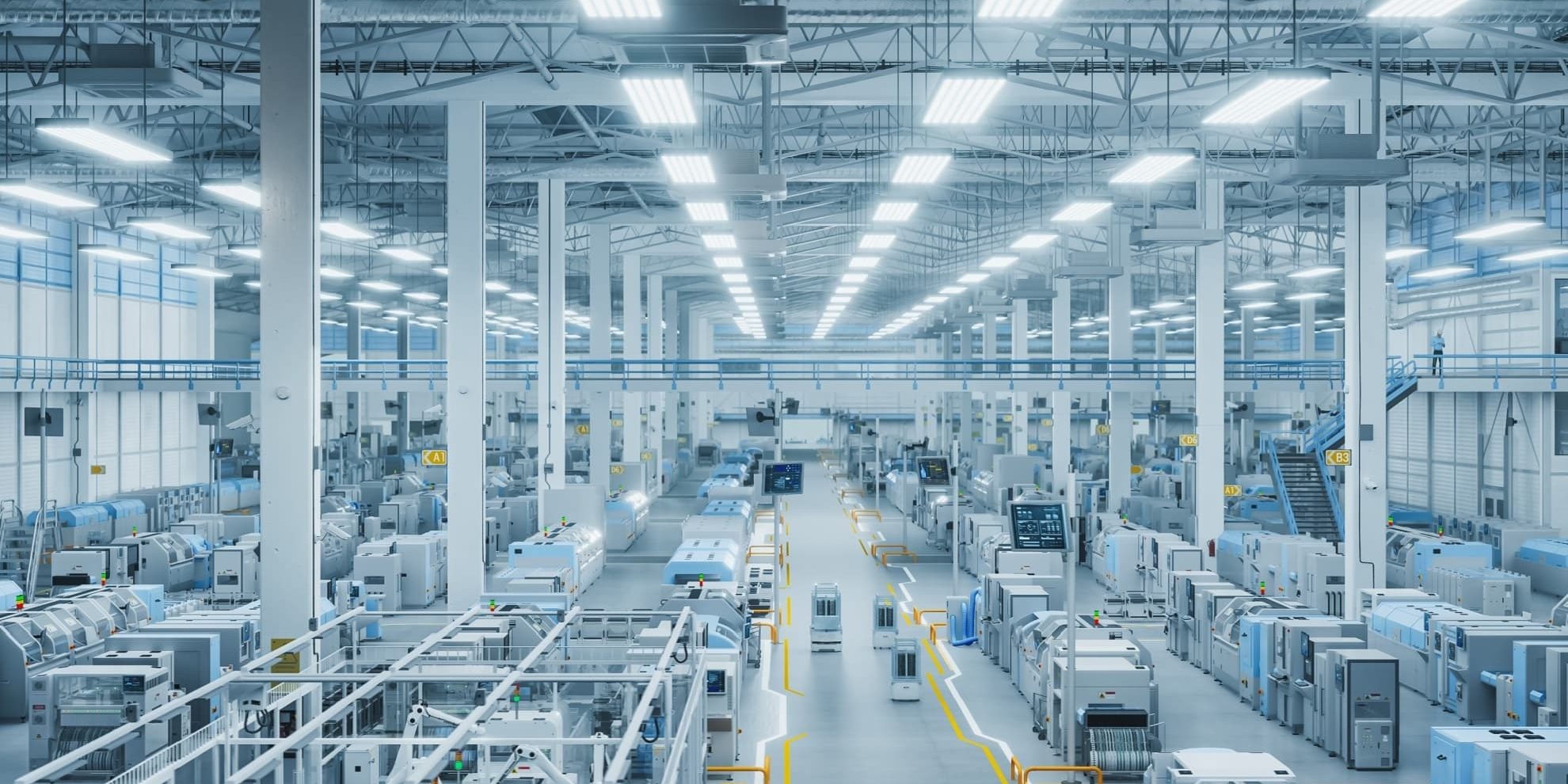
January 2026 Industrial Report: Developers Look for Energy Security


Key Takeaways:
- The coming year promises plateauing vacancies in industrial real estate, while construction is at the lowest point in a decade. Tariff threats continue to bring uncertainty as the industry awaits the review of the U.S.-Mexico-Canada Agreement (USMCA) in July.
- In-place industrial rents averaged $8.87 per square foot nationwide at the end of the year, up $0.11 on the month and 5.4% annually.
- The national vacancy rate sat at 9.2% at the start of the year — more than twice the level from 2022 and 120 basis points (bps) higher than last year.
- Currently, 357.4 million square feet of industrial space is being built nationwide. Last year’s deliveries stand just above 300 million square feet, which was the slowest year for construction since 2017.
- Industrial transactions had their strongest year since 2022, and average sale prices per square foot also increased by 10% year-over-year (Y-o-Y).
Regional Highlights:
- Western markets: California’s Orange County, Los Angeles and Bay Area occupied the national podium for in-place industrial rents, despite deflating price growth.
- Midwestern markets: Detroit led the region in 2025 industrial sales volume at $4.8 billion, followed by Chicago’s $2.8 billion and the Twin Cities with $1.4 billion.
- Southern markets: The Southern markets included in our study logged close to $18 billion in industrial sales throughout 2025, with Dallas-Fort Worth accounting for more than $7 billion of that total.
- Northeastern markets: Vacancies in Philadelphia rested around 8% in December — the same rate logged at the start of the year — while Bridgeport, Conn., still boasts one of the lowest vacancy rates nationwide.
For industrial real estate, 2026 promises to be a transformative year shaped by shifting policy and changes in industrial development. With vacancies beginning to plateau after the supply glut and absorption lag of previous years, site selection is turning into a key factor in construction of new stock. Read more in our U.S. industrial market report below.
Trends & Industry News
Supply Pipeline Priorities Shift
Tariff uncertainty will likely play a smaller part in the industrial sector in 2026, despite the uncertainty of policy shifts and increased material costs likely manifesting in future developments.
At the same time, the U.S.-Mexico-Canada Agreement (USMCA) is due for review in July this year, creating cause for further anxiety for industrial developers and operators. All three countries would have to agree to extend the agreement for another 16 years, whereas a failure to reach an agreement would result in a 10-year gap before the USMCA is annulled. Still, the prospect of a shortened and potentially sunsetting trade agreement would certainly give pause to long-term plans in industrial, given that much investment activity in the sector is now focused on repositioning supply chains and nearshoring production capacity.
Industrial pipelines have declined significantly following record deliveries in 2022 and 2023, and this year is likely to bring the lowest amount of deliveries in the last decade. Still, our analysts expect this pullback to be beneficial for the industrial sector which has contended with high vacancies in most major markets. At 9.2%, the national industrial vacancy rate is now twice as high as it was three years ago and 120 bps higher than it was in January 2025. Still, vacancies have shown signs of leveling in recent months, and we project this plateau to continue in the first half of 2026 before vacancies start to tighten in the second half of the year. Then, as vacancies decline and decreasing interest rates make investment more attractive, the market may see increased enthusiasm for new developments by the end of the year.
“As we anticipate an increase in construction starts, developments are being met with local concerns of resource consumption and greater scrutiny on ensuring a positive economic impact for the community.”
Peter Kolaczynski, Director, Yardi Research
Although construction starts are expected to pick up, our industrial property outlook indicates that the locations for these new developments may be shifting compared to recent years. For example, proximity to population centers and transportation networks has decreased in importance in terms of site selection, with access to power now being cited more often as a critical demand for industrial development. Utility prices are on the rise, and formerly niche, power-intensive categories — such as data centers and advanced manufacturing — are poised to further increase peak demand. Consequently, many developers are looking for locations with reliable power networks and cost-effective energy. To drive the point home, a recent survey conducted by Prologis found that 89% of supply chain executives experienced energy-related disruptions in the last 12 months, and 83% believe that the next crisis that supply chains will have to grapple with will be related to energy.
The high pace of data center investment will likely continue this year, our industrial real estate report shows. It’s worth mentioning that there are growing concerns of a bubble in the AI sector, while the question of energy procurement for the new wave of data centers is also difficult to answer. Backlash from local communities in which data center developments were announced began to take shape last year with residents citing power and water usage, as well as the strain on infrastructure, as their primary concerns. This pushback may increase in 2026, subsequently increasing stress while concerns of an emerging data center bubble keep rising.
Rents & Occupancy
Atlanta Rents Continue Climb Amid Logistics Wins
In-place industrial rents averaged $8.87 per square foot nationwide at the end of the year, up $0.11 compared to November and increasing by 5.4% annually.
Once again, Atlanta secured the top spot for in-place industrial rent growth among major U.S. markets at 8.8%. Here, population growth and a robust infrastructure network are evidence of the market’s strong suits for industrial investment: Atlanta is among the fastest-growing metro areas by population in recent years and enjoys a central location in a region that’s also experiencing a population boom. It also houses a global airport; access to multiple interstates and railway connections; and proximity to the growing Port of Savannah, Ga., further boosting its status as a logistics hub.
At the same time, the logistics advantages that Atlanta presents are also increasing its potential for manufacturing. To that end, Chinese company WinSun recently selected the metro for its first facility in the U.S. that will span approximately 500,000 square feet of Atlanta industrial space and bring up to 150 jobs to the area in its first phases.
After Atlanta, the markets with the fastest rent growth according to our industrial real estate report include Miami (8.4% Y-o-Y); Tampa, Fla. (6.7%); Philadelphia (6.7%); and Seattle (6.5%). Conversely, Midwestern markets continued to see sluggish rent growth with St. Louis (2.5%); Kansas City, Mo. (2.6%); and Detroit (2.7%) remaining at the bottom of the list among major U.S. markets in our study.
Overall, the national vacancy sat at 9.2% at the end of December for a 120-bps annual increase. Yet, as owners and occupiers meet in the middle and occupancy continues to rise in newly delivered stock, our industrial real estate outlook shows that a plateau and a gradual decrease in nationwide vacancies is likely to come later in the year if conditions follow the same track.
Supply
Texas Development Benefits From Nearshoring Trends
At the start of the year, 357.4 million square feet of industrial space was being built nationwide for a projected inventory expansion of 1.7%. For comparison, throughout 2025, approximately 300 million square feet of new industrial space was delivered according to our industrial market data, although that figure may increase as data for year-end completions trickles in during the first quarter. Even so, completions for last year are on track to be at their lowest level since 2017.
Looking forward, 2026 is expected to see even more muted construction compared to last year as new starts continue to decelerate. In fact, our industrial real estate market report shows that developments breaking ground in 2025 total just 265 million square feet. Granted, this number may grow in the coming months like delivery data, but it nevertheless points to shrinking pipelines and completions.
As a silver lining, Texas remains active in terms of industrial construction, primarily due to the reshoring of manufacturing capacity: In 2025, nearly 25 million square feet of new construction starts broke ground in Dallas-Fort Worth, and that figure stood at 23.2 million square feet in Houston — more than 18% higher compared to 2024. Phoenix landed in third place at 13.1 million, trending downward after being the epicenter of industrial development earlier last year. Austin, Texas, also saw a high level of new developments as a percentage of starts with 5.9 million square feet of space.
Transactions
New Jersey Logs Strong Year for Industrial Transactions
Our U.S. industrial market report indicates that last year’s industrial transactions totaled $76.3 billion, which was almost on par with the previous year’s $76.2 billion. Again, delays in data collection will likely boost 2025’s final tally, providing the sector with its strongest year for investment since 2022. In this case, transactions from last year resulted in an average sale price of $135 per square foot, marking a 10% increase compared to 2024. While total sales volumes are neck and neck, less square feet of space was traded in 2025 compared to the previous year.
New Jersey had a strong year in terms of industrial transactions: Sales volume in 2025 reached $2.8 billion in the market, increasing by 8.5% compared to the year prior. Similarly, average sale prices increased by 7.6% in the same timeframe to rest at $226 per square foot. The market’s largest transaction last year took place when Prologis purchased 201 Middlesex Center Blvd., a property within close proximity to Interstate 95, for $166.8 million.
Despite lagging rent growth and high vacancies, New Jersey maintained its attractiveness for investors that target quality properties amid scarcity of developable land. Of course, a high population density and proximity to major ports also contribute to the market’s potential. The e-commerce boom has also greatly boosted sales figures with average sale prices for New Jersey industrial space more than doubling since 2019.
Western Markets
Regional Rent Growth Decelerating, but California Markets Maintain Top Spots
Industrial vacancy rates across the region remained mixed at the close of 2025, with certain markets sitting closer to occupancy equilibrium than others. The Bay Area remains the tightest market in the West at 7.9% (up 70 bps Y-o-Y), followed by the Inland Empire at 8.4% (up 80 bps Y-o-Y). Meanwhile, vacancy in Orange County saw a more sizable annual increase of 430 bps to bring its rate to 8.5% as of December. Los Angeles also settled at 8.5%, establishing it as the final Western market to remain below the 9.2% national average. At a distance, Denver industrial properties recorded the region’s highest average vacancy rate at 12.5% following a 140-bps annual increase.
The Western U.S. maintained its status as the country’s premier high-cost lease destination through December, even as the rapid rent growth of the current cycle kept showing signs of moderating. A familiar trio of California markets — Orange County, Los Angeles, and the Bay Area — currently occupy the national podium for the most expensive industrial space, with average in-place rates of $17.42, $15.54, and $14.66 per square foot, respectively. The region’s pricing dominance is further underscored by its footprint in the national ranking: Of the 13 major U.S. markets that recorded average rents above the $8.87 national benchmark at year-end, eight are located in the West, significantly outperforming the Northeast (three markets) and the South (two markets).
In this region, capital markets activity in 2025 was headlined by Phoenix, where industrial sale totals for the year reached $3.7 billion — surpassing all other regional markets by a significant margin. Los Angeles followed with $2.3 billion in volume, while California’s Inland Empire recorded $2.1 billion. Although total sales exceeded previous-year levels in most markets nationally, San Francisco and Los Angeles were notable exceptions with transaction volumes dropping by 65% and 6% Y-o-Y, respectively. Regional sale prices remain generally elevated, but have begun to show signs of stagnation or slight retractions in several major hubs, including Portland, Ore.; Orange County, Calif.; and the Inland Empire, Calif.
Regarding the regional pipeline, the most significant increases in industrial construction were recorded in the Bay Area and Portland. More precisely, construction activity in the Bay Area grew from 2.5 million square feet at the end of 2024 to 3.6 million square feet currently, whereas Portland industrial space in the pipeline expanded from 2.5 million to 3.5 million square feet in the same period. Despite these gains, these development totals remain diminutive compared to the massive volumes seen in other U.S. regions as persistent high costs and limited land availability continue to squeeze industrial development starts across the West.
Midwestern Markets
Detroit, Chicago & Twin Cities Lead Region in 2025 Industrial Sales Volume
At the end of December, Midwestern markets remained the most affordable in the nation for industrial leases. In fact, Kansas City, Mo., currently offers the second-cheapest in-place rents in the country at $5.20 per square foot, followed closely by St. Louis ($5.28) and Indianapolis ($5.29). Not far behind, Cincinnati; Columbus, Ohio; and Chicago also maintain highly competitive affordability profiles, but Detroit and Minneapolis-St. Paul have broken away from the regional pack: By the end of December, these two markets commanded significantly higher average rates of $7.49 and $7.53 per square foot, respectively.
As usual, development activity across the region experienced a seasonal deceleration in December as winter conditions and a wave of year-end deliveries tempered the pipeline. Yet, while several markets saw their under-construction totals remain level or contract as new supply hit the inventory, industrial construction continues to be robust in specific regional hubs. The Minneapolis-St. Paul market stands out in this regard as space currently under construction here has increased threefold compared to December 2024.
Following another month-over-month dip, industrial vacancies in St. Louis dropped below 6% by the end of December, establishing it as the third-tightest industrial market in the country. This positioning follows a significant 160-bps Y-o-Y contraction. Elsewhere in the region, occupancy stability remains a moving target: The Minneapolis-St. Paul market saw vacancy climb to 8.4% (up 200 bps Y-o-Y), whereas Detroit’s vacancy rate is a relatively low 6.7%, despite a 210-bps annual increase.
Investor interest in the Midwest accelerated through 2025, driven by the region’s expanding reshoring potential and its critical role in the national logistics network. Detroit led the region with a sizable $4.8 billion in industrial sales volume — a figure bolstered significantly by the $2 billion sale of the GM battery plant in Lansing, Mich. Chicago and Minneapolis-St. Paul followed with $2.8 billion and $1.4 billion in transactions, respectively. Notably, Detroit; Kansas City, Mo.; and Indianapolis recorded the largest sales volume increases nationwide compared to 2024, further demonstrating the shift in institutional capital toward the region.
Southern Markets
Major Southern Markets Log $18 Billion in Industrial Sales in 2025
Despite a general dip in construction starts toward the end of the year, a wave of new projects totaling close to 2 million square feet in Charlotte, N.C., brought that market’s total pipeline to 8.3 million square feet by the close of December. This year-end surge means the Charlotte industrial market now has 32% more space under construction compared to the end of 2024, representing a total inventory expansion of approximately 2.4%. Otherwise, other major Southern hubs saw slight month-over-month contractions in their respective pipelines as deliveries outpaced new starts, but Dallas-Fort Worth and Houston continue to lead the nation in terms of total industrial space currently underway.
Across the entirety of 2025, the Southern markets included in our study notched nearly $18 billion in industrial transactions, reflecting a highly liquid investment landscape. In particular, the Dallas-Fort Worth Metroplex was responsible for more than one-third of this regional total, surpassing $7 billion in sales by the end of December. Houston and Atlanta followed in terms of total volume, recording $2.9 billion and $2.5 billion in transactions, respectively. However, the Charlotte market boasted the largest annual increase in sales volume regionally at 159%, with totals rising from $781 million in 2024 to more than $2 billion in 2025.
Despite robust investor appetite and construction activity, numerous Southern markets continued to face elevated vacancy rates. Memphis registered the highest vacancy rate in our U.S. industrial market report at the end of December at 12.7%, declining slightly from the previous month but still 410 bps higher annually. Additional markets including Baltimore; Miami; Dallas-Fort Worth; and Tampa also recorded vacancy rates exceeding the national benchmark of 9.2%. Conversely, Atlanta’s rate settled at 8.1% at year’s end following several months of stabilization, while Houston commanded the fourth-lowest vacancy rate nationwide at 6.1%.
At the conclusion of 2025, in-place industrial rents throughout the South maintained their upward trajectory. Miami retained its position as the region’s most expensive market at $13.41 per square foot, representing an 8.4% increase compared to year-ago rates. Baltimore was the only other Southern market with in-place rents surpassing the national average at $9.09 per square foot. Tampa followed at $8.71, trailed by Charlotte’s $7.52 and Houston’s $7.37.
Northeastern Markets
Philadelphia Vacancy Rate Stabilizes Year-over-Year
New Jersey industrial transactions in 2025 averaged $226 per square foot, establishing it as the region’s most expensive market for investment and the sixth-priciest nationwide. Boston also positioned itself in the upper half of national rankings in terms of average sale prices at $171 per square foot, while Philadelphia stood just below the national average at $130 per square foot. Conversely, Bridgeport, Conn. industrial transactions resulted in an average price of $69 per square foot, securing its position as the fourth-most-affordable market in our industrial real estate study.
In terms of in-place leases, Philadelphia remained the region’s most accessible major market at the conclusion of 2025. Leases here averaged $8.60 per square foot, trailing the national average of $8.87. Notably, in-place leases in Bridgeport surpassed the $10-per-square-foot threshold in December, climbing 6% Y-o-Y, while rates in Boston also advanced 5.6% annually to reach $11.94 per square foot.
However, vacancies throughout the region remained mixed: Boston’s 11% rate positioned it toward the upper end of the national scale following a 160-basis-point yearly increase. Similarly, Philadelphia’s vacancies hovered around 8% at year’s end, which was roughly on par with rates recorded at the start of 2025. And, Bridgeport, Conn., still maintained one of the nation’s tightest leasing landscapes with a vacancy rate of just 5.8%, although this figure represented a 140-bps increase compared to December 2024.
Additionally, new deliveries appeared unlikely to contribute meaningfully to vacancy pressures in the market as the pipeline remained stable at just more than 1.5 million square feet — unchanged from two months prior — indicating an absence of new deliveries or construction starts. Moreover, projected market expansions from construction currently underway across the region hovered around 1% of existing stock, reflecting subdued construction activity.
Economic Indicators
E-Commerce Picks Up in Second Half of 2025
While the recent government shutdown has led to delays in some economic data releases, e-commerce sales figures have caught up and are back on schedule. E-commerce sales in Q3 2025 totaled $310 billion, up 1.9% quarter-over-quarter and 5.1% Y-o-Y.
In Q3, e-commerce sales accounted for 19.2% of core retail sales for the highest share since Q2 2020 at the height of online orders during the pandemic. Prior to that, e-commerce sales and the share they represented of the total retail sales grew at a relatively consistent rate, later becoming more uneven as supply chains and customer demand shifted.
Lastly, early data from the private sector indicates that e-commerce sales were also strong during the holiday season. Estimates from the National Retail Foundation showcase resilient consumer spending with sales between November 1 and December 31 increasing 4.1% Y-o-Y. Visa and Mastercard data corroborates this growth, noting that e-commerce sales were up 7% annually.
Methodology
The monthly CommercialCafe national industrial real estate report considers data recorded throughout the course of 12 months and tracks top U.S. industrial markets with a focus on average rents; vacancies (including subleases, but excluding owner-occupied properties); deals closed; pipeline yield; forecasts; and the economic indicators most relevant to the performance of the industrial sector. Listing rate and occupancy information was based on Yardi Research data.
- Average Rents: Provided by Yardi Market Expert, a cutting-edge service that uses anonymized and aggregated data from other Yardi platforms to provide the most accurate rental and expense information available.
- Vacancy: The total square feet vacant in a market, including subleases, divided by the total square feet of industrial space in that market. Owner-occupied buildings are not included in vacancy calculations.
Stages of the supply pipeline:
- Planned: Buildings that are currently in the process of acquiring zoning approval and permits, but have not yet begun construction.
- Under Construction: Buildings for which construction and excavation has begun.
Sales volume and price-per-square-foot calculations for portfolio transactions or those with unpublished dollar values are estimated using sales comps based on similar sales in the market and submarket, use type, location and asset ratings, sale date and property size.
Year-to-date metrics and data include the time period between January 1 of the current year through the month prior to publishing the report.
Market boundaries in the CommercialCafe industrial report coincide with those defined by the CommercialCafe Markets Map and may differ from regional boundaries defined by other sources.
Fair Use & Redistribution
We encourage you and freely grant you permission to reuse, host, or repost the research, graphics, and images presented in this article. When doing so, we kindly ask that you credit our research by linking to CommercialCafe.com or this page so that your readers can learn more about this project, the research behind it and its methodology. For more in-depth, customized data, please contact us at [email protected].



Lucian Alixandrescu
Senior Content Writer, CRE Industry Reports & Studies
Lucian is a senior content writer for CommercialCafe, specializing in commercial real estate research and data-driven reporting since 2019. With deep expertise in industrial real estate, office markets, demographics, and economics, he produces comprehensive market studies and insights on national and regional CRE trends. He also reports on adjacent subjects such as population shifts and the job market. His reports have been cited by and featured in The New York Times, Forbes, NBC, Bisnow, The Business Journals, and Yahoo Finance. Lucian holds a background in language and literature studies and brings more than 5 years of previous freelance writing experience to his commercial real estate journalism.